General Insurance
Risk Management
Mould losses: the insurance risk hiding behind water damage




Claim your CPD points
When we think about natural hazard losses, attention is typically focused on the primary event: a burgeoning river, a tree branch suddenly intertwined with a roof following a storm, or missing roofing in the wake of a cyclone. However, an increasingly important source of claim development may emerge only after the water has receded.
Mould is rarely considered a standalone insured peril. In most cases, it is an explicit exclusion in the product disclosure statement, unless it arises directly from another insured event such as storm damage, flooding or a burst pipe. Yet recent industry experience suggests mould has the ability to transform what initially appears to be a straightforward property claim into a complex dispute involving causation, remediation scope, claims handling, health impacts and customer vulnerability.
In that sense, mould may be viewed as a secondary peril; one that develops after the initial loss event but can materially influence the ultimate cost and complexity of a claim.
How does water damage become a mould claim?
The pathway is relatively simple…
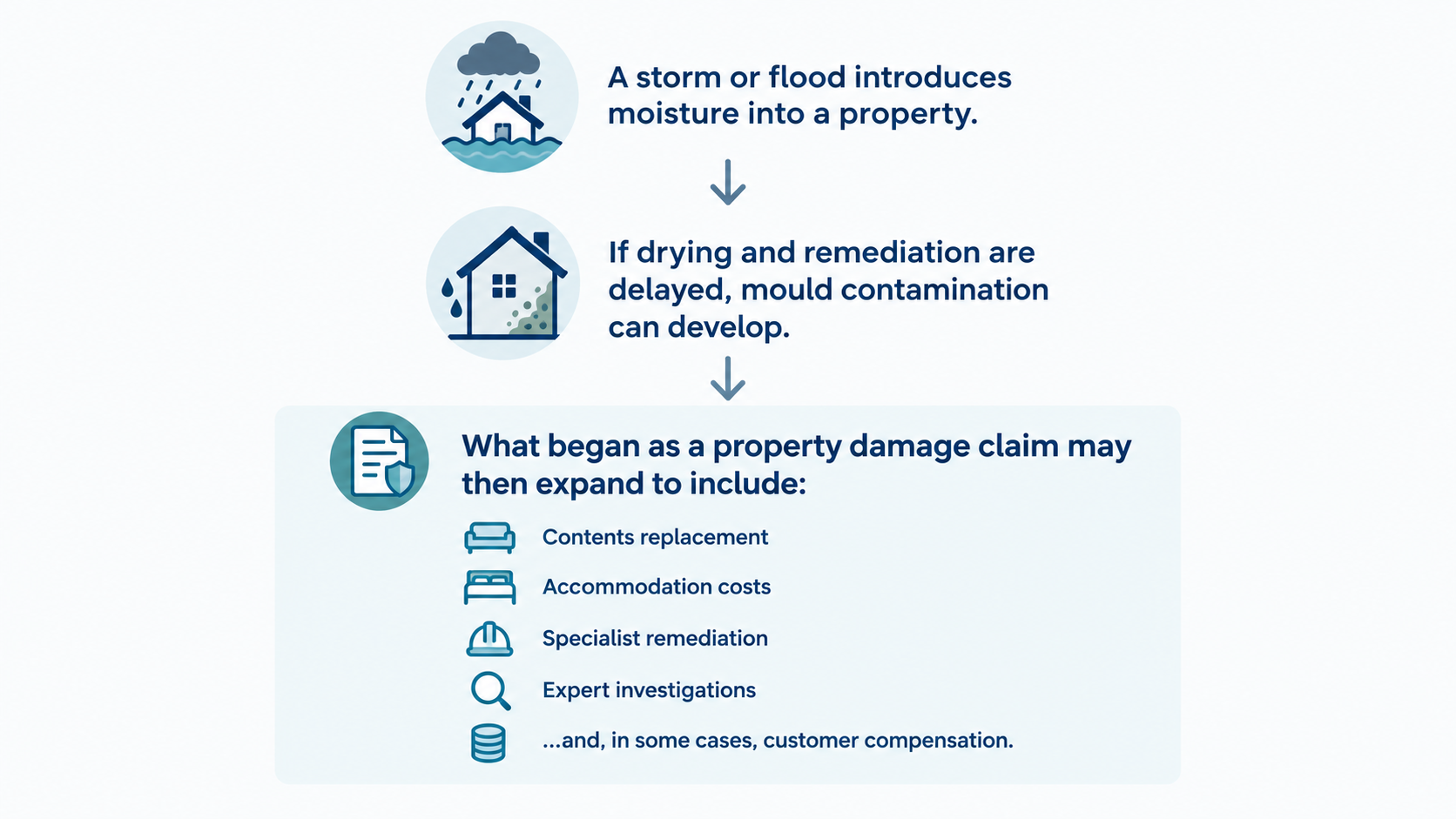
The timing of the response can become as important as the severity of the original damage. Industry commentary following the 2022 East Coast floods noted significant increases in mould-related activity and highlighted the importance of rapid intervention before moisture has an opportunity to develop into contamination [i] .
This raises an interesting actuarial question: to what extent can operational capacity, particularly following catastrophe events, influence ultimate claim costs?
Traditionally, catastrophe modelling has focused on estimating damage caused directly by the event itself. Mould introduces an additional layer of uncertainty because claim outcomes may be affected by inspection delays, contractor availability and remediation timeframes.
Given the less-than-immediate linkage between an event and resulting mould, its coverage is often contested.
Recent dispute outcomes suggest mould is increasingly appearing in complaints brought before the Australian Financial Complaints Authority (AFCA). Cases have involved disputes over causation, repair scope, loss of rent, claims handling and the treatment of vulnerable customers [ii] .
The common theme is that mould often blurs traditional boundaries, with questions being raised such as:
These questions can be difficult to resolve and frequently involve competing expert opinions.
For insurers, mould therefore represents more than a property damage issue. It sits at the intersection of claims management, customer experience, legal interpretation and health considerations.
Weather events are not the only factor potentially influencing mould risk.
Australia's National Construction Code has progressively strengthened condensation management requirements since 2019, reflecting increasing attention on moisture-related risks within the built environment [iii] .
At the same time, modern buildings are becoming increasingly energy efficient, with greater airtightness and insulation standards. While these changes deliver important sustainability and comfort benefits, researchers have noted potential links between highly airtight buildings, moisture retention and mould formation if ventilation and condensation management are not adequately addressed.
This does not imply that energy-efficient buildings create mould problems. However, it raises broader questions for insurers and actuaries. As building standards evolve, could underlying mould exposure also change? Are pricing models sufficiently sensitive to emerging building-performance risks? And how might these risks interact with changing weather patterns?
Mould claims remain a relatively small component of overall insurance losses. Nevertheless, they illustrate how secondary consequences of an event can become material drivers of claim outcomes.
For actuaries, the topic highlights several themes that are becoming increasingly relevant across the industry: claim inflation, catastrophe loss development, operational resilience, customer vulnerability and the interaction between climate, building design and insurance.
For insurers, as they continue to adapt to a changing risk environment, understanding what happens after the initial event is becoming as important as understanding the event itself.
And for the whole industry, mould may be just one example of a broader challenge: the emergence of secondary risks that are harder to predict, harder to model and potentially more complex to resolve than the original loss that triggered them.
[i] https://www.suncorpgroup.com.au/news/news/suncorp-insurance-breaking-the-mould
[ii] AFCA published decisions: https://my.afca.org.au/searchpublisheddecisions/
E.g. https://my.afca.org.au/searchpublisheddecisions/kb-article/?id=a86b5a4a-d7dd-ef11-8eea-6045bdc2f9b7
[iii] NCC editions over time: https://ncc.abcb.gov.au/editions-national-construction-code
The views expressed in this article are those of the author(s) or working group named below, and do not necessarily reflect the views of the Actuaries Institute. This work is licensed under a Creative Commons Attribution-NonCommercial-No Derivatives CC BY-NC-ND Version 4.0.


From natural hazard pricing to claims analytics, explore actuarial perspectives on Australia's general insurance sector
Subscribe to Actuaries Digital for free and receive the latest actuarial analysis, research, and commentary direct to your inbox