General Insurance
From Copilot to Autopilot – AI in General Insurance Part 1




Claim your CPD points
In Part 1 of this multi-part series, we examine how AI fits into the general insurance value chain, recent examples of real insurance use cases from insurers, and the implications from ‘silent AI’.
Actuaries have long been early adopters of analytical techniques that turn complex data into better insurance decisions. From the widespread adoption of generalised linear models to increasingly sophisticated machine-learning techniques, the profession has continually adapted as new technologies have become available.
Artificial intelligence is the next step in that evolution, but the pace and breadth of change are different.
Generative AI (GenAI) has already moved well beyond experimentation into practical insurance applications, from coding and analytics to underwriting and claims. Agentic AI takes this a step further: rather than simply generating an output in response to a prompt, an agentic system can work towards a defined goal through an iterative cycle of planning, acting, observing and adjusting. This repeated cycle of planning, acting and responding to new information is often described as an “agentic loop”.
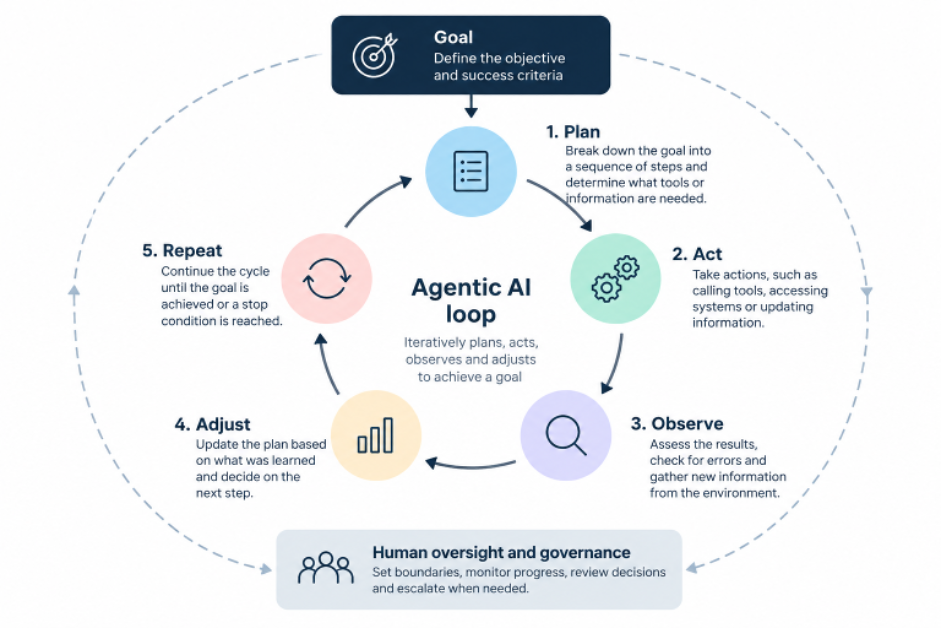
Figure 1: Illustrative agentic loop
These more complex AI processes are being utilised by more and more insurers. So where is this AI actually being used in the general insurance value chain?
AI is appearing across general insurance, from pricing and underwriting through to distribution and claims.
Table 1 below widens the lens, giving colour to where AI could create value at each stage of the insurance value chain and the challenges that come with it.
Table 1 – Opportunities and challenges across the insurance value chain
| Insurance value chain | Potential AI opportunities | Key AI risks / challenges |
| Product design and development |
|
|
| Pricing and actuarial analytics |
|
|
| Underwriting |
|
|
| Distribution and customer acquisition |
|
|
| Claims, customer service and complaints |
|
|
But these opportunities aren’t just theoretical. There are current examples of insurers using AI to change entire processes and deliver real-world value.
While actuarial and analytical teams can use AI to speed up core tasks like coding, data processing and modelling, GenAI and agentic AI can reshape organisational workflows. As these tools become more accessible, judgement, business understanding and the ability to challenge AI outputs become increasingly important.
Here are just a handful of recent examples of AI being used by insurers:
Companies like Akur8 are now releasing end-to-end agentic workflows for ground-up rate making. Their Akur8 Agents [1] are designed to guide actuaries from data discovery to model deployment.
QBE’s Cyber Underwriting AI Assistant [2] reviews submissions for completeness and relevant risk controls, with QBE reporting a 65% reduction in review time. The underwriter remains responsible for the final decision, but AI increasingly shapes how information is extracted and presented.
Suncorp’s Single View of Claim [3] uses GenAI to summarise claim histories and recommend next actions.
Allianz [4] goes further with an agentic AI solution for food-spoilage claims, which it says can reduce processing and settlement times by around 80%.
These examples show AI moving from supporting analysis and recommendations to now increasingly taking on parts of the insurance workflow itself. As autonomy increases, clear escalation points within human accountability frameworks become increasingly important.
AI is changing not only how insurers work, but also the types of risks they may need to cover.
There is heightened risk with professionals increasingly relying on AI in their work. In Dayal [2024] FedCFamC2F 1166 [5] , a solicitor relied on AI-generated legal research containing false authorities, leading to professional and regulatory consequences and notification to the Legal Practitioners’ Liability Committee. While the judgment does not confirm professional indemnity (PI) coverage, it illustrates a potentially insurable AI-related professional liability exposure.
The insurance market is also beginning to respond. Lloyd’s describes Armilla AI [6] as a Managing General Agent (MGA) and Lloyd’s coverholder that is focused on risks such as algorithmic error, model drift and generative-AI hallucinations.
For commercial insurers, the broader issue is how these emerging exposures fit within existing PI, cyber, Directors and Officers (D&O) and technology errors and omissions (Technology E&O) policies. Some losses may already fall within existing wordings, creating potential “silent” exposure, while reliance on common models and vendors could increase aggregation risk. This may lead insurers to refine underwriting questions, place greater focus on clients’ controls and human oversight, and consider more explicit AI-related cover.
AI is moving from a supporting role into general insurance workflows. This changes how risks are assessed, how underwriting and claims are managed, and the exposures insurers may need to cover.
As AI’s role expands, the key question is not just what AI can do, but how much authority it should be given and how that authority should be governed. As insurers move from AI that predicts to AI that generates, and ultimately AI that acts, the governance challenge also shifts – from a traditional focus on model performance towards questions of decision authority, human oversight and accountability.
The General Insurance Practice Committee (GIPC) AI Working Group is continuing to monitor this evolving area. Part 2, Governing AI in general insurance: what practitioners need to ask, will focus on a practical approach to prioritising AI risks, defining accountability and applying governance principles to real insurance use cases.
[1] Akur8 Agents: Expert Actuarial AI, built by Actuaries for Actuaries .
[2] QBE, “QBE scales GenAI solutions across operations”, https://www.qbe.com/newsroom/news/qbe-scales-gen-ai-solutions-across-operations , accessed 14 October 2026.
[3] Suncorp Group, “FY24 look back: a year of major tech milestones for Suncorp”, https://www.suncorpgroup.com.au/news/news/major-tech-milestones , accessed 14 October 2026.
[4] Allianz Australia, “Allianz wins 2026 Canstar Innovation Excellence Award”, https://www.allianz.com.au/about-us/work-with-us/partners/news/allianz-wins-2026-canstar-innovation-excellence-award.html , accessed 14 October 2026.
[5] Federal Circuit and Family Court of Australia, Dayal [2024] FedCFamC2F 1166, https://www.lexisnexis.com.au/ContentNotifier/URJNotifier/LinkMan?bcnum=2414379.htm&jurisdiction=fmca , accessed 14 October 2026.
[6] Lloyd’s, “Armilla AI”, Lloyd’s Lab Accelerator Alumni, https://www.lloyds.com/insights/lloyds-lab/programmes-and-initiatives/lloyds-lab-accelerator/alumni/armilla-ai , accessed 14 October 2026.
The views expressed in this article are those of the author(s) or working group named below, and do not necessarily reflect the views of the Actuaries Institute. This work is licensed under a Creative Commons Attribution-NonCommercial-No Derivatives CC BY-NC-ND Version 4.0.


From natural hazard pricing to claims analytics, explore actuarial perspectives on Australia's general insurance sector
Subscribe to Actuaries Digital for free and receive the latest actuarial analysis, research, and commentary direct to your inbox