Climate and Sustainability
General Insurance
Beyond the model: Risk, reality and recalibration



Claim your CPD points
That was the question running through every contribution at the second plenary of the 2026 All Actuaries Summit. Chaired by Christa Marjoribanks of IAG, the session moved across climate, geopolitics, technology and health. Four different domains, each arriving at the same uncomfortable conclusion: the industry is being asked to price and manage exposures that its existing tools were not designed for.
The session's most striking numbers came early. Australia's insurance protection gap — the difference between insured losses and the true economic cost of disasters — sits at $12 billion. Globally, a single year of uninsured extreme weather events cost $327 billion.
Alix Pearce, General Manager of Climate, Social Policy and International Engagement at the Insurance Council of Australia, used a personal account from Queensland to put a human face on what those figures mean in practice: households in high-risk areas watching premiums become unaffordable, or finding cover withdrawn entirely. The instinct to treat this as a pricing problem, charge more to reflect higher risk, has a logic to it.
But Alix Pearce's argument was that the logic runs out. In communities most exposed to climate risk, higher premiums don't solve the protection gap. They widen it. New mechanisms for spreading risk, accelerated resilience investment and stronger land use planning are all part of the answer; and none of them happen without the kind of long-term modelling and policy engagement actuaries are well placed to provide.
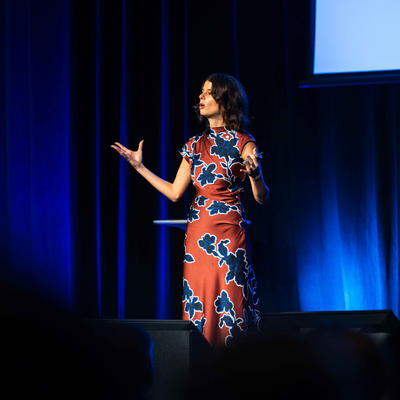
Alix Pearce, General Manager of Climate, Social Policy and International Engagement at the Insurance Council of Australia, presenting at the 2026 All Actuaries Summit.
Rade Musulin, Principal at Finity Consulting, reframed a question the industry has been slow to ask directly. How much of standard catastrophe modelling quietly assumes a geopolitical environment that no longer exists? His argument drew on decades of claims experience. Geopolitical events don't just create losses, they amplify them through labour shortages, materials price spikes and logistics disruption that compound well after the initial event. The Iran War, Hurricane Katrina, recent supply chain fractures, each illustrated how an industry built around modelling physical risk can be caught out by the human and political systems wrapped around it. The current environment, Rade Musulin suggested, is more volatile than anything the industry has navigated in recent memory.
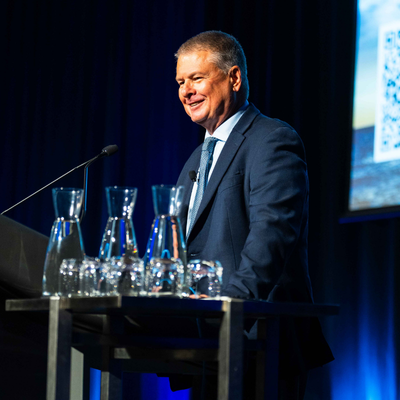
Rade Musulin, Principal at Finity Consulting, presenting at the 2026 All Actuaries Summit.
The recommendation was not to abandon existing models but to augment them with scenario analysis, explicit pricing of uncertainty, and a willingness to treat geopolitical risk as a first-order consideration rather than a footnote.
Technology risk has been part of the industry's vocabulary for years. What Corey Barker, Managing Director of See. Be. Consulting, argued is that its character has fundamentally changed and that the standard response of broad exclusions is increasingly inadequate.
Electric vehicles now hold a 16.4% market share in Australia. Generative AI is reshaping business processes across every sector the industry insures. The exposures embedded in motor, home and business interruption products are shifting faster than most pricing frameworks can track, and the risk cycles are compressing. What took years to emerge as a claims pattern in previous eras now appears in months.
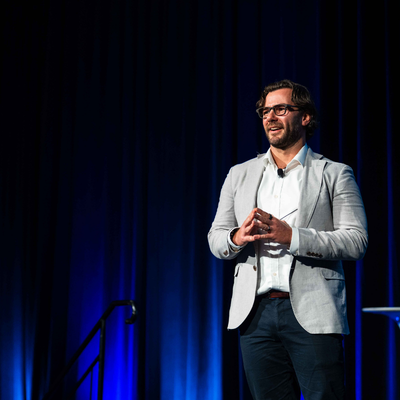
Corey Barker, Managing Director of See. Be. Consulting, presenting at the 2026 All Actuaries Summit.
The more productive path, Corey Barker argued, is building the analytical infrastructure to make technology causes observable — understanding accumulation, mapping dependency and moving deliberately from reflexive exclusion toward structured insurability. It requires actuaries to get closer to the technology itself, not just the losses it eventually produces.
Ben Harris, Director of Policy and Research at Private Healthcare Australia, brought a different kind of structural pressure to the session. Private health insurance was designed for acute episodes. Discrete, bounded events with clear costs and defined recovery pathways. What it now faces is a chronic disease burden that doesn't fit that model. Long-term conditions require ongoing management, preventive investment and outcome-based funding structures that fee-for-service models actively work against.
Meanwhile, rising premiums are pushing younger, healthier members out of the system, accelerating exactly the cost dynamics they were meant to offset. Ben Harris made a direct case for actuaries to engage in health policy reform, bringing long-term modelling and analytical rigour to a sector that needs both.
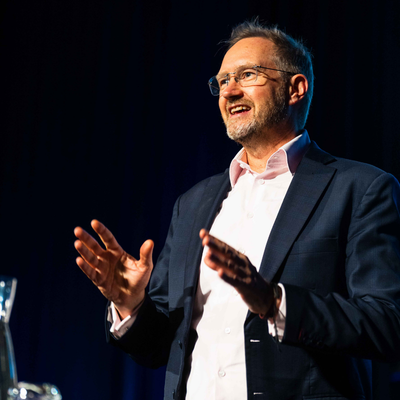
Ben Harris, Director of Policy and Research at Private Healthcare Australia, presenting at the 2026 All Actuaries Summit.
Climate, geopolitics, technology, health — different risks, different time horizons, different stakeholders. But the panel kept returning to a single underlying tension. The gap between the speed at which risk is evolving and the speed at which the profession's frameworks are responding.
Christa Marjoribanks put it plainly in her closing remarks. The risks are not waiting. The question is whether the appetite for genuine recalibration — in modelling, in policy engagement, in the willingness to price uncertainty honestly — is growing fast enough to meet them.
Have a perspective on the themes raised in this session? Actuaries Digital welcomes contributions from Members. Find out more.
The views expressed in this article are those of the author(s) or working group named below, and do not necessarily reflect the views of the Actuaries Institute. This work is licensed under a Creative Commons Attribution-NonCommercial-No Derivatives CC BY-NC-ND Version 4.0.

Missed a session? Catch up on the key ideas, debates and insights from across the 2026 All Actuaries Summit.
Subscribe to Actuaries Digital for free and receive the latest actuarial analysis, research, and commentary direct to your inbox