Climate and Sustainability
Risk Management
The Climate Average Trap




Claim your CPD points
Apart from climate scientists and their brethren, the mere mention of +1.5°C does little to strike fear, not to mention concern, in the minds of most of the lay population. Could this in part be the reason for the recent rapid abandonment of decarbonisation goals and overall interest in climate risk altogether, particularly against a backdrop of cost-of-living crisis and increasing geopolitical instability?
The persistent lack of urgency is understandable. Beyond the very benign-sounding number itself, and until very recently, heatwaves (particularly those occurring outside summer) are often reported alongside images of beach goers, blue sky 'glorious' winter days. Although this narrative is abruptly giving way to reports of chaotic fights over air conditioning units in France amid the ongoing European heatwave, it remains to be seen if this memory will endure or fade akin to mask and tissue paper panic buying during COVID.
While there are persuasive reasons to 'keep the message simple' in climate policy by gravitating to a single average number that covers the entire world, we argue that its benefits are significantly outweighed by a gross underestimation of the current severity and imminence of climate impacts to society. For example, the recent reaction to the retirement of the most pessimistic climate scenario of Representative Concentration Pathways (RCP) 8.5 reveals a collective lack of understanding of the climate sensitivity relationship - i.e., that a lower concentration of carbon emissions could still result in temperature outcomes associated with RCP 8.5.
As such, this article will first illustrate the scale of the "perception gap" created through averaging across space and time. It will also highlight how mainstream interpretation (i.e. through climate scenarios and climate stress tests) and communication of climate risk further compounds the underestimation issue. Finally it will suggest some practical ways to overcome these challenges.
Cognitive research indicates that the perception gap is significant even if we focus on the temperature variable and deliberately ignore impacts to changing precipitation patterns, winds and marine heatwaves. Namely, the risk of misinterpreting the complex planetary average of ' + 1.5 °C ' as a uniform, benign local increase.
However, warming is not uniform, and we argue that a poor appreciation of the impact of averaging across space and time lulls the public into a false sense of security. For example, land areas warm significantly faster than oceans, as oceans have a higher heat capacity and distribute heat through mixing and currents. As such, large continents like Europe and Asia have warmed at roughly double the rate of the global land and ocean. This divergence is expected to further increase through feedbacks, particularly with reduced rainfall leading to drier soils, less evaporation and even more energy available to heat land and accelerate the warming rate. (see Table below)
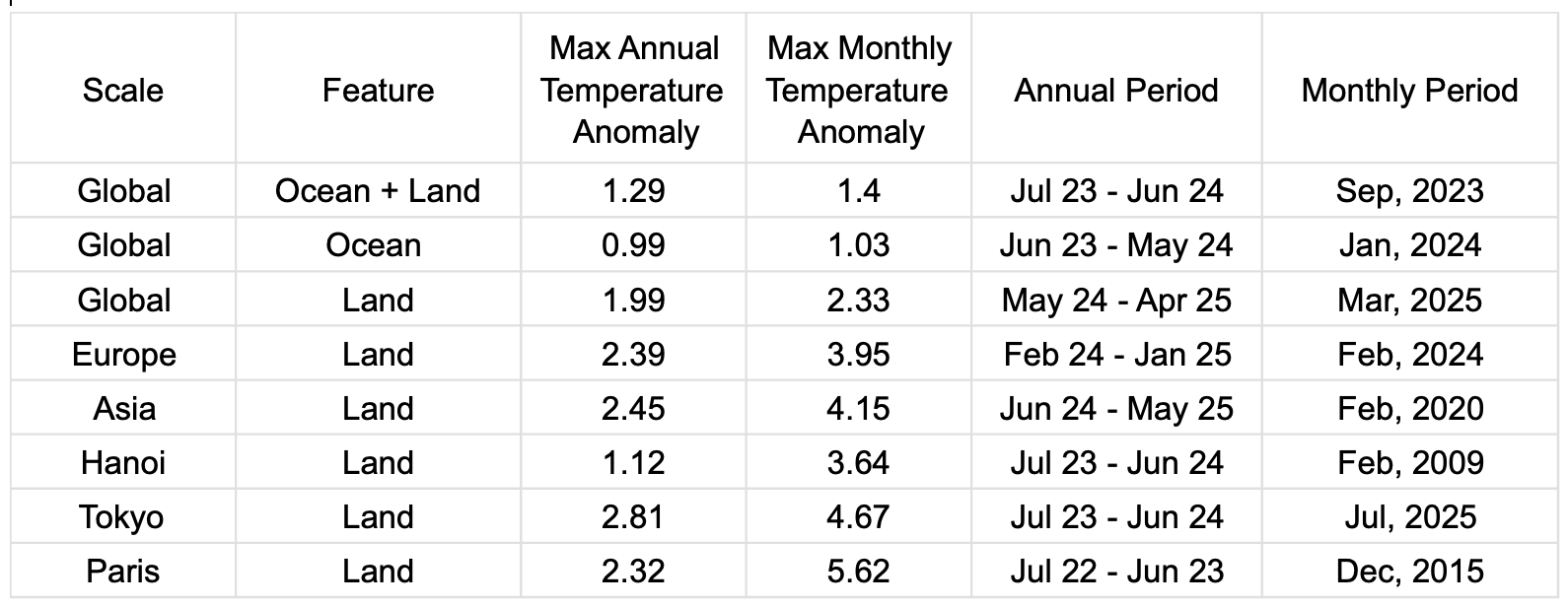
Table 1: Maximum annual and monthly temperature anomalies (departures from 20th century average) at global, continent and city levels. Note that all anomalies have occurred in the 21st century, and with the exception of Hanoi and Paris (recent heatwaves have not been taken into account), all have occurred post-2020. Source: Climatic Research Unit.
After removing the effect of averaging across both space and time dimensions, the deviations become even more pronounced. For example, when we shrink from global/annual to a city/month level, monthly daily maximum temperature anomalies have already reached up to +5.6°C and + 4.7°C for Paris and Tokyo, respectively, in recent history. These deviations naturally become even more glaring if we focus on the tail - where events such as the recent European heatwave produced anomalies that exceeded +10°C above historical reference means for late June 2026. For cities, or the built environment, the effect of climate change can be amplified by the urban heat island effect. This is especially dangerous where there is high humidity (i.e. Tokyo and Hanoi) or if the heat is prolonged and there is little adaptive capacity (i.e., lack of air conditioning). This leads to heat stress and excess mortality for aged persons.
Naturally, climate impacts extend well beyond temperature outcomes into changes in rainfall, biosphere and the risk profile of natural weather disasters. The link to these impacts is even more tenuous at +1.5°C, which increases this perception gap.
Apart from the reduction of climate complexity into a single policy +1.5°C target, the way evidence of climate change is presented officially further encourages society to downplay the seriousness of the issue. Firstly, the use of the term 'climate crisis' does not strike a strong enough connection between temperature increase and the root cause of the issue. This deflects attention to symptoms rather than addressing the root cause - akin to risks of smoking termed 'lung crisis'. Perhaps ‘emissions crisis’ may be closer to reality.
Next, while it is important to communicate climate risks in ways that resonate with the general public, mainstream media tends to over-simplify, underplay or over-exaggerate climate risks rather than report science without fear or favour. Heat has been given a positive spin, with anomalously warm days associated with beachgoers frolicking by the ocean or using language such as a 'glorious winter day' to characterise heatwaves that occur outside summer. In fact, even with the devastating impacts of the recent European heatwave laid bare, an op-ed featured in a major newspaper used the irrefutable evidence of clear and present climate danger to argue that Britain should 'embrace a warmer Mediterranean lifestyle' and an excuse to give up on Net Zero efforts altogether [1] .
On the other extreme, sensationalising climate impacts may risk alienating those who are ‘on the fence’ or open-minded readership who are genuinely interested in climate action - through the 'crying climate wolf' effect [2] . Instead of acknowledging the inherent uncertainty and complexity of climate science, predictions of imminent climate doom can be counter-productive. Examples of focus for dramatic effect include the failed drought predictions in 2007 by mammalogist Tim Flannery [3] , a dramatic increase in uninsurability [4] , as well as trillion-dollar damage bills and credit rating downgrades [5] .
Lastly, there have been repeated rounds of financial climate stress tests conducted across various jurisdictions around the globe. But the stubborn finding of 'nothing to see here' with respect to systemic climate risk impacts may lull authorities into a false sense of security, and further delay decarbonisation policy. However many of these stress tests are premised upon scenarios from bodies like the Network for Greening the Financial System (NGFS) that have emerged as a de facto global standard in financial climate reporting. These scenarios, in turn, rely on potentially flawed damage functions within their Integrated Assessment Models (IAM) that estimate benign GDP impacts despite extreme climate change (i.e., over 4-5°C global surface average temperature warming). A key reason for this persistent view is the lack of interdisciplinary collaboration - i.e., economists and physical climate scientists conducting research in silos [6] . Worryingly, there remains limited appetite from authorities and standard setters to challenge the way climate stress tests and global scenarios are presented. But a body of new research into tipping points, and interdisciplinary alternative efforts such as storyline approaches [7] are now available.
As climate impacts are increasingly felt around the world, one would have expected increased urgency to tackle the issue.
As climate impacts are increasingly felt - and in many cases live-streamed - around the world, one would have expected increased urgency to tackle the issue. Research reveals that positive 'nudges' in support for climate action follow lived climate disaster experience [8] .
However, these latest data points reaffirm studies that show this experience pales in comparison to economic and social forces when it comes to shaping climate action such as voting preferences. This suggests that the general public views climate action and economic welfare can be in financial conflict. This is exacerbated by economic welfare generally being a more immediate concern than climate., This conflict is not strictly true, as economic and social security presupposes a stable climate regime. Successive reports are projecting more adverse future impacts, and attribution science is making it increasingly clear how elapsed climate change has contributed to current impacts.But while we cannot rely on 'lived experience' to motivate sustained ground-up climate action, what are practical steps to both increase the level of awareness and crucially, ensure that awareness translates into action?
Firstly, language used in climate communication needs to be overhauled to ensure that risks of climate change truly resonate with the wider public beyond climate risk practitioners. For example, the Potential Energy Coalition suggests translating 1.5°C into messages such as 'stop overheating' and replace 'Net Zero' with 'no pollution'. The most effective words are not necessarily the most scientifically precise - they are the ones that connect with the people you are trying to reach. To this end, the recent declaration of suffering heat days above 40°C, a term that was crowd-sourced in Japan by the Japan Meteorological Association (JMA), represents an effort to spur greater awareness.
Next, while greater media coverage that explicitly links weather disasters to climate change is helpful, this needs to be accompanied by highlighting solutions (both emerging and those that are underway). Optimism in climate risk communication - which is not the same as downplaying risks of climate change - is critical, as it has been repeatedly shown that fear without hope can reduce people's sense of efficacy and leave them feeling powerless rather than motivated.
Another subtle impediment to real action is climate reporting. Climate disclosure is supposed to inform investors and motivate climate action through incentivising capital allocation. Instead of decision-useful insights, 'tick the box' exercises have in part contributed to increased disillusionment with climate risk being a distraction rather than a genuine issue that warrants real attention [9] . Disclosure reform should introduces the need for transparent methodology and objective, measurable standards and an uplift of physical risk expertise across the disclosure ‘ecosystem’. Without this, climate disclosure will continue to serve to delay rather than spur climate action. This reform is needed from global scenario modellers, services providers, standard setters, regulators and regulated entities.
Lastly, climate experts and scientists may not want to acknowledge the uncomfortable truth that gaps in science communication have been and continue to be exploited by sceptics to propagate misinformation to devastating effect. Therefore, experts must strive to make research more accessible, foster more interdisciplinary collaborations, and publish beyond technical journals. This would create a better chance for a ‘truth-driven’ positive ripple effect where individuals move the needle within their own spheres of influence.
This article was originally published Altiorem and has been republished here with full permission.
You can view the original article here.
Sources:
[1] Heath A., We’ve lost the war against climate change. Time to scrap net zero, Telegraph, 29th July 2026
[2] Pui A. and Pitman A., Science integrity, (mis)communication and risks of crying climate wolf, UNSW Press, 2023
[3] https://theconversation.com/climate-and-floods-flannery-is-no-expert-but-neither-are-the-experts-5709
[4] https://www.theguardian.com/commentisfree/2025/jan/17/australia-is-becoming-an-uninsurable-nation-there-may-only-be-one-solution
[5] https://www.smh.com.au/politics/federal/trillion-dollar-cost-of-climate-change-will-challenge-federal-budget-20230818-p5dxji.html
[6] Neal et al., Reconsidering the macroeconomic damage of severe warming, Environmental Research Letters, 2025
[7] Fiedler, T et al., Storylines: A Science-Based Method for Assessing and Measuring Future Physical Climate-Related Financial Risk, Accounting and Finance, 2025
[8] Ghasemi et al., A decade of weather anomalies and natural disasters and their influence on environmental beliefs and actions across Australia, Journal of Environmental Psychology, 2026
[9] Waqas E. et al., Climate Change News Audience Report 2025: Analysis of News Use and Attitudes in Eight Countries, Oxford Climate Journalism Network, 2025
https://www.climate.gov/news-features/features/whats-number-meaning-15-c-climate-threshold
Hornsey et al., Climate skepticism decreases when the planet gets hotter and conservative support wanes, Global Environmental Change, 2026
Wright S., Trillion-dollar cost of climate change will challenge federal budget, Sydney Morning Herald, 21st August 2023
The views expressed in this article are those of the author(s) or working group named below, and do not necessarily reflect the views of the Actuaries Institute. This work is licensed under a Creative Commons Attribution-NonCommercial-No Derivatives CC BY-NC-ND Version 4.0.


From physical risk modelling to transition pathways, explore our latest thinking on climate and sustainability
Subscribe to Actuaries Digital for free and receive the latest actuarial analysis, research, and commentary direct to your inbox