General Insurance
Climate and Sustainability
Data Science and AI
Risk Management
Life Insurance
Quantum global industry challenge




Claim your CPD points
Did you know that 2025 marked 100 years since the initial development of quantum mechanics? To recognise the importance of quantum science, the UN declared 2025 the International Year of Quantum Science & Technology and set up the Global Industry Challenge, which invited teams to apply quantum computing technologies to key industry problems in finance, insurance, infrastructure, energy, and life sciences.
More than 600 applicants from over 60 countries participated, and by the end of the multi-phase program, our very own Actuaries Institute team – Australian Quantum Actuaries – was awarded runner-up in the World Bank Group’s challenge.
The team comprised Anthony Lowe and Michael Walker (who have released several Institute thought leadership papers on the topic of Quantum Computing see here ); actuary Ramona Meyricke , Chair of the Institute’s Climate and Sustainability Practice Committee; and quantum experts Nishikanta Mohanty and Muria Roberts.
Before 2025 is too far behind us, we wanted to recap the challenge question, our solution and the role quantum might have for actuaries and insurance in the future.
The World Bank Insurance challenge asked participants to develop a sustainable, quantum-driven risk-based climate risk insurance model that benefits all stakeholders, including policyholders, insurers, reinsurers, governments, and financial institutions.
Quantum computers represent data differently from classical ones and perform different operations on them. These differences in data representation and manipulation allow quantum computers to run algorithms not available to classical computers, which makes quantum computing especially promising for some complex problems where classical computers struggle, such as optimisation, simulation, and cryptography.
Quantum advantage refers to situations where a quantum computer can solve a problem meaningfully better than a classical computer. In practice, many real-world solutions are likely to involve elements of both quantum and classical computing – only using quantum algorithms for parts of the problem where it offers an advantage. For example, Telstra is partnering with Silicon Quantum Computing to use quantum machine learning to enhance Telstra’s response to complex challenges using predictive network analytics that can pre-empt and resolve network issues better than classical computing methods. [1]
We chose to focus on an area of climate risk insurance where we saw potential for quantum concepts to add most value: parametric climate risk insurance contracts, or index-based insurance. As climate change continues to evolve and new risks emerge, certain lines of business are struggling to find Natural Catastrophe capacity, creating growing demand for parametric solutions to help mitigate the financial impact of natural disasters. [2] In developing countries, parametric climate risk insurance contracts are increasingly used by governments at a national level to address specific, single-hazard, high-impact events.
Parametric climate risk insurance contracts provide fast, predetermined payouts based on objective, third-party data (e.g., wind speed, rainfall, satellite imagery) rather than individual loss assessments. While having high potential value to individuals in developing countries, existing parametric arrangements tend to focus on specific climate hazards (rather than being multi-hazard) and be available at National level with limited local tailoring. For example:
We were motivated to explore the use of quantum to unlock more complex, locally tailored, multi-hazard parametric products for developing countries – that could be sold in real time and purchased via a mobile phone – requiring complex calculations to be performed incredibly fast. If quantum could make this a reality the benefits to stakeholders could include:
To meet this need - the Australian Quantum Actuaries team proposed Quantum Collective Climate Risk Insurance (Q-CCRI) — a scalable, innovative solution addressing advanced climate risk modelling and the urgent global challenge of insurer withdrawal from high-risk areas.
To demonstrate its potential, Q-CCRI prototyped this solution for drought risk in Indonesia — a Southeast Asian nation where millions of people do not have insurance protection. The World Resources Institute (WRI) Water Risk Atlas ranks Indonesia as the country with the 10th highest drought risk globally [3] [4] . Vulnerability of Indonesia’s population to drought is also high – with millions exposed to impacts including severe agricultural failure, water scarcity, and food insecurity for farming communities.
Figure 1: Map of the average drought index of Indonesia 1962–2021 with four successive different seasons, namely DJF (a), JJA (b), MAM (c), and SON (d)
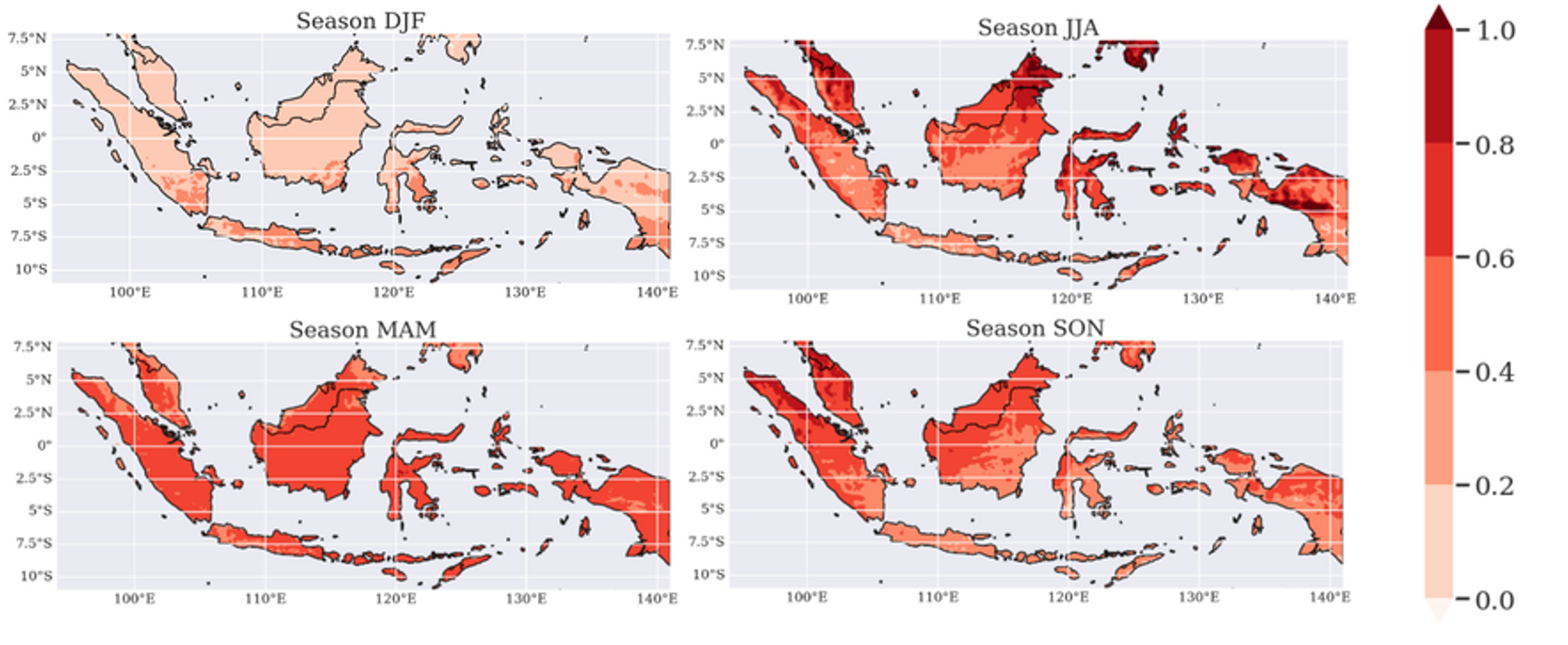
Source: Robbani, Ismail & Wiratmo, Joko & Susandi, Armi & Yee, Jurng-Jae. (2025). Exploring rainfall-driven climate hazards using the climate hazard index and historical data from ERA5 (Study case: Indonesia). Theoretical and Applied Climatology. 156. 10.1007/s00704-024-05329-3.
The prototype solution proposed quantum-enhanced algorithms for localised risk assessment, dynamic pricing, and portfolio optimisation, forming the foundation of a next-generation index insurance platform powered by quantum technologies. The Q-CCRI prototype integrates quantum computing, climate, insurance and actuarial expertise to create a 4-layer architecture:
Q-CCRI aims to make climate risk protection possible at low cost in developing countries. By providing locally tailored parametric cover for vulnerable populations and enabling sustainable insurer participation, Q-CCRI could unlock sustainable insurability and establish a globally scalable model to safeguard at-risk communities in the climate risk era.
The solution demonstrates how quantum computing can complement actuarial thinking and traditional methods in insurance. If this article has got you interested, you can learn more about quantum computing's potential to reshape data processing, cybersecurity and complex modelling systems across industries here .
The Actuaries Institute is forming a Working Group to explore what quantum computing could mean for the profession. Whether you're deep in the technical detail or curious about what it means for your practice, your perspective matters.
[1] Telstra. (2025, October 13). Quantum meets connectivity: Telstra and SQC explore smarter network prediction [Press release]. https://www.telstra.com.au/aboutus/media/media-releases/Telstra-SQC-quantum-network
[2] Qin, B. (2024, March 10). Parametric insurance and its growing place in the industry. Actuaries Digital. https://www.actuaries.digital/2024/03/11/parametric-insurance-and-its-growing-place-in-the-industry/
[3] Samadhi, N., & Permatasari, A. P. (2025, September 25). Collective action urgently needed for water security in Indonesia. WRI Indonesia. https://wri-indonesia.org/en/insights/collective-action-urgently-needed-water-security-indonesia
[4] World Resources Institute. (n.d.). Aqueduct Water Risk Atlas. Retrieved February 11, 2026, from https://www.wri.org/data/aqueduct-water-risk-atlas
The views expressed in this article are those of the author(s) or working group named below, and do not necessarily reflect the views of the Actuaries Institute. This work is licensed under a Creative Commons Attribution-NonCommercial-No Derivatives CC BY-NC-ND Version 4.0.


From the basics to what's next
Receive industry-leading perspectives, straight to your inbox.