Superannuation and Investments
Life Insurance
Retirement adequacy, disability cover and longevity answered




Claim your CPD points
Where questions could not be addressed during the session, this article provides responses to those raised on retirement adequacy, disability cover and longevity.
For more than a decade, the Standard Risk Measure (SRM) has helped members understand the likelihood of short-term losses. This narrow lens may lead members to choose lower-risk options that fail to meet their long-term retirement needs.
The Super Member Outcomes Sub-committee proposes an Adequacy Risk Measure (ARM) to complement the SRM by estimating the probability an option fails to achieve Consumer Price Index (CPI) + 3% p.a. over 20 years. Shifting the focus from annual losses to retirement adequacy gives a more meaningful view of risk.
The proposal explores adding the ARM to superannuation disclosures via a simple five-level scale. This would help members choose options aligned to their retirement goals and support better outcomes across the system.
Were legal teams at AMP and Aware nervous about the possibility that the “who might invest in this?” paragraph might be perceived as advice?
No. The section isn't intended as personal advice. It is designed to help members understand when a risk measure may be more relevant, as funds already do with investment horizons and risk profiles. The key is staying factual and not recommending a specific course of action.
As a financial adviser, I am very careful with the use of the word risk without proper explanation. Your proposed approach is a good way to frame it.
"Risk" does mean different things to different people. The SRM focuses on short-term volatility, but many members face a greater risk of an inadequate retirement over the long-term. Describing both shifts the question from "How much might my balance fall next year?" to "How likely am I to reach my retirement goal?"
Do you expect that Adequacy Risk Measures will become a requirement for all funds? Should this be incorporated into the Australian Prudential Regulatory Authority (APRA) performance tests, and how?
It's too early to say. Industry adoption and testing come first, and regulators may consider standardisation if it proves useful. We’d be wary of adding it to APRA's Performance Test, which assesses trustee performance against benchmarks rather than member retirement outcomes.
For further information, refer to the ARM article .
For further questions, reach out to Estelle Liu .
Total and Permanent Disability(TPD) cover has long been a default disability benefit in super group insurance, often alongside Income Protection (IP). The Insurance in Super Sub-committee (ISSC) examines issues limiting the effectiveness and suitability of current TPD arrangements. The findings cover the importance of clear TPD objectives, current fund offerings, stakeholder perspectives and the complexity of mixed definitions, concluding with alternative member-centric designs, pricing impacts and trustee considerations.
Will the Insurance in Super Sub-committee cover the innovations in retail insurance as examples that could be applied for super?
Yes. Recent retail TPD changes (e.g. TPD Support Option, Severity and Core) will be covered in part 2.
To what extent can actuaries contribute to tidying TPD in super?
Actuaries work across funds and as consultants on design and pricing. They can help by:
Are tax law changes needed to encourage/allow alternative structures for TPD? Eg. Payments over a period rather than a single lump sum.
Superannuation taxation rules for disability benefit are complex, with lump sums and income streams taxed differently, and depend on the claimant’s circumstances. The Institute's Public Policy Statement supports simplifying the relevant Superannuation Industry (SIS) Act , tax and Superannuation Guarantee legislation, which would help trustees move away from lump-sum designs.
How can trustees define “erosion of retirement income” to enable a broader definition of TPD?
Trustees should weigh benefits as well as costs across all SIS covenants, given around 30% of members suffer financial loss from death or disability while working. Default premiums could be expressed as a percentage of retirement income, noting they don't affect all three sources (Superannuation Guarantee (SG), other savings, Age Pension), consistent with the Institute's Public Policy Statement.
For further information, refer to the ISSC Public Policy Statement .
For further questions, reach out to Ed Tam or Jeff Humphreys .
The presentation focused on a simple proposition: super members don't all have the same life expectancy, and the differences matter for retirement outcomes and lifetime income products.
AT A GLANCE: Different levels of wealth → different life expectancies → different member outcomes for the same strategy
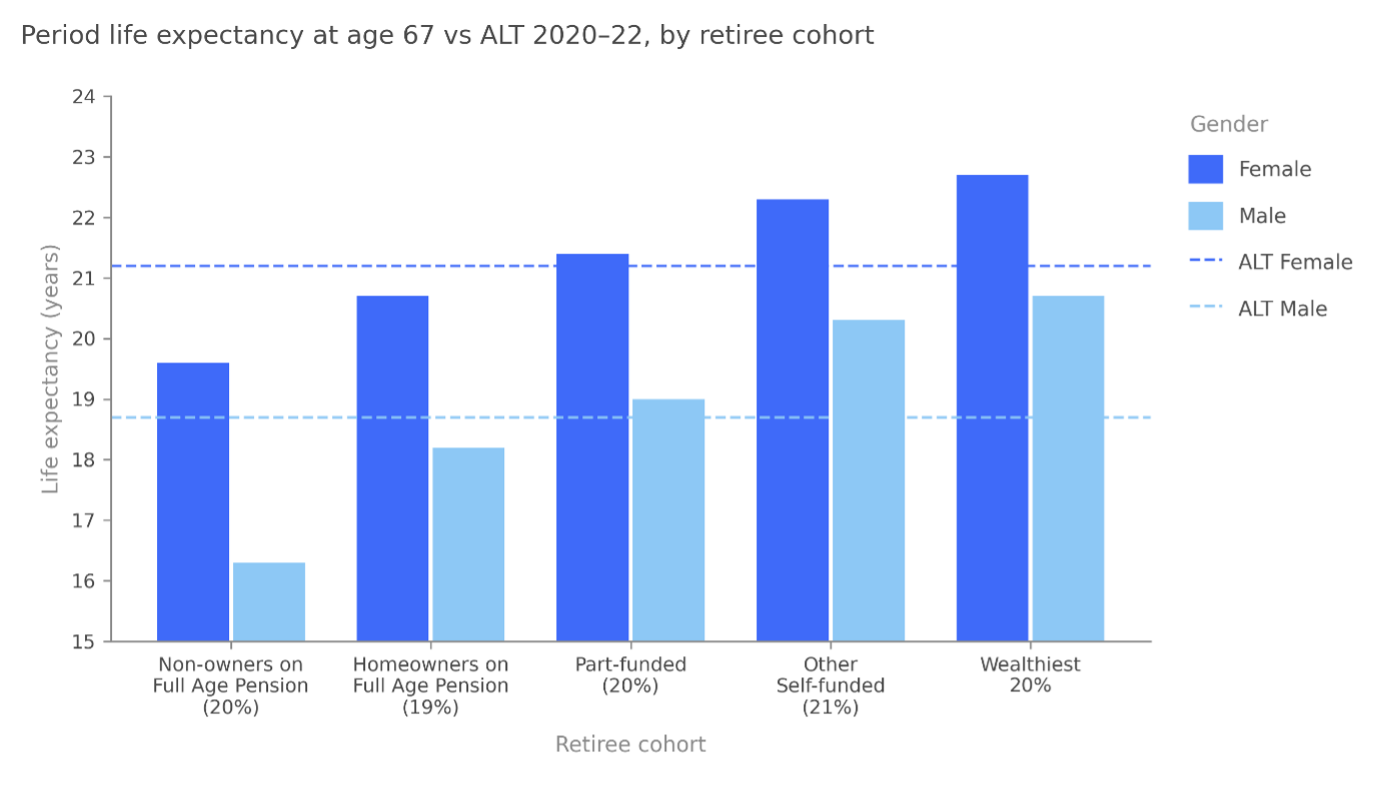
The analysis estimated life expectancy for cohorts defined by likely Age Pension eligibility, a wealth measure strongly predictive of longevity. It isn't a replacement for health-based assessment, but a practical way to differentiate life expectancies where data are scarce.
The chart below illustrates the resulting differences in period life expectancy between wealth cohorts, relative to the base Australian Life Tables (ALT) 2020–2022 Life expectancies.
Why it matters
For an account-based pension, life expectancy affects the chance of running out of money. For a lifetime income product, it affects how long payments continue, and so the value members receive relative to what they pay.
Using an Insurance Regulatory Information System (IRIS) product proposed in the Australian market, priced only by single or joint life, the presentation estimated the expected lifetime fee: the share of the investment retained by the insurer. For wealthy couples retiring at 67, it was around 3.9%; for full Age Pension couples who don't own their home, 8.7%. Those who live longer effectively pay less for the same product.
Trustees routinely monitor what life and TPD cover cost members. Given how much savings a longevity guarantee can absorb, they should also know its expected cost for members offered lifetime income, the segment most likely to take it up, and actual purchasers.
Will the five wealth cohorts stay at roughly 20% each, and does it matter?
The split uses 2025 Australian Institute of Health and Welfare (AIHW) data and carries some uncertainty, as eligible retirees may delay claiming a part Age Pension or never claim it. The self-funded share is also growing as super reduces Age Pension reliance, and retiree home ownership is changing. The model doesn't require an even split; it just needs recalibrating as cohorts evolve.
Have you considered selection effects in annuity pricing?
The cohorts cover all super members, not just annuitants. Finkelstein et al. (2002) [1] distinguish active selection, based on people's knowledge of their own health, from passive selection, where demand correlates with wealth, itself linked to mortality.
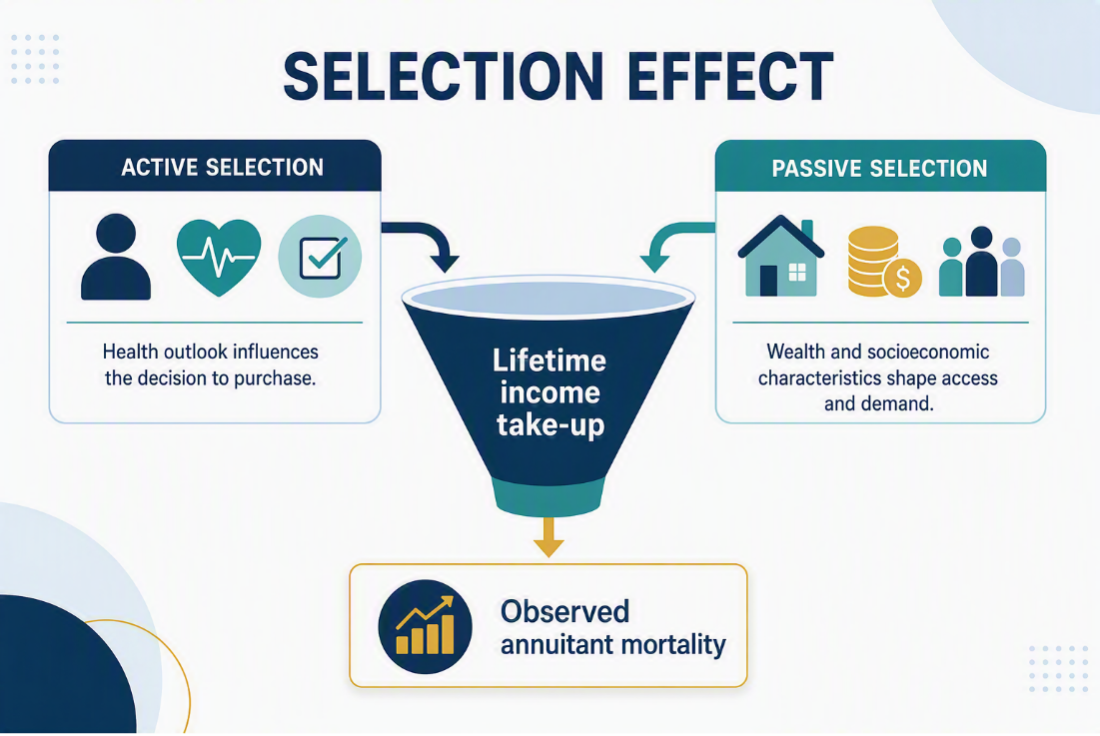
The two are closely intertwined. United Kingdom (UK) Continuous Mortality Investigation (CMI) evidence shows the mortality gap between annuitants and non-annuitants is small among the wealthiest but much larger among the most deprived. Annuitants' life expectancy may therefore exceed the estimates presented, so the analysis offers realistic lower bounds and complements, rather than replaces, traditional annuitant experience analysis.
Read more here .
For any further questions, or to provide feedback, email Philip Clark .
Members can access the complete Superannuation and Investments Exchange here .
[1] Finkelstein, A. and Poterba, J. (2002). “Selection Effects in the United Kingdom Individual Annuities Market.” The Economic Journal, 112(476), 28–50. DOI: 10.1111/1468-0297.0j672.
The views expressed in this article are those of the author(s) or working group named below, and do not necessarily reflect the views of the Actuaries Institute. This work is licensed under a Creative Commons Attribution-NonCommercial-No Derivatives CC BY-NC-ND Version 4.0.


From superannuation policy to retirement income strategy, explore our latest analysis on the system Australians rely on
Subscribe to Actuaries Digital for free and receive the latest actuarial analysis, research, and commentary direct to your inbox