Superannuation and Investments
Life Insurance
The Price of Fairness: Lessons from Granular Pricing Around the World




Claim your CPD points
How granular should pricing be for lifetime income products? At first glance, this sounds like a purely technical question, but in reality, it is also a question about societal goals. Every pricing framework involves balancing competing objectives between fairness, complexity and sustainability. The challenge is determining where Australia should sit on that spectrum.
Retirement markets around the world sit at very different points on the pricing granularity spectrum. The factors used are summarised below.
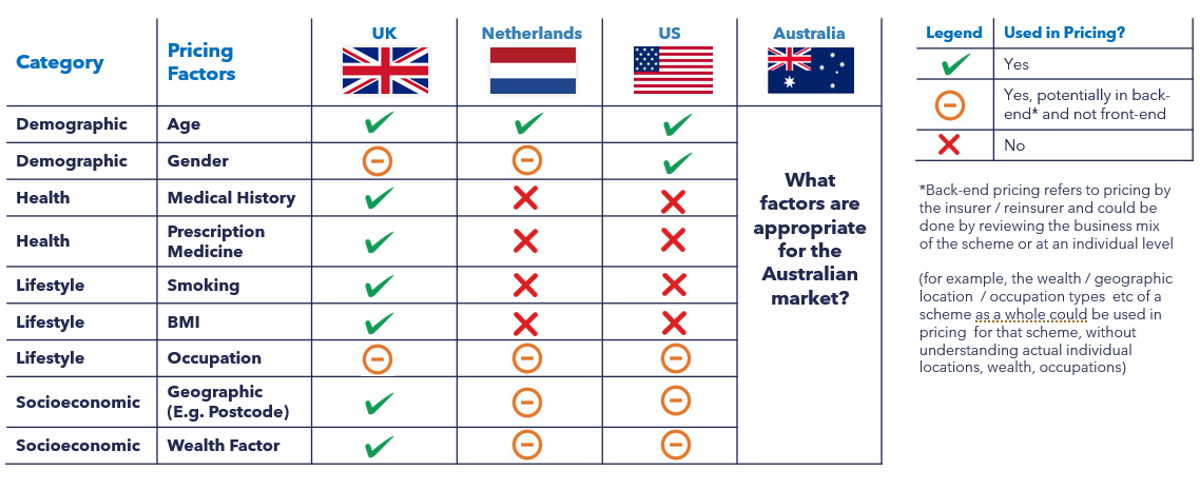
At one end is the Netherlands, where pricing is largely pooled, and varies only by age. The 2012 EU directive bans gender-differentiated pricing. Longevity risk is shared collectively, reflecting a cultural emphasis on solidarity. The result is a simple and highly engaged system, although significant cross-subsidies inevitably exist across genders and between unhealthy to healthy lives.
At the other end is the United Kingdom, with a highly segmented individual annuity market. Retirees receive different annuity rates based on a mix of directly asked health and lifestyle questions and socioeconomic factors inferred from postcode and pot size. A retiree’s income can vary by upwards of 20% depending on their risk profile. This system is actuarially fairer but also introduces complexity and has reduced engagement from healthier lives.
The United States sits somewhere between these two models. The main lifetime income products are single premium individual annuities (‘SPIA’), are perceived as complex and have had limited engagement. On the other hand, pricing has not been granular enough (e.g. to allow for impaired health) to attract those with lower life expectancy. State-by-state regulatory variation has also created unintended differences in pricing across states. This has resulted in these products remaining relatively unpopular and being adversely selected against.
Audience Survey
To understand industry sentiment in Australia, we presented this topic at the 2026 Actuaries Summit and surveyed attendees.
Most respondents favoured moderate pricing differentiation. This suggests that industry participants recognise the benefits of more accurate pricing but acknowledge its practical limits.
Poll Question - In your view, where should Australia sit on the pricing granularity spectrum in the long term?
| Pricing granularity | % of audience |
| 1. Fully Pooled (age only) | 6% |
| 2. Lightly differentiated (age + sex) | 28% |
| 3. Moderately differentiated (age + sex + BMI + smoking) | 47% |
| 4. Highly Granular (age + sex + BMI + smoking + affluence/postcode) | 13% |
| 5. Fully individualised (involving underwriting) | 6% |
When asked about the most important considerations in determining pricing granularity, three themes consistently emerged: transparency, incentives and the size of the pricing pool. Other responses included fairness, societal expectations, discrimination concerns, regulatory considerations and whether consumers can control the factors being priced. These responses highlight that pricing design cannot be separated from questions of consumer trust and market sustainability.
The survey also explored which pricing factors attendees considered most acceptable for use in Australian annuity pricing. Age and gender are the most widely accepted factors, followed by the lifestyle factors of smoking status, BMI and occupation. The least accepted factors were medical history, postcode and wearable-health data. The findings suggest a distinction between variables that are widely understood and historically accepted, and data sources that raise concerns around privacy, equity and governance.
In summary, there is no optimal pricing framework. Different markets around the world have made different trade-offs depending on their regulatory environments, cultural norms and societal objectives. As Australia's retirement income market evolves, the system will need to balance competing objectives and decide which outcomes its retirement system is designed to deliver. Now is the time for actuaries, product designers and policymakers to weigh in before pricing conventions harden.
To explore this topic further, view the Summit presentation slides and recordings here .
The views expressed in this article are those of the author(s) or working group named below, and do not necessarily reflect the views of the Actuaries Institute. This work is licensed under a Creative Commons Attribution-NonCommercial-No Derivatives CC BY-NC-ND Version 4.0.


From superannuation policy to retirement income strategy, explore our latest analysis on the system Australians rely on
Subscribe to Actuaries Digital for free and receive the latest actuarial analysis, research, and commentary direct to your inbox