Superannuation and Investments
Tackling regulatory complexity: applications in retirement



Claim your CPD points
The opinions expressed within this article are solely the author's and do not reflect the opinions and beliefs of the website or its affiliates. The information in this article is for general information only.
We should do something about excessive regulatory complexity. It seems everyone agrees. The Business Council of Australia has called for a 25% reduction in its estimated cost of $160 billion annually. The government plans to start with reductions that they hope will cut $10 billion annually. Five years ago, the Financial Services Council commissioned research that estimated that changes to the Corporations Act could reduce the cost of financial advice by 35% or more.
These are all compliance costs. They take no account of what is crowded out by poorly designed and overly complex regulations. This is what I found in research into financial advisers’ views of lifetime income products. They were often distracted from considering the benefits of life annuities by unnecessary complexity.
Asset test
Most distracting is the asset test. The impact of drawing the minimum (the effective default) is shown in Figure 1. Advising on how to smooth consumption requires fancy spreadsheets and difficult explanations.
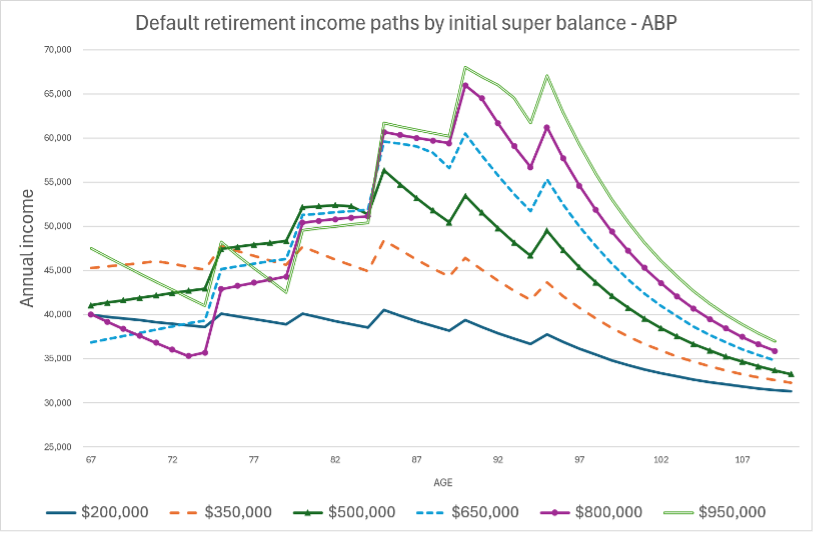
Figure 1: Assuming no other assets, no inflation and investment returns of 3%. The steps come from changes to the minimums and the slope between steps from the drawdown rate being higher than the assumed investment returns.
The obvious solution is to abolish the asset test, converting assets into income using life expectancy and then applying the income test. This would straighten the lines in Figure 1. It would increase Age Pension payments and I do not want to suggest an even more generous treatment of wealthier retirees. The change could however be balanced by including a portion of the family home in the income test. This could eliminate another distracting calculation and discussion – and distortion in the housing market .
Work bonus
While it did not come up specifically in my interviews, working after retirement age produces another unfair distortion that advisers need to consider. The problem is that the claw back of the Age Pension and tax on earned income can lead to effective marginal tax rates (EMTRs) of over 100%. The current work bonus addresses this issue, but is only partly effective, and is complicated beyond measure. It could be abolished if the EMTR was capped at 50% by adapting the income test to give credit for tax paid. [1] The Seniors and Pensioners Tax Offset (SAPTO) could then also go.
Policy settings should distinguish between people if their needs and other circumstances are materially different. Materiality is debatable, but as an indication in this context, we can consider the ratio between the consumption needs of couples and singles. Arguments can be made for ratios between 1.32 and 1.6, which suggests that it is difficult to get closer than 10% of a precise measure of need. Using this measure, one can identify a number of benefits and tax provisions that distract from better retirement planning and could be abolished.
Supplements
Given also that money is fungible [2] , one benefit or tax concession can effectively be replaced by another. Applying a 10% materiality threshold to allowances, suggests that the Pension Supplement, Energy Supplement, Pensioner Education Supplement, Pharmaceutical Allowance, Telephone Allowance, Remote Area Allowance and Essential Medical Equipment Payment can all be abolished. They range from $37 per quarter to $86 per fortnight. The savings could be incorporated into the basic Age Pension.
Contributions
For superannuation tax contribution concessions, the materiality should apply over a lifetime rather than year by year – given that people only see the benefit in retirement. This would mean abolishing the Government Co-Contribution for Low Income Earners, the Spouse Contribution, opportunities to carry-forward or bring-forward contributions and the Division 293 tax on some people with combined income and concessional contributions of over $250,000.
An exception can perhaps be made for the Low Income Superannuation Tax Offset (LISTO). While it is largely immaterial, without it, people on lower incomes will need to be warned that they will pay more tax if they contribute extra to superannuation. It is one allowance that simplifies advice.
Means tests
For the means tests, the $15,000 exemption for funeral bonds can be removed. While limits on gifting are necessary to protect the integrity of the means tests the current $10,000 annual limit and $30,000 rolling five-year limit add complexity. A simpler approach may be to replace these with a single annual gifting limit.
Other taxes
Tax on the taxable component of superannuation death benefits paid to recipients who are not death benefit dependants for tax purposes is material, but complicates estate planning and is only paid by the ignorant and those who die suddenly – which are strange criteria to apply.
The general tax rate of 15% on investment earnings in the accumulation phase, the Division 296 tax on large balances and the transfer balance cap are also material. The last two could however be combined into a single tax of 30% on realised income on balances over a specified threshold in between the two thresholds currently applied.
Conclusion
There are other possibilities in the administration of the means test, charging for aged care and grandfathering rules. The above examples of unnecessary complexity do illustrate what governments could do. But governments’ actions are constrained by their political capital, which depends as much on public opinion as on the opposition. Just as politicians have a responsibility to consider the interests of their constituents, the superannuation industry has a responsibility to look beyond its defence of each small concession to the wider interests of its members. The narrative we need to encourage is that complexity with an immaterial impact is a real burden to everyone.
Proposals emerge from time to time to abolish superannuation . If we do not lose some extraneous bathwater, we may end up losing the baby.
This a summary of a longer paper presented to the Actuaries Summit earlier this year. The author thanks the Orford Foundation for sponsoring the research through the IRIS Knowledge Hub at the University of New South Wales.
[1] Possible tax refunds could be paid to Centrelink to prevent the EMTR falling below 50% to limit the cost of this concession.
[2] Lovely word from economics meaning that one dollar or tax or financial benefit can be replaced by another dollar.
The views expressed in this article are those of the author(s) or working group named below, and do not necessarily reflect the views of the Actuaries Institute. This work is licensed under a Creative Commons Attribution-NonCommercial-No Derivatives CC BY-NC-ND Version 4.0.

From superannuation policy to retirement income strategy, explore our latest analysis on the system Australians rely on
Subscribe to Actuaries Digital for free and receive the latest actuarial analysis, research, and commentary direct to your inbox