This series has examined the data challenges facing superannuation funds and the case for Modern Data Platforms (MDPs) as the architectural response. Part 3 moves from theory to practice.
MDPs provide funds with a secure, scalable and unified environment to manage, process and analyse vast volumes of data — built on key layers that collectively support better decision-making, operational efficiency and regulatory compliance. Here's how those layers fit together, and how funds can implement them.
Key layers of MDP
- Data storage and processing: Secure, flexible and cost-effective data storage.
- Data warehouse: works best with structured data and where the use cases are data analysis and reporting
- Data lake: suitable for both structured and unstructured data and ideal for streaming, AI/ML initiatives
- Data lakehouse: combines the features of data warehouse and data lake and offers a unified platform for various workloads
- Data ingestion: ETL (Extract, Transform, Load) or ELT (Extract, Load, Transform). Can be done using data pipelines and data ingestion tools.
- Data transformation and modelling: Involves taking raw data and conforming it into more useable format ready for analysis and reporting. This includes data profiling, data cleaning and data modelling.
- Data advanced analytics: Applies Artificial Intelligence (AI) and Machine Learning (ML) in analytics to generate data-driven insights, helps optimise operations and mitigate operational risks.
- Data observability: To fully understand the health of the whole data ecosystem, monitoring data performance, enhancing reliability and maintaining compliance.
Examples of key layers of Modern Data Platform and select vendors
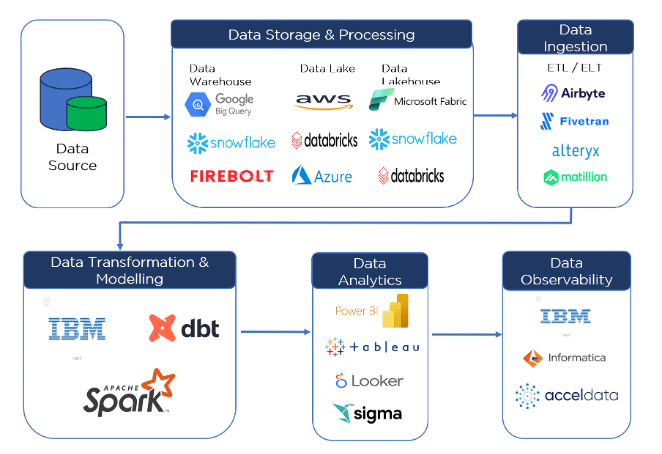
The above diagram illustrates example layers of a modern data platform and a selection of representative vendors. It is provided for illustrative purposes only and does not represent an exhaustive list of technologies or providers.
A practical roadmap for implementation
Implementing an MDP requires a structured approach that balances technology, people and processes. The implementation roadmap typically consists of sequential and parallel stages, from assessment and planning through architecture design, data governance and integration, to analytics enablement, testing and go-live. Each stage involves critical tasks such as defining business objectives, establishing data governance policies, migrating and validating data, configuring platform components and training users.
Modernising a fund’s data environment is a journey that requires careful planning and phased execution. Below is a 10-phase, high-level roadmap example to guide the process.
Phase 1: Establishing your data strategy
- design an enterprise data strategy that aligns and supports the business strategy, visions, and goals
- establish key data initiatives that deliver value and strengthen business case and funding
Phase 2: Assessment and planning
- conduct a comprehensive data maturity assessment to identify gaps and risks
- evaluate AI readiness to drive innovation while building strong data foundations
- define scope and success metric
- assess existing infrastructure and data sources
Phase 3: Architecture and design
- define target data architecture
- decide on cloud versus on-premises or hybrid
- understand and assess the right type of operating model for the business (i.e., centralised, dispersed, centre of excellence)
- market scan based on MDP evaluation criteria to find the best fit for purpose solution
- support establishing the chosen operating model
- select MDP tools, platforms and integrations
- establish a reference architecture, high-level design on how to build and implement MDP solution
- establish governance and oversight forums and committees
- define data governance framework
Phase 4: Data governance and strategy setup
- establish data and AI governance policies and standards
- define roles, responsibilities and accountability
- design metadata management, master data management and data quality processes
Phase 5: Data integration and migration
- identify and prioritise data sources
- design and implement ETL/ELT pipelines
- deploy centralised storage and automated ingestion pipelines
- migrate high-priority datasets, beginning with those needed for regulatory reporting
- migrate historical data to the MDP
- test data quality and consistency
Phase 6: Platform development and configuration
- configure MDP components (storage, processing, analytics tools)
- set up user access controls and security frameworks
- implement monitoring and logging
Phase 7: Analytics, reporting and AI enablement
- build dashboards, reports and self-service tools
- implement AI/ML models if applicable
- test and validate insights
- train users on analytics and self-service features
- launch advanced analytics initiatives and AI pilot programs, such as personalised retirement tools
- implement real-time observability dashboards to monitor data quality and performance
- conduct scenario-based stress testing to model market shocks and liquidity risks
Phase 8: Testing and validation
- conduct system testing, integration testing and performance testing
- validate data accuracy, lineage and quality
- user acceptance testing (UAT)
Phase 9: Change management and training
- develop training materials and programs
- conduct workshops for business users and IT staff
- communicate benefits and usage guidelines
Phase 10: Go-live and support
- deploy MDP to production
- monitor performance and usage
- provide ongoing support, optimisation and iterative improvements
- refine governance frameworks as regulations and member needs evolve
- introduce new, data-driven services such as proactive fraud detection and member lifecycle insights
- use data to assess uptake of platform, improve and adjust based on performance, useability and more.
Building the future of superannuation through data
The superannuation industry is entering a transformative decade. As funds consolidate and grow to unprecedented scale, their ability to manage data securely and intelligently will define their success.
An MDP can serve as a supporting foundation for this transformation. It enables funds to meet regulatory demands, enhance cybersecurity, deliver personalised member experiences and help identify new opportunities for innovation.
By unifying data, embedding security and enabling real-time insights, an MDP allows funds to:
- deliver faster, more accurate regulatory reporting
- protect members from cyber threats
- personalise services at scale
- Contribute to new capabilities like predictive analytics and AI.
Funds are taking different paths toward a future shaped by transparency, agility and member-focused innovation — but the underlying requirement is the same. Those that invest in modern data infrastructure now will be better positioned to navigate the complexity, competition and change that lies ahead. This series has outlined why, what, and how. The funds that act on that foundation will be the ones best placed to serve their members through the decade ahead
The views expressed in this article are those of the author(s) or working group named below, and do not necessarily reflect the views of the Actuaries Institute. This work is licensed under a Creative Commons Attribution-NonCommercial-No Derivatives CC BY-NC-ND Version 4.0.