Superannuation and Investments
Risk Management
Health
The car park decision: How the Aged Care Working Group aims to make a difference




Claim your CPD points
Presenters Georgina Hemmings, Alfie Qiang, Candice Ming and Qiao Zhou discussed how small changes using information that already exists could improve the navigation path for consumers, while Catherine Nance emphasised simplification to means testing to improve the consumer experience. Lastly, Anthony Asher covered how actuaries can apply their toolkit to shaping the financial sustainability of aged care providers.
Alas, we are not immortal [1] , and at some point, many of us will face this for a family member or ourselves: support with daily living to remain at home, seek independent living in a retirement village or transition into residential aged care in the final years. Around half of older Australians will eventually move into residential aged care [2] , entering on average at 85 years [3] and staying on average between two to three years [4] . Residential Aged Care is complicated, and people seeking support will usually need help.
The 2021 Royal Commission [5] has driven improvement, particularly on quality of care and the rights of older Australians. Mandated patient care minutes have increased, provider compliance has been strengthened, and wages have risen. Whilst these changes are positive, they have put further pressure on a sector that is already fragile. More than 60% [6] operate at a loss, many are small-medium sized providers (three of five providers operate a facility with less than 100 operational beds [7] ), and 59% of the sector is not-for-profit. [8]
Unlike superannuation, insurance and health, actuaries do not typically work in the aged care sector but have useful skills and expertise. As such, the Institute established the Aged Care Working Group this year, with the aim of building experience and informing policy, coupled with the hope of making a difference to aged care in Australia.
The first round of work has focused on Residential Aged Care and where actuarial skills transfer directly: the consumer experience, means testing and provider resilience. A particular area of focus was the My Aged Care Portal . This is the Australian Government’s central portal for accessing all funded aged care services, providing information, eligibility assessments and referrals to approved providers.
Start with the consumer, not the system

My Aged Care hospital navigation infographic
Consider an 80-year-old living alone who falls at night and arrives in emergency with a broken hip.
Searching the My Aged Care portal for help returns a case about a planned hip replacement (not the same), guidance on planning ahead (too late), material on in-home services (not clear if he is returning home) and links to many other topics (including downloadable booklets on services he may never access). In short, there is a large amount of information but a labyrinth [9] to navigate to get the right help. The challenge is that each of us are unique and so there are infinite paths and levels of urgency for aged care support. One can’t cater to all the paths, so it is more useful to facilitate the navigation, particularly how to start and key questions to focus on, to assess costs, care and quality.
Several practical enhancements identified include:
Simplify aged care means testing
Aged Care costs flowchart infographic
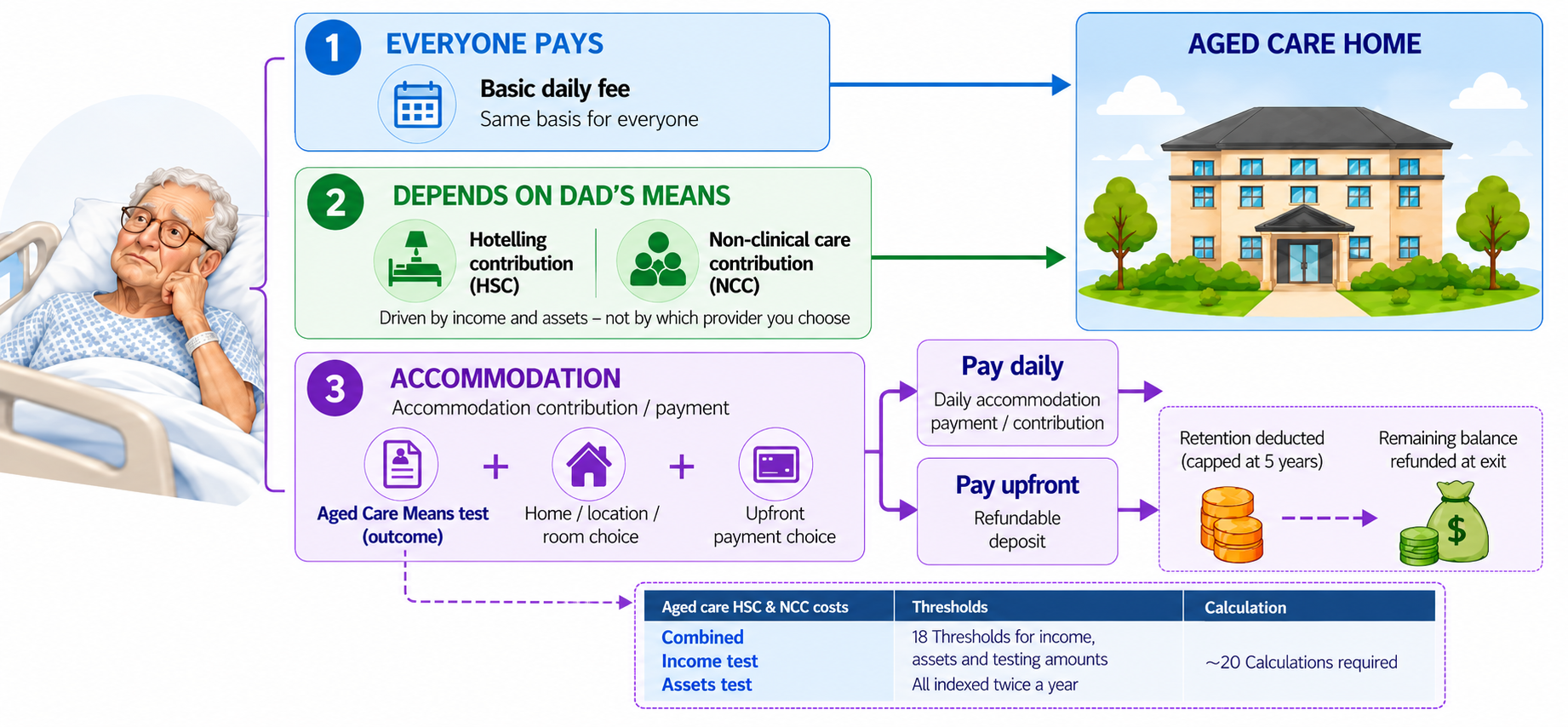
Costs add another layer of complexity. Residential aged care fees consist of four main components (the basic daily fee, hotelling supplement contributions, non-clinical care contributions, accommodation costs).
However, what the resident ultimately pays depends on eligibility for government support, personal financial circumstances and the aged care home chosen.
Government support is means-tested. The Age Pension means test is one income test and one asset test. Aged care combines both, running roughly 20 calculations and 18 thresholds indexed twice yearly, underpinned by five legislative instruments. The calculation is complex, and the My Aged Care portal models a single scenario with no capacity for “what ifs”.
Further, selling a home, or paying a larger up-front refundable accommodation deposit can change both aged care contributions and Age Pension entitlements.
In addition, the current My Aged Care tools produce cost estimates for aged care homes that look precise but lack the ability to account for these nuances, thus showing misleading cost comparisons. In one worked example [10] , a government supported accommodation resident contributing $200,000 upfront could pay around $86 a day rather than the $223 shown in My Aged Care and the same $86 a day across all three shortlisted homes, which immediately shows that room price is not a differentiator.
The Working Group propose:
At this stage, there is no solvency requirement for aged care providers in Australia. However, there is a recently introduced liquidity requirement, and the Government monitors the financial strength of providers, but solvency is not easy to evaluate.
Providers hold substantial property assets, but they are valued inconsistently in accounts and so it is not clear how much capital they hold as a buffer against losses.
They have significant refundable accommodation deposit liabilities that are repayable after residents leave, so are vulnerable if they cannot find residents who can replace the deposits.
These refundable accommodation deposits are guaranteed by the Government, but the sector is exposed to the Government levying the industry for the losses.
Property values (captured at adjusted book value or historical cost) may not provide a useful picture of an operator’s ability to withstand stress, while common earnings-based valuation approaches may be poorly suited for not-for-profit providers; i.e. the sector’s Earnings Before Interest, Taxes, Depreciation, Amortisation, and Restructuring or Rent (EBITDAR) approach tends to understate the business.
A more forward-looking approach to financial resilience should explore:

The first round of work has deliberately been practical. Refitting information in existing tools and simplifying the means test.
The Working Group has begun engagement with government and regulators to take these findings forward, while continuing to identify further areas of work.
And the car park decision?
The 80-year-old mentioned earlier is your father who has had a fall and cannot go home and you are standing outside trying to find somewhere for him to live. Anything that makes that experience less bewildering is worth doing.
This article is based on the presentation given on 3 September 2026.
Working group members: Georgina Hemmings, Alfie Qiang, Candice Ming, Qiao Zhou, Anthony Asher, Geoff Keen, Kim Cossart, Alice Chau, Margaret Kerr, Nirosana Maheswaran, Cecilia Li, Catherine Nance
[1] One of the writers recently watched The Odyssey and now has Greek methodology on the brain.
[2] Cooper-Stanbury, M. (2025), "Regional Variation in Lifetime Probability of Admission to Residential Aged Care in Australia," Journal of Aging and Health
[3] AIHW GEN Aged Care Data - Admissions into age care, 2024-25
[4] AIHW GEN Aged Care Data, People leaving aged care, 2024–25; AIHW, Australia's Welfare: Aged care, 2025.
[5] The Royal Commission into Aged Care Quality and Safety
[6] StewartBrown, Residential Aged Care Financial Performance Survey Report, March 2026.
[7] AIHW GEN Aged Care Data – Providers of age care, at 30 June 2025
[8] AIHW GEN Aged Care Data – Providers of age care, at 30 June 2025
[9] On labyrinths, see Ariadne’s String.
[10] Shaping the Future of Aged Care: Insights and Priorities for Reform, Actuaries Institute Insights presentation 3 September 2026, page 36.
The views expressed in this article are those of the author(s) or working group named below, and do not necessarily reflect the views of the Actuaries Institute. This work is licensed under a Creative Commons Attribution-NonCommercial-No Derivatives CC BY-NC-ND Version 4.0.


From superannuation policy to retirement income strategy, explore our latest analysis on the system Australians rely on
Subscribe to Actuaries Digital for free and receive the latest actuarial analysis, research, and commentary direct to your inbox