Superannuation and Investments
Who wants to live forever?



Claim your CPD points
When Brian May penned these words for the soundtrack to Highlander he captured the emotional cost of immortality, particularly when faced with mortality of those we love.
For any person who has been a long-term carer for someone in the advanced stages of life, you know the practical reality of longevity risk. You understand the invisible cost of being the person who makes sure the wheels keep turning. You know what longevity risk means for those who are left behind.
The concept of a Retirement Trilemma acknowledges the trade-offs between the objectives of the Retirement Income Covenant. [1]
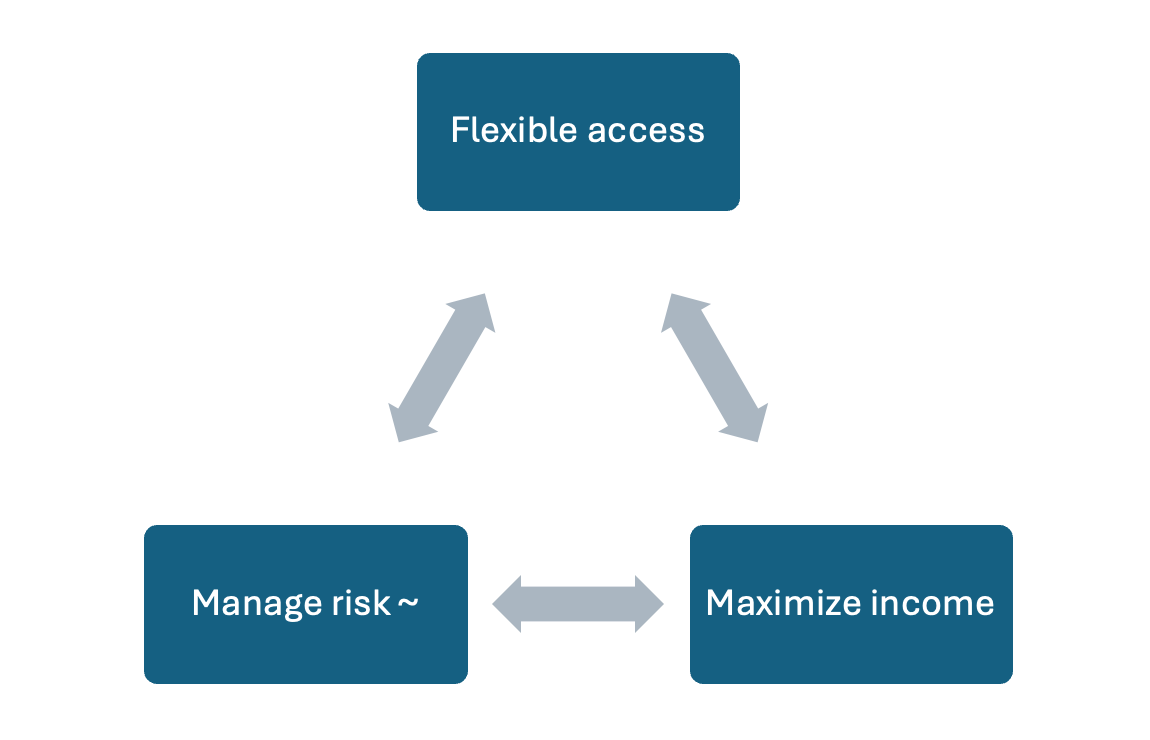
Figure 1. The Retirement Trilemma[2]
~ While the primary focus is managing longevity, investment, inflation and sequencing risks, other factors, for example cognitive decline or a change in Government policy can quickly change needs and outcomes.
In my previous article, The Goldilocks Dilemma , I discussed how the trade-offs and appetite for risk, need to be at the heart of decision-making at each stage of the product development cycle. I emphasised how this starts with understanding your customer.
I have since spoken with some people who share similar views. This gives me some confidence that I’m moving in a positive direction – safety in numbers!
As I road test my ideas, I recently had a conversation with a brilliant actuarial mind who explained to me the difference between science and engineering.
So, here’s my attempt at applying the science of longevity literacy to engineering a product solution that has commercial value.
Orford and Huppert (n.d.) from Optimum Pensions emphasise the importance of longevity literacy to the extent that they view it as a critical, but often missing, element of developing a retirement plan. [3] In subsequent publications, Optimum Pensions is compelling in its argument about the importance of understanding your personal time horizon and has developed a tool, The Lifespan Calculator, to assist with this process. [4]
The concept of longevity literacy is a natural extension to highlighting the importance of financial literacy in decision-making. This is grounded in informed consent.
As an example, Driver, Brample, Freudenberg and Hunt (2025) attribute Australia’s underinsurance problem to an absence of insurance literacy. [5] This study reminds me of the – perhaps - overlooked value that financial advisers played in helping the life industry with cross subsidy by promoting the sale of insurance products.
To answer my question, I tasked Microsoft Copilot with designing a questionnaire to understand tolerance for longevity risk. You might view this as using artificial intelligence (AI) to assemble a team of actuarial analysts.
I must acknowledge my Copilot AI actuarial team for the quality of their deep dive and quick turnaround time!
Taking you through my journey, the Copilot AI team explained that we must go beyond traditional volatility questions to focus on preferences and trade-offs. I do wonder if AI just mirrored back to me comments I had made in our virtual chats in the past.
However, to my surprise, one of my AI team mentioned a Retirement Income Style Awareness (RISA) framework.
I took on responsibility to investigate this further and learned RISA is trademarked but the 6-page questionnaire is available for self-assessment through a free subscription. [6]
Collectively, my Copilots consolidated ideas and proposed a list of multi-choice risk assessment questions. Sources were diligently acknowledged so I could fact check. It was simple but elegant – the best solutions usually are!
Actuaries, like other professionals, are trained to consult with their peers. We also have the responsibility of training our actuarial analysts.
Microsoft Copilot, along with other AI tools are incredibly useful but, like overseeing our analysts, experienced professionals play a critical role in applying judgement.
One of the most powerful questions that you can ask is “so what?” because it forces a discussion about outcomes.
The “so what?” for me is trying to help customers improve their longevity literacy so they can make informed choices when it comes to their retirement strategy. These insights then pave the way for a bottom-up approach to product design that is grounded in customers’ needs and preferences.
This questionnaire is the start of my journey to engineer a solution that helps customers understand themselves, so they feel confident in their product choices in retirement. I envisage that a questionnaire of this nature could be used by both human advisers and providers developing digital solutions to support their customers navigating retirement.
| Question | a) | b) | c) | d) |
| How confident do you want to be that your retirement income will last your whole lifetime? | I don't want any risk of running out, even if this means my income might be lower. | I'm conservative but am willing to take some risk to increase my income. | I want to balance income security with potential growth in my funds. | My priority is maximum growth and liquidity, meaning I am comfortable with the risk of possibly running out of money. |
| How would you prioritise your retirement income objectives? | I want peace of mind that my basic expenses will be covered by a guaranteed income source. | I want to know that my income will keep pace with the rising cost of living. | It is important to me to leave money to my heirs. | I want to have flexibility so I can access large withdrawals if something unexpected happens. |
| If you run out of money in your 90s, how would this affect you? | This would be catastrophic as I would be forced into a low-cost lifestyle or would become dependent on others. | The impact would be significant as I would need to severely cut back on my lifestyle. | This is manageable for me as I have a fallback plan, such as downsizing or getting help from my children. | This is very unlikely to happen to me because I have multiple sources of income. |
| How do you feel about giving up possible high investment growth in exchange for a guaranteed, lifelong income stream? | I prefer a guaranteed income stream, even if I miss out on high market returns. | I want it all but acknowledge this means a combination of part guaranteed, part invested. | I prefer to retain control, meaning I choose investments, manage my own drawdown, and accept the risks involved. | I value the security of guaranteed income but want to get, at least, my initial investment back. |
| Which of these scenarios scares you more? | Living independently at 90+ but having no money left. | Missed opportunities because I lived too conservatively. | Dying shortly after retiring with a huge, unspent fortune. | Having someone else make decisions for me about where I live and my finances. |
| What is your perspective on health and longevity? | My family lived long and healthy lives, so I expect the same for myself. | I am in average health and expect to have an average life expectancy. | I have health issues and do not expect to live a long life. | I haven't thought about how long I might live and don't know my life expectancy. |
| Have you considered how you would fund future long-term aged care expenses? | Yes, I have insurance or a specific pool of funds set aside. | When the time comes, I'll use what is left of my retirement savings. | I think social security, like the age pension, will be enough to cover the cost. | No, I haven't planned for this and will think about it later. |
The key sources used by Copilot to formulate these questions include Murguia and Pfau (2022), [7] National Seniors Australia and Challenger (2013), [8] [9] and AllianzRetire+ (2025). [10]
I haven’t presented all the results collated by Copilot as I’ll leave it to you to engage your own team of AI actuarial analysts with this task. I have also made some adjustments to Copilot’s output while retaining the sentiment intended by the original source.
The science of longevity literacy is important for helping customers understand their planning horizon.
A questionnaire, like the one proposed in this article, is a potential way to engineer a solution that helps customers understand their needs and preferences so they can choose products with confidence.
This raises the question of how responses translate to understanding preferences for accepting, reducing, removing or transferring risk.
This brings me to the next step in my business case which is developing “cohorts” with reference to trade-offs and risk profile and designing retirement solutions tailored accordingly.
Clarity from providers about how their products balance the trade-offs of the Retirement Trilemma for “cohorts” could help customers navigate the system with more confidence.
Further, Deloitte’s Retirement Solutions Assessment Framework [11] and Saliba’s (2025) application of it [12] might be the bridge that I’m looking for to engineer the next step.
Ultimately, it is about bringing this all together for the customer.
No budding engineer wants their project to end up in a sinkhole! I welcome feedback and discussion about my emerging business case.
[1] Boal, A., & Saliba, A. (2022, 2 May). Retirement trilemma: Borrowing ideas from beyond financial services. Deloitte Australia. https://www.deloitte.com/au/en/Industries/investment-management/blogs/retirement-trilemma-borrowing-ideas-beyond-financial-services.html
[2] Consult Hub. (n.d.). Best practice principles – superannuation retirement income solutions. https://consult.treasury.gov.au/c2025-685228
[3] Huppert, S., & Orford, D. (n.d.). The missing piece: Longevity awareness and your retirement plan. Optimum Pensions. https://optimumpensions.com.au/the-missing-piece-longevity-awareness-and-your-retirement-plan/
[4] Optimum Pensions. (n.d.). Lifespan calculator. https://www.optimumpensions.com.au/lifespan-calculator/
[5] Driver, T., Brimble, M., Freudenberg, B., & Hunt, K. (2025). Getting personal about personal insurance. Financial Planning Research Journal, 11 (1). https://reference-global.com/article/10.2478/fprj-2025-0003?tab=article
[6] Retirement Researcher. (n.d.). Take the RISA®: Retirement Income Style Awareness. https://retirementresearcher.com/landing/risa/
[7] Murguía, A., & Pfau, W. D. (2022, December). Risk tolerance questionnaires and retirement income concerns (Research Paper No. 018C-2022). Alliance for Lifetime Income, Retirement Income Institute. https://www.protectedincome.org/wp-content/uploads/2022/12/RP-18C_Murguia_Pfau_Dec_v3.pdf
[8] National Seniors Australia & Challenger. (2013, March). Retirees' needs and their (in)tolerance for risk. National Seniors Australia. https://nationalseniors.com.au/uploads/130301_NationalSeniorsResearch_Challenger_RetireesToleranceRisk.pdf
[9] National Seniors Australia & Challenger. (2012, December). Seniors sentiment index. National Seniors Australia. https://nationalseniors.com.au/uploads/121201_NationalSeniorsResearch_Challenger_SeniorsSentimentIndex_0.pdf
[10] AllianzRetire+. (2025, April). CPD: A new approach to assessing risks in retirement. Adviser Voice. https://www.adviservoice.com.au/2025/04/cpd-a-new-approach-to-assessing-risks-in-retirement/
[11] Boal, A., Freeborn, S., Merten, A., & Saliba, A. (2023, 17 February). Retirement solutions assessment framework. Deloitte Australia. https://www.deloitte.com/au/en/Industries/financial-services/analysis/retirement-solutions-assessment-framework.html
[12] Saliba, A. (2025). How to consider retiree preferences in retirement solutions. https://www.linkedin.com/posts/anthonyjsaliba_it-is-widely-acknowledged-that-a-solid-understanding-activity-7345958140711997440-0L9i/?utm_source=share&utm_medium=member_ios&rcm=ACoAAAICFF0BQF0kP0Ia7dEJB93TcMUf0U1IawM
The views expressed in this article are those of the author(s) or working group named below, and do not necessarily reflect the views of the Actuaries Institute. This work is licensed under a Creative Commons Attribution-NonCommercial-No Derivatives CC BY-NC-ND Version 4.0.

From superannuation policy to retirement income strategy, actuaries help shape the system Australians will rely on. Explore our latest analysis.
Receive industry-leading perspectives, straight to your inbox.