Superannuation and Investments
Life expectancies: The missing assumption in retirement income strategy



Claim your CPD points
The Retirement Income Covenant has challenged superannuation funds to move beyond accumulating balances and towards helping members achieve better retirement outcomes. Trustees are investing in more sophisticated retirement guidance and innovative retirement income products. Yet one critical assumption often remains surprisingly generic: how long members are expected to live.
Most retirement projections still rely on a single set of life expectancy assumptions applied across an entire membership. While convenient, this approach overlooks one of the most important realities of retirement: Australians do not all experience the same longevity.
Research over many years has consistently shown that mortality varies with socioeconomic circumstances. Wealthier Australians tend to live longer, while those with fewer financial resources generally experience shorter life expectancies. Despite this evidence, translating these differences into practical mortality assumptions for retirement modelling has remained a challenge due to a lack of member data.
At this year's Actuaries Institute’s Superannuation and Investments Exchange, I will present a practical use for differentiated mortality assumptions framed around Age Pension eligibility.
The framework recognises that Age Pension eligibility reflects underlying wealth, making it a natural basis for segmenting retirees into cohorts with different life expectancies.
Bingley et al. (2025) have indeed demonstrated that wealth is the best socioeconomic mortality predictor in the absence of individual health data (which no super fund holds). Hence a wealth-based indicator such as Age Pension eligibility measure, is possibly the single most potent predictor of mortality for an institution with limited member data.
Rather than relying on a single generic life expectancy, retirement projections can better reflect the characteristics of the members they are intended to serve.
The approach builds on the 2018 Exploring Retiree Mortality dialogue paper , the Australian Government Actuary's Life Tables by Relative Socio-Economic Advantage and Disadvantage and most recent Australian research by Huang et al. (2025) on socioeconomic mortality differentials. Together, these studies provide the evidence needed to move from recognising mortality differences to incorporating them into practical retirement modelling based around Age Pension eligibility.
The presentation will propose five retiree cohorts, from retirees who are unlikely ever to receive the Age Pension through to those who qualify for the full pension at retirement.
Their life expectancies have broad applications across retirement income strategy. They can improve projections of retirement income adequacy, sustainable drawdown rates, and assessing the value delivered by lifetime income streams to different groups of members.
The insight session presentation will discuss a case study showing how life expectancies by cohorts framed around Age Pension eligibility, such as those in the graph below, can inform the calculation of the member value of a lifetime income stream.
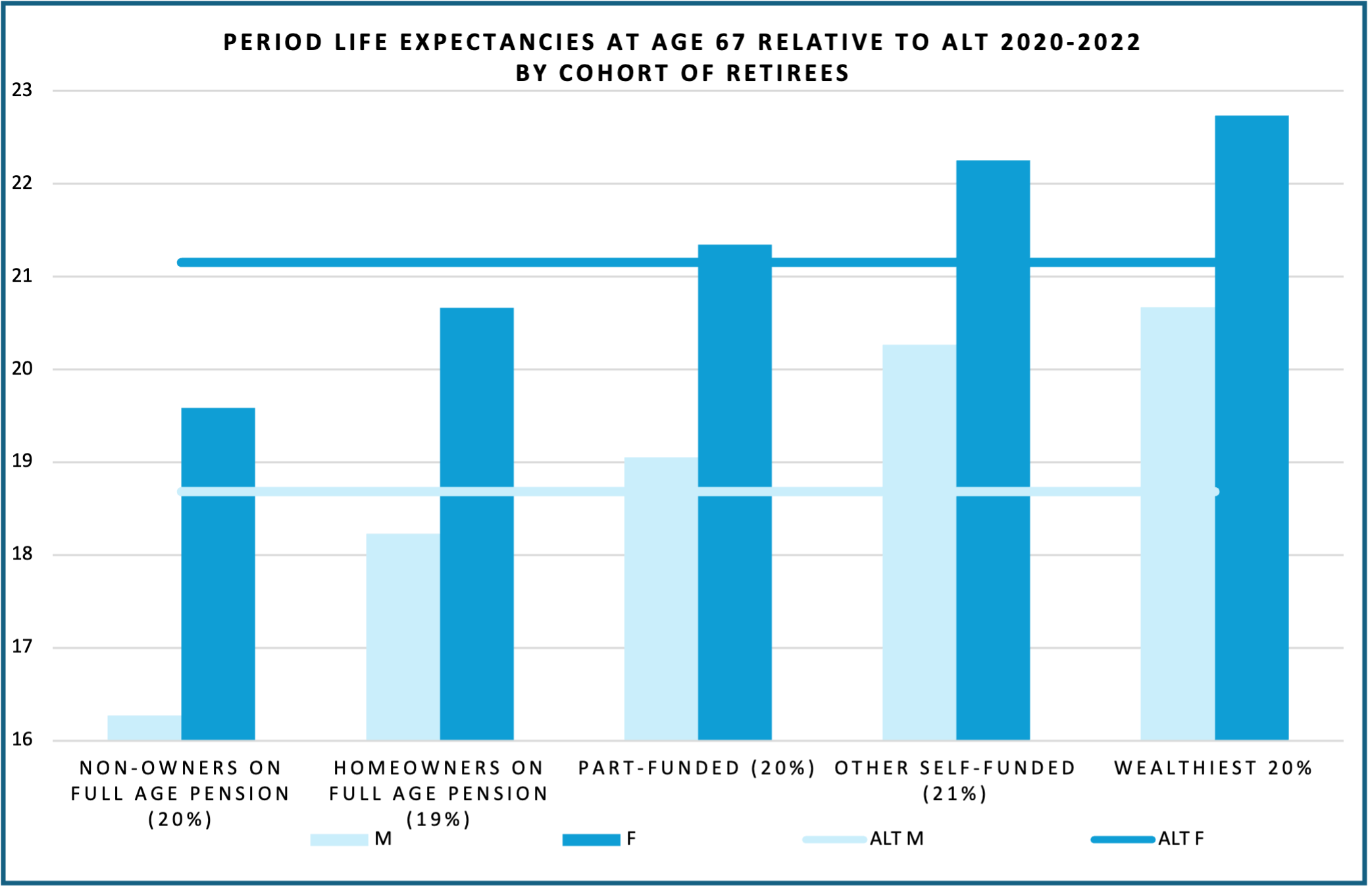
Period Life Expectancies at Age 67 Relative to Alt 2020-2022 by Cohort of Retirees
If you are interested in retirement income strategy, longevity research or retirement product design, I hope you can join the discussion at the Insights Session on Tuesday 1 September. I look forward to seeing you there.
Insights Session: Superannuation and Investments Exchange
References:
Australian Government Actuary. (2021). Life tables by relative socio-economic advantage and disadvantage.
Bingley, P., Kreiner, C. T., & Serena, B. L. (2025). Socioeconomic inequality in longevity: A multidimensional approach (CESifo Working Paper No. 12249). CESifo.
Huang, F., Hui, F., & Villegas, A. (2025). Towards fairer retirement outcomes: Socio-economic mortality differentials in Australia. Paper prepared for the Actuaries Institute 2025 All-Actuaries Summit.
Actuaries Institute. (2018). Exploring retiree mortality. Dialogue paper.
The views expressed in this article are those of the author(s) or working group named below, and do not necessarily reflect the views of the Actuaries Institute. This work is licensed under a Creative Commons Attribution-NonCommercial-No Derivatives CC BY-NC-ND Version 4.0.

From superannuation policy to retirement income strategy, explore our latest analysis on the system Australians rely on
Subscribe to Actuaries Digital for free and receive the latest actuarial analysis, research, and commentary direct to your inbox