Career and Leadership
Data for good: how actuaries helped six charities solve real problems



Claim your CPD points
Over two months, volunteer actuaries stepped in to change that, turning scattered and incomplete data into tools six charities can put to immediate use.
The Actuarial Hackathon is an annual Actuaries Institute initiative that pairs volunteer actuaries with charities and not-for-profits facing a genuine data or analytical problem. Over two months, teams work in their own time to turn scattered, incomplete or inconsistent data into a practical tool the organisation can use, from dashboards and calculators to evidence bases and scoring frameworks. It gives volunteers, many of them early-career actuaries, a hands-on way to see the impact of their skills beyond a traditional brief.
This year's six partner organisations were You Can Sit With Me, the Community Council for Australia, Justice Connect, the Brave Foundation, Save the Children Australia and WWF-Australia.
You Can Sit With Me wanted its Respect Check dashboard to do more than show national trends. The team, David Dingsdag, William Tan and Dang Tung Vo, designed a secure, segmented login so individual schools can view their own results and benchmark against national and regional averages, giving each school a confidential read on how it's tracking.
Community Council for Australia set out to build an evidence base on the charity sector's workforce. The team, Luke Viney, Wanzhang Jing, Simon Ong and Elizabeth Baker, built a data register, an ABN-keyed enriched dataset and an interactive analysis covering charities, grants and contract notices across the sector, and reported its findings even where they didn't support the expected story. It proposed a single survey instrument, with several possible paths to the field, to help close the sector's biggest data gaps. As the team put it: risk doesn't disappear when it's transferred, it's absorbed, or passed on.
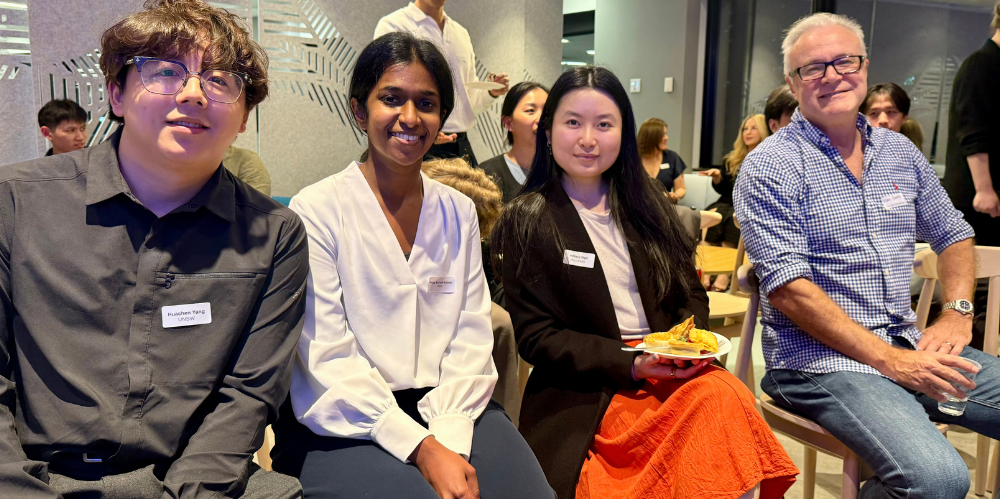
Justice Connect's 'Unlock DGR' team, Priya Surash Kumar, Sasha Konstantinidis, Cody Yang and Adam Allen, examined how Deductible Gift Recipient (DGR) status shapes where donations go. Using an event study of charities that gained DGR endorsement in recent years, the team found a meaningful uplift in donations following endorsement, evidence that broadening DGR access could shift the flow of giving without shrinking the total pool.
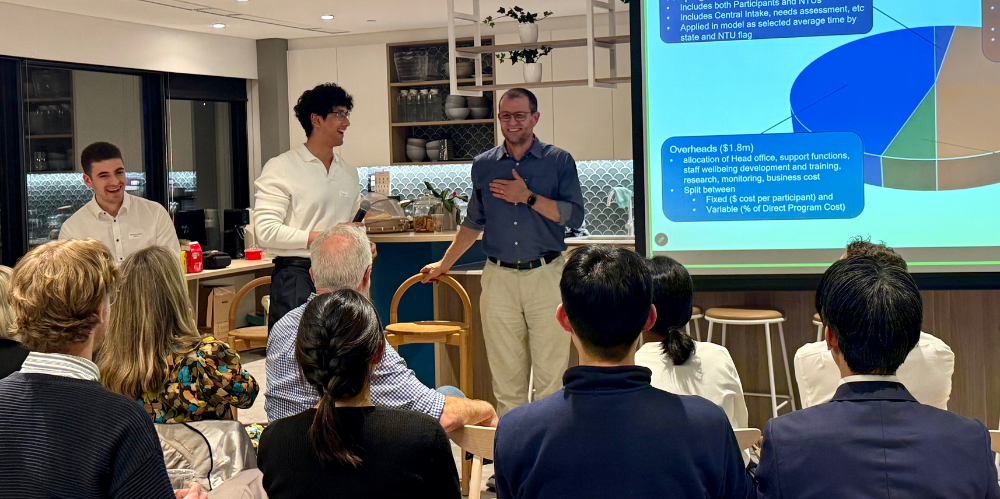
Brave Foundation needed a defensible cost-per-participant figure for its Supporting Expectant and Parenting Teens (SEPT) program to support funding applications and service planning. The team, Jeff Thorpe, Muiz Murad, Sagar Shende, Dilshan Wijesena, Rhys Williams, Marcus Lautier and Sally Kwong, modelled mentor time, travel, overheads and pre-program costs separately, built a predictive model of mentor time by participant characteristics, and delivered a calculator that works at both the individual and whole-portfolio level.
Save the Children Australia, working toward a significant expansion of its impact over the coming years, needed a consistent way to compare programs that operate very differently across geographies. The team, Han Yu, Thomas Ng, Kenneth Chua and Alice Chong, proposed an Impact Score combining “Effective Service Units” (a measure of reach) with an Outcome Factor (depth of change) and a Calibration Factor, giving the organisation a single comparable metric across otherwise very different program types.
WWF-Australia wanted to know which advocacy tactics reliably drive lasting policy change. The team, Jannat Kazi, Emily Van, Konka Hong and Alfie Qiang, scored a range of campaign tracks against a documented rubric, testing hypotheses about combined tactics, early engagement and post-win vigilance. Direct engagement with government departments emerged as the strongest driver of durable change, while public mobilisation was more closely linked to a campaign's adaptability, a finding the team triangulated against independent polling and academic research rather than treating as conclusive on its own.
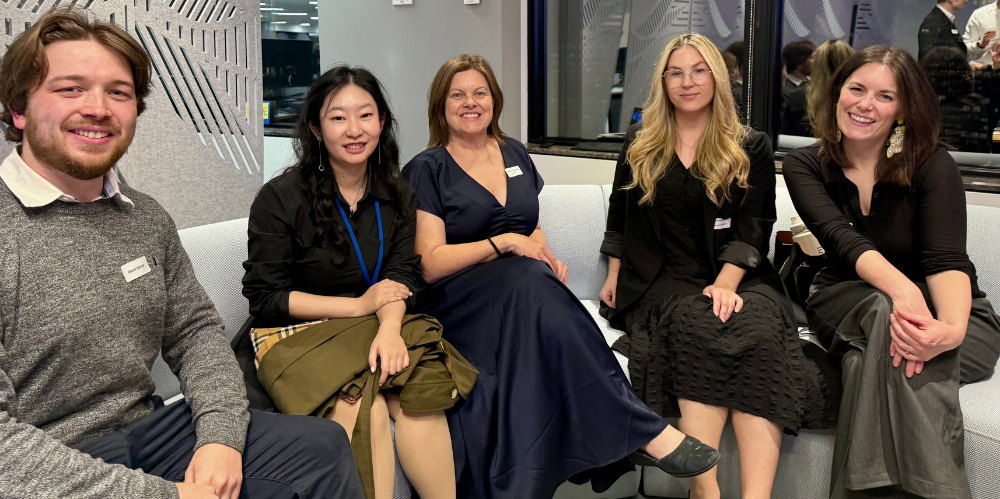
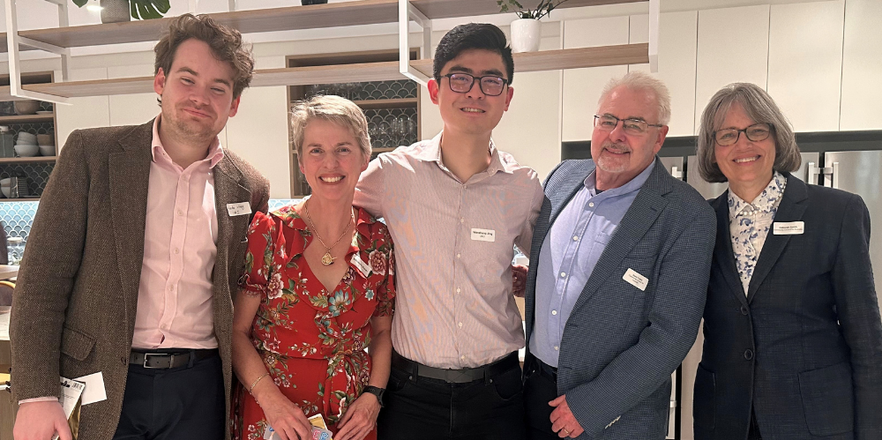
This year's winning team, Luke Viney, Wanzhang Jing, Simon Ong and Elizabeth Baker, worked with the Community Council for Australia.
Six very different charities, six very different problems and the same underlying pattern: none of the data was built to answer the question being asked of it. Someone had to build the structure before any modelling could begin. That's a skill set charities rarely have in-house, and one the actuarial profession has in abundance.
That barrier is also the opportunity. Charities and not-for-profits are sitting on more data than they can use, most of it collected for compliance rather than insight. The Actuarial Hackathon is proof of what happens when actuarial thinking meets that gap, and a sign of how much further it could go. If your organisation has a data problem that doesn't fit a standard actuarial brief, this is exactly the kind of problem actuaries are suited to solve.
Thank you to our 2026 Actuarial Hackathon Organising Committee, Joint Chairs, Cathy Wu and David Dingsdag, Adam Allen, Muiz Murad, Alfie Qiang, Robert Sorbello, Tamlyn Hex, Alice Truong, Kelly Holcroft and Leona Spencer.
The views expressed in this article are those of the author(s) or working group named below, and do not necessarily reflect the views of the Actuaries Institute. This work is licensed under a Creative Commons Attribution-NonCommercial-No Derivatives CC BY-NC-ND Version 4.0.

From career pivots to professional development, explore insights and advice from actuaries at every stage of their career
Subscribe to Actuaries Digital for free and receive the latest actuarial analysis, research, and commentary direct to your inbox