Career and Leadership
Data Science and AI
Actuaries Built to Pivot: The seat, the mode and the cycle



Claim your CPD points
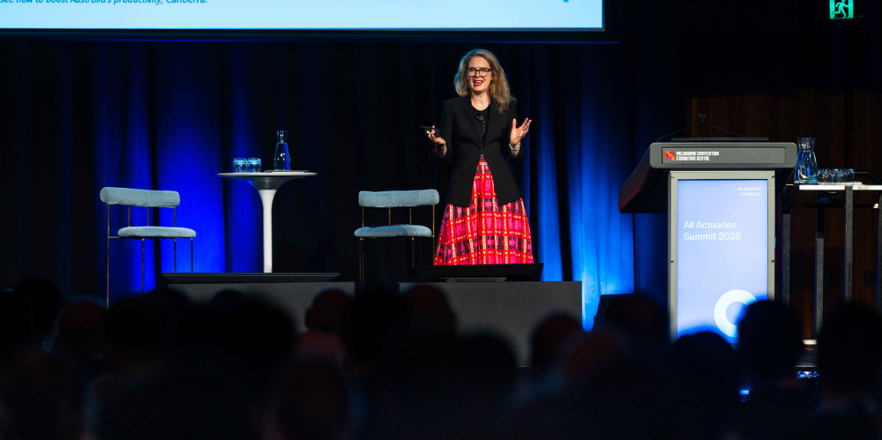
Still, successive Institute presidents have used the Summit stage to encourage the profession to extend its influence further. Karan Anand, Chief Strategy Officer and Managing Director Australia at Hnry, opened his plenary at the 2026 All Actuaries Summit with a provocative reading of that pattern: the gap between trust and influence isn't a marketing problem. It's structural — and the profession already holds the tools to close it.
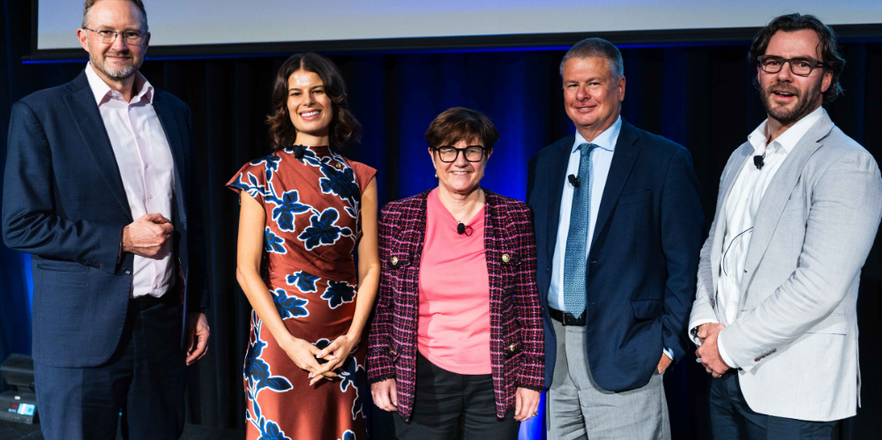
Chaired by Annette King, the session ranged across disruption theory, modes of reasoning and hard-won startup lessons.
Karan Anand's framing drew on Clayton Christensen's The Innovator's Dilemma2: disruptive innovation happens when enabling technology meets a business model that serves customers the incumbents' cost structures had given up on. Hnry, the digital accountancy for sole traders that Karan Anand helped scale into Australia, is a classic disruptor by that test — built one bet at a time, for a market the payments, accounting software and accounting industries couldn't economically serve.
The same lens, he argued, now applies to specialist professions. Actuaries, doctors, lawyers and engineers are the high-margin incumbents of the knowledge economy, and AI is the disruptive technology entering from the bottom. Analysis that once took a smart analyst three weeks can now be done in an afternoon. "Disruption doesn't kill incumbents, it unbundles them," Karan Anand told the audience. It strips away what has commoditised and concentrates value in what hasn't. The question that determines who keeps the seat isn't who holds the credential — it's who has the mode of reasoning AI can't replicate.
Actuarial training excels at two modes of reasoning. Deductive reasoning, rule plus fact equals guaranteed conclusion, underpins compliance and mathematical work. Inductive reasoning, many observations converging on a pattern, drives reserving, pricing and analysis. The second is exactly what large language models do natively, which is why its premium is compressing fastest.
The third mode, abductive reasoning, operates where no stable rule exists and the observations run out: one puzzling situation, and a need to act. Abduction means committing to the best available explanation and designing the test that would kill it. It is the mode boardrooms need most, and the one AI structurally cannot do, because committing under uncertainty is a judgment problem, not a pattern recognition problem.
Karan Anand compressed the cycle into a single question: what would have to be true for this to work, and how would I know if I'm wrong? The second half matters most. If you can't name what would disprove you, you're not doing abduction — you're rationalising.
Two stories from Hnry's Australian expansion showed the question's value in practice.
The first was a year lost. Hnry entered Australia with a proven New Zealand playbook in which recruitment firms were the anchor channel. Nothing converted, because Australian recruitment firms operate as labour hire businesses that deduct tax at source — making Hnry's value proposition moot before the customer ever saw it. Karan Anand's assessment was blunt: he'd have got there twice as fast if he'd asked what would have to be true for the reference class to apply.
The second was the bet that paid. Facing a data gap on sole traders and a fraction of competitors' marketing budgets, Hnry launched an independent research publication, the Hnry Sole Trader Pulse, with kill criteria defined up front. Fourteen editions later, the Pulse has generated hundreds of media articles across Australia and New Zealand, a co-authored report with the New Zealand Retirement Commission and Karan Anand's seat on the Federal Small Business Minister's advisory council. Same operator, different question — asked before committing.
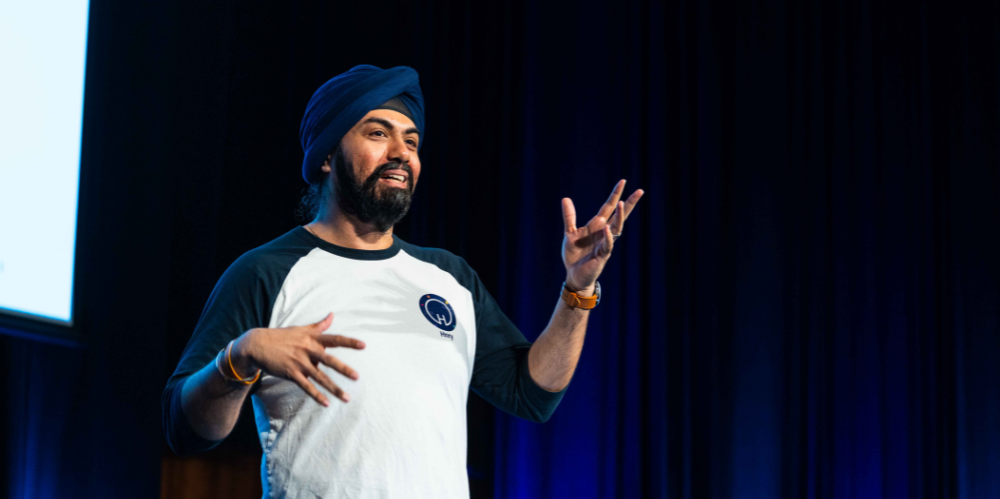
Karan Anand, Chief Strategy Officer and Managing Director Australia at Hnry
None of this requires new tools. The loop Karan Anand described — define the problem, design a test with kill criteria, learn, refine, go again — is the actuarial control cycle, a point he credited Annette King with making in her 2022 presidential address . The profession runs it slowly with high precision because regulated work demands it. The commercial world runs it fast, and mostly badly: Christensen put product innovation failure at 95%. The arbitrage is actuaries running the same cycle at commercial cadence, with the discipline a century of practice has built. The profession has the cycle. The commercial world has the cadence. Almost nobody has both.
In the executive room, that shift is about disposition: lead with the call, then the reasoning, then the caveats. "The people in the room can handle uncertainty," he said. "What they can't handle is ambiguity about what you actually think."
Asked to close with one action, Karan Anand kept it immediate. The next time a non-routine problem lands on your desk, ask: what would have to be true for this to work, and how would I know if I'm wrong? Document the assumptions, design the cheapest test and give yourself permission to be wrong intelligently.
Have a perspective on the themes raised in this session? Actuaries Digital welcomes contributions from Members. Find out more.
References
The views expressed in this article are those of the author(s) or working group named below, and do not necessarily reflect the views of the Actuaries Institute. This work is licensed under a Creative Commons Attribution-NonCommercial-No Derivatives CC BY-NC-ND Version 4.0.

Missed a session? Catch up on the key ideas, debates and insights from across the 2026 All Actuaries Summit.
Subscribe to Actuaries Digital for free and receive the latest actuarial analysis, research, and commentary direct to your inbox