Feature
Career and Leadership
Data Science and AI
What does it mean to lead right now?



Claim your CPD points
That was the question at the heart of the opening plenary, chaired by Andrew Matthews of Finity Consulting. The session drew on decades of experience across disaster recovery, AI strategy and Indigenous self-determination and three themes ran through it all: exponential thinking, the limits of exclusion as a risk strategy and the human cost of change done badly.
The panel opened with reflection. Each speaker was asked to identify a hindsight moment, something they now see more clearly in retrospect.
Suhit Anantula, founder of Helix Lab, drew on the chessboard and rice analogy to illustrate how difficult it is to intuit exponential growth. Place one grain of rice on the first square, double it on each subsequent square and the numbers stay unremarkable for a surprisingly long time before becoming, quite suddenly, beyond comprehension. His point was direct. We are now deep into that curve with AI and many organisations are still behaving as though we are on the early squares. For actuaries working with risk models, pricing frameworks and data infrastructure, the implications are significant. The question is not whether AI will reshape these functions — it is whether the profession is moving fast enough to shape how that happens.
Ian Hamm, Chair of the Indigenous Land and Sea Corporation and First Nations Foundation and Board Director of the Healing Foundation, reflected on more than four decades of working in Aboriginal affairs, noting that effort and investment have not always translated into meaningful progress for communities. His hindsight was a reorientation. Rather than focusing on what is wrong, the more powerful question is what is already working and how to build from there. This asset-based framing has direct application beyond community development. In any change process, organisations that start from deficit tend to design solutions that entrench the problem. Those that start from strength tend to build something that lasts.
Jacki Johnson, non-executive director at Community First Bank, looked back to the Christchurch earthquakes as a formative lesson in complexity and collaboration. No single organisation could drive recovery — it required collective wisdom, genuine humility about the limits of any one discipline and a willingness to sit with uncertainty far longer than felt comfortable. She connected this directly to the insurance sector. The traditional instinct to manage risk through tighter exclusions has a logic to it, but it is a logic with diminishing returns. Products and systems designed to bring more people in, rather than screen more people out, are both more equitable and increasingly more commercially sustainable.
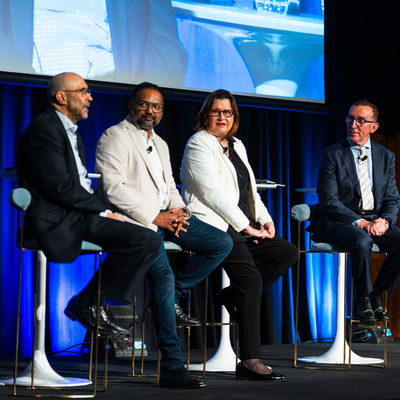
Ian Hamm speaking during the opening plenary panel discussion
Disruption and opportunity, the panel agreed, are arriving together and the profession's response to one will shape its ability to capture the other.
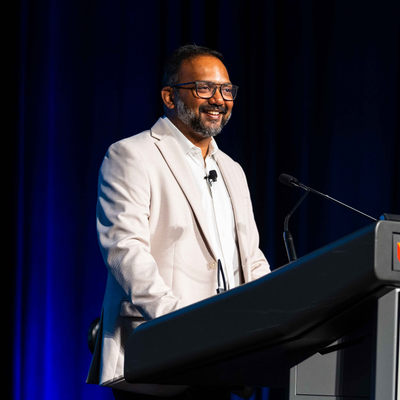
Suhit Anantula discussing exponential thinking and AI strategy on the opening plenary panel
Suhit Anantula was direct about what AI makes possible. The potential to drive growth, not just efficiency, is substantial. But organisations that treat AI primarily as a cost-reduction lever will capture only a fraction of the available value. The larger opportunity lies in using AI to extend human capability and judgment — to do things that were previously impossible, not just to do existing things more cheaply. For actuaries, this means asking harder questions about where human expertise genuinely adds value and designing workflows accordingly.
Ian Hamm returned to the importance of meeting people where they are. Transformation programs that are technically sound but humanly tone-deaf tend to stall or, worse, generate the kind of resistance that sets progress back by years. The investment in relationships, in genuine listening and in building trust before asking for change is not a soft addition to the work. It determines whether the work succeeds.
Jacki Johnson challenged the room to consider the difference between compliance and value creation. Companies that do the minimum required by regulation will be outpaced by those willing to ask what it means to create genuine value for every stakeholder. For actuaries, the profession's analytical frameworks are well-suited to multi-stakeholder thinking. The constraint is rarely technical capability. It is the willingness to apply that capability to harder, broader questions.
The session closed with each panellist naming the change they most want to see.
Ian Hamm called for a shift towards collective responsibility — away from the primacy of individual gain and towards shared investment in outcomes that benefit whole communities.
"That's the recalibration I want to see — less focus on individual gain, more focus on what we can achieve together." — Ian Hamm
Suhit Anantula pushed for a more positive framing of what lies ahead. The instinct to lead with risk is understandable, but the larger opportunity is in asking what becomes possible when diverse populations are genuinely supported to contribute. Growth, not risk mitigation, is the better north star.
Jacki Johnson closed with a call for actuaries to lift their gaze from individual problem-solving to broader societal questions. Ethical leadership means engaging with issues beyond the immediate brief and bringing actuarial rigour to problems that matter at scale.
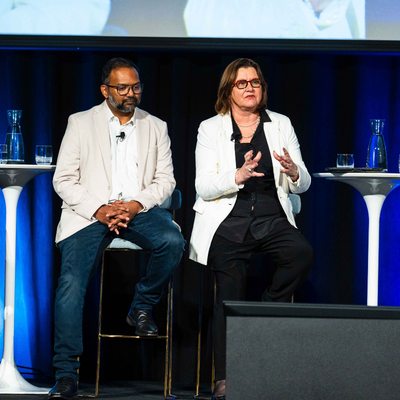
Jacki Johnson speaking during the opening plenary panel discussion
Leading across multiple rhythms of change means making decisions before the picture is clear, investing in relationships before the returns are visible and asking bigger questions before you're sure the profession is ready to answer them. The discomfort, the panellists suggested, is the point.
Have a perspective on the themes raised in this session? Actuaries Digital welcomes contributions from members. Find out more.
The views expressed in this article are those of the author(s) or working group named below, and do not necessarily reflect the views of the Actuaries Institute. This work is licensed under a Creative Commons Attribution-NonCommercial-No Derivatives CC BY-NC-ND Version 4.0.

Missed a session? Catch up on the key ideas, debates and insights from across the 2026 All Actuaries Summit.
Subscribe to Actuaries Digital for free and receive the latest actuarial analysis, research, and commentary direct to your inbox