Interview
Career and Leadership
I Am an Actuary: Six Different Careers Built on One Qualification



Claim your CPD points
What made you become an actuary? For most people, the answer isn't a straight line.
In this edition of I Am an Actuary, six members share the winding routes that led them into the profession — a primary school class that assigned "The Giver"-style life roles, a Google search for "good at maths, good pay, good job security," a science school that revealed a distaste for science. From econometric modelling to Appointed Actuary reserving, defined benefit funds to climate risk, these are six very different careers built on the same qualification.
I was admittedly one of those kids who picked an actuarial degree because they didn’t know what to do, which I’ve come to learn is a pretty common experience. Even throughout university, I really didn’t have a good idea of what an actuary was.
It wasn’t until my internship at EY that I started to gain an appreciation for the work that actuaries do, being exposed to insurance, banking and health work. At that time, I was very much focused on the technical and the nitty-gritty details of the concepts underpinning my work.
I then found myself working at MLC Life, where I began to understand the inner workings of a life insurance company. A key takeaway I had was around the actuary’s role as an adviser and communicator and the big picture beyond the formulas and processes.
A few months ago, I joined Taylor Fry, where I am now working on projects involving econometric modelling and pricing optimisation. I am greatly enjoying working more closely with statistical modelling across different applications, which has challenged me to learn new concepts.
While the path to where I am now has not been linear, what has been constant is that every role has shown me a different perspective of what the actuarial toolkit can offer. I am surprised time and time again by how the profession invites and rewards curiosity.
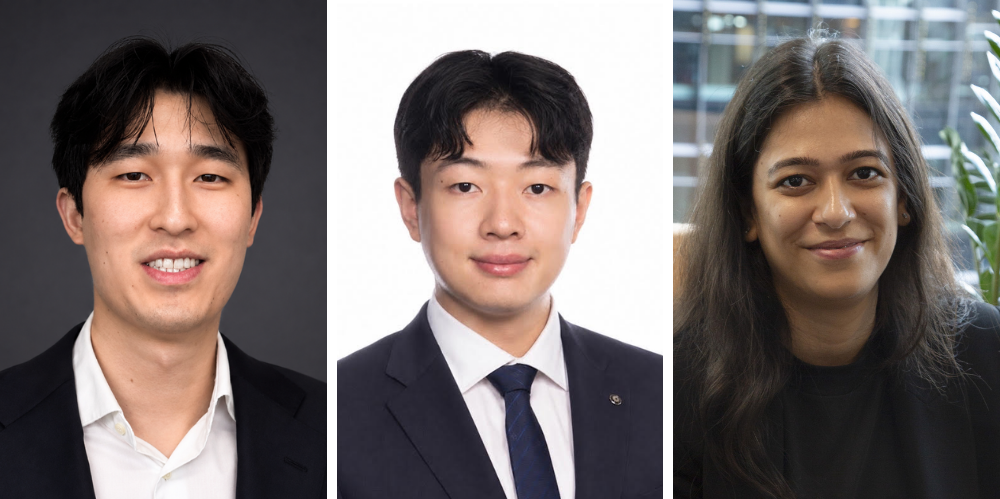
Eric Zhu, Kangnan Wang and Somya Ohri
My foray into the actuarial industry was not particularly dramatic.
A careers adviser and my maths tutor introduced me to the profession, and the appeal seemed straightforward: I was good at maths and here was a career that would let me use it.
What I imagined came next was equally straightforward: Lots of modelling, plenty of assumptions and a career spent somewhere between claims and pricing.
None of that was wrong, but working in actuarial consulting within EY’s general insurance team has shown me how incomplete that picture was.
My work has ranged from Appointed Actuary reserving to scheme reviews and regulatory work. What has surprised me most is how often actuarial thinking can be applied outside the problems I would traditionally have labelled “actuarial”. The same skills used to understand insurance liabilities can help structure much broader commercial, financial and policy questions.
That breadth has also changed my view of what actuaries actually bring to a problem. Being an actuary is not just about building the model or producing the number. The harder part is stepping back and asking whether the result actually makes sense, what assumptions are driving it, what uncertainty lies behind it and how to explain all of that to someone who may not care about the technical details nearly as much as you do.
Being detail-oriented and thinking through problems logically were qualities that initially attracted me to the profession. What I have come to appreciate is that the technical answer is only part of the value we provide and the judgement and the ability to communicate commercially are just as important.
There is still a huge amount of actuarial work I haven’t touched - and I find that exciting. The profession I entered is much broader than the one I originally imagined.
Growing up in India, I always loved mathematics, but actuarial science was not a career I was familiar with. I discovered the profession towards the end of university and what immediately appealed to me was the opportunity to apply academic knowledge to real-world problems and decision-making.
I began my career at Quantium as a graduate analyst, where I gained experience across reserving, capital modelling, pricing, and claims analytics, working with a range of private sector insurers. This broad exposure gave me a strong technical foundation and a deep appreciation for the value of data-driven insights.
A desire to make a meaningful contribution to society led me to join PwC and, subsequently, Scyne Advisory, where I have the opportunity to support the public sector. Alongside traditional actuarial work, I have developed a strong interest in the role actuaries can play in addressing climate-related challenges. I am passionate about how our quantitative skills can help organisations and communities build resilience, manage climate risk and support the transition to a net-zero economy.
The common thread throughout my career has been applying quantitative thinking to real-world challenges. Today, that includes exploring how emerging technologies such as AI can be used responsibly to help organisations make better decisions and achieve better outcomes.
After more than a decade in the profession, my greatest takeaway has been the resilience it fosters and the balanced, judgement-based thinking it develops. These qualities enable actuaries to make a meaningful impact across a wide range of complex and evolving challenges.
I chose actuarial studies because I enjoyed mathematics, problem solving and the idea of using data to make better decisions. At the time, I assumed the pathway would be fairly straightforward: complete university, pass the exams and gradually qualify. I have since learnt that an actuarial career is not always linear and that uncertainty is something we experience as much as we analyse.
I currently work as an Actuarial Consultant in Deloitte’s Business Algorithms team. Before reaching this point, I completed a Bachelor of Actuarial Studies at UNSW, gained my Foundation Program exemptions and continued studying towards my Associate and Fellowship qualifications. I also progressed through several insurance and actuarial roles while completing university and beginning my professional studies.
One of the biggest lessons I have taken from the actuarial pathway is the importance of consistency. Balancing full-time work with professional exams can be challenging, and progress does not always happen as quickly as expected. Receiving the Andrew Prescott Prize was particularly meaningful because it represented the effort behind the result and reminded me that consistent work eventually pays off.
What I value most about the profession is that there is no single path an actuary must follow. The qualification gives us a strong way of thinking, but there are many directions in which it can lead. I am still early in my journey, so my focus is on continuing to learn, remaining curious and becoming someone who can make complex problems clearer and more manageable.

Sourish Agarwal, Sunny Cai and William Zeng
The first time I heard the word “actuary” was in primary school, after our class read “The Giver” by Lois Lowry, where the characters were each assigned a lifelong role in their community. Our teacher thought that it would be fun to assign each of us a “career” like in the novel. Unsurprisingly, I wasn’t assigned the actuary role.
Little did I know that life would eventually come full circle. Years later, an affinity for maths in high school and an interest in pursuing a degree with diverse career opportunities lead me to study Actuarial Studies at the University of New South Wales.
Throughout university, I interned at several organisations which exposed me to a range of traditional and non-traditional actuarial roles, from general insurance pricing and life insurance regulation to banking and capital markets. These experiences showed me just how varied an actuarial career could be and how differently actuaries can contribute across industries.
I eventually began my career through a graduate role as an Actuarial Consultant at Ernst & Young. What I enjoy most about this role is the opportunity to work on a wide range of projects across different industries, including banking and general insurance pricing. I also appreciate the level of client exposure I have had from the get-go, which has strengthened my professional communication skills and helped me better understand how actuarial work extends beyond simply working with numbers.
Looking ahead, I’m excited about continuing to explore the different paths an actuarial career can offer and contribute to work that creates meaningful outcomes for clients, organisations and the wider community.
Having attended a science school, I always thought I would lean into a career in the sciences. The irony is that during those years I discovered I didn’t quite enjoy science as much as I thought I did, and when career discussions came around in my final year of high school, I wasn’t sure what I wanted to pursue.
I liked playing video games, and they held my attention far more reliably than any subject did, although I understood early that pursuing them professionally carried a meaningful risk of eviction. With limited options, I decided to play to my strengths and typed into Google my wish list: “Good at maths, good pay, good job security”. One of the first results was actuary and at the time I had no idea what it meant but after a quick read it seemed to tick all the boxes.
I completed both a Bachelor and Master of Commerce at the University of Melbourne majoring in Actuarial Science, before joining Mercer as a graduate, where I remain today as an Associate.
The role has given me the opportunity to work on a wide variety of projects across the superannuation spectrum - from the more traditional actuarial work on defined benefit funds through to the less traditional defined contribution side. The work there tends to be more open-ended and can span anything from strategy and governance through to product development and modelling.
Throughout my journey, I have gained a greater appreciation of the actuarial skillset – particularly how it blends technical rigour with commercial and regulatory judgement to inform decisions that are pragmatic and considered. Looking forward, I hope to keep refining my skills and continue contributing to a superannuation system that delivers a dignified retirement for all Australians.
The views expressed in this article are those of the author(s) or working group named below, and do not necessarily reflect the views of the Actuaries Institute. This work is licensed under a Creative Commons Attribution-NonCommercial-No Derivatives CC BY-NC-ND Version 4.0.

From career insights to big-picture thinking, our interview series brings together diverse voices shaping the actuarial profession
Subscribe to Actuaries Digital for free and receive the latest actuarial analysis, research, and commentary direct to your inbox