Banking
Securitisation is born




Claim your CPD points
In this article, we will expand on the fundamental concepts of securitisation and draw parallels to the concepts of life insurance. The life insurance context will be familiar to most actuaries and help to demonstrate how applicable the actuarial skillset is to securitisation.
As previously mentioned, securitisation was first conceived to fund mortgages in the US market, which served as inspiration for an Australian adaptation.
The key difference was that the US mortgage market was (and is) dominated by 30-year fixed-rate mortgages. An entertaining summary of the early days of this market is provided in the semi-autobiographical book Liar’s Poker by Michael Lewis.
In contrast, Australia’s primary mortgage structures are generally set for terms varying between 20-to-30 years and use a floating rate that issuers may vary at relatively short notice, often driven by a change in a benchmark such as the official cash rate.
Nevertheless, studying the US market, the Australian originators realised that a pool of mortgages had some key features which were common to both markets:
The mortgage originators also recognised that most of the mortgages were quite homogenous in their structure/characteristics e.g:
Now that the originators had identified a pool of mostly homogenous assets which benefited from risk diversification when pooled, it was time to create the instrument for financing these assets.
The key structure used for financing the pool of mortgages was to stream the income – i.e. prioritise who got first access to the total pool of income paid from the mortgages.
A simple structure was generally used in the earlier period of securitisation:
The A and B series funders could be constructed legally as debt instruments with defined payment terms. These are referred to as the Class A Notes (“A Notes”) and Class B Notes (“B Notes”) respectively.
The A Notes had priority in payment to the income of the pool, and the B Notes then had access to the residual income. The A Notes were in a better risk position than the B Notes, as they had greater income cover for any of their payments, and any losses came out of the B Notes’ payments first. The B Notes typically received a higher coupon to compensate for this risk.
One benefit of pooling the assets and streaming the income into the A and B Notes was that these Notes could withstand greater stress than an individual underlying mortgage. This paved the way for the notes to be favourably rated by a rating agency (such as S&P).
The higher the rating achieved, the cheaper the financing would be for the originator. Therefore, originators took additional steps to improve the rating outcome:
The A Notes, with proper parameters and structuring, were generally rated AAA, and the B Notes were generally rated AA.
At these ratings, the first Australian originators could quite easily fund a blended margin (A and B Notes) that allowed for:
The NIM could further benefit the pools’ ability to defray arrears and defaults.
Most importantly, for the early originators, it represented a source of institutional funding that they otherwise could not access, given their own direct balance sheets were not strong enough to access Investment Grade funding. Securitisation was a more cost-effective funding source than other more traditional capital structures.
To highlight just how familiar concepts in securitisation may be for actuaries, we draw parallels between life insurance and securitisation by comparing a pool of lives and a pool of residential mortgages, the most commonly securitised asset in Australia. Specifically, a residential mortgage securitisation is like a run-off life insurance portfolio, in that the pool once formed will have no new entrants.
Whilst there are many similarities, there are also some fundamental differences. Managing a pool of lives for life insurance is managing a portfolio of liabilities, whereas a pool of mortgages is a pool of assets. This is particularly noticeable in the direction of cashflows over time (see diagrams below).
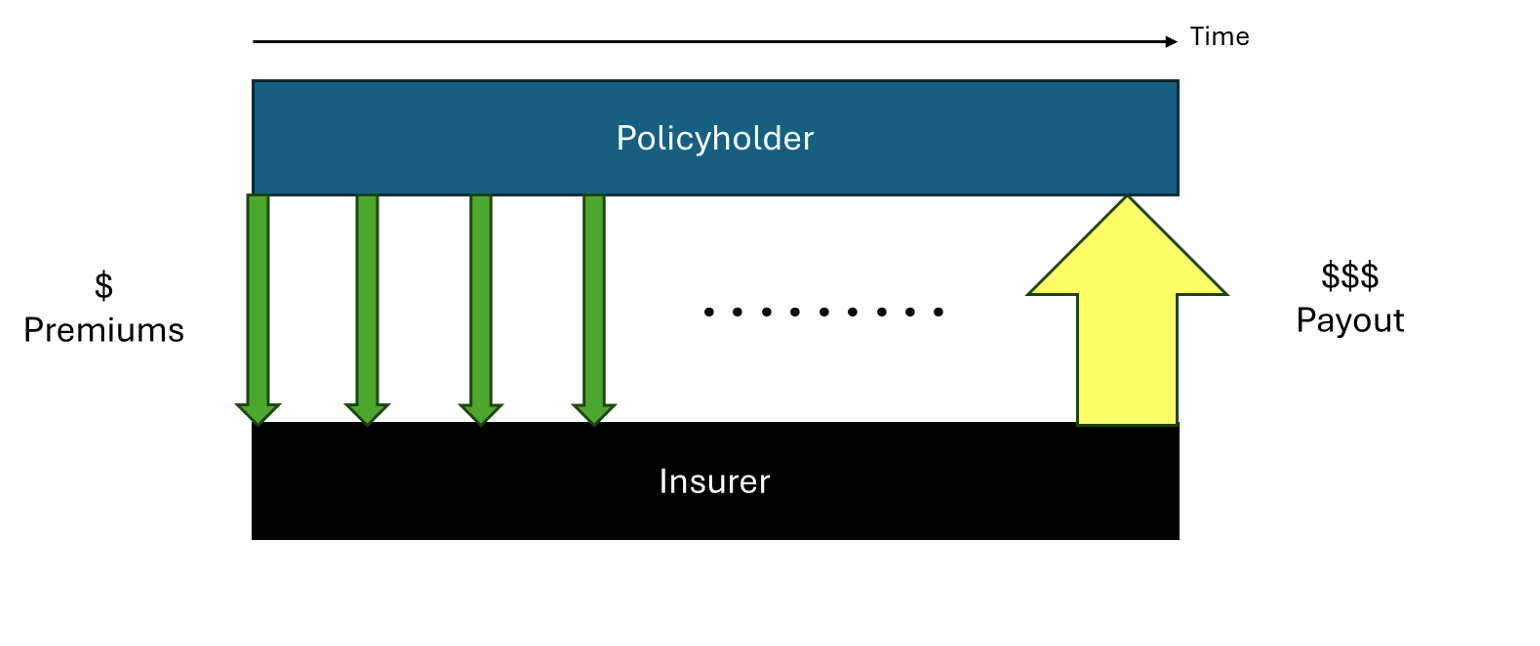
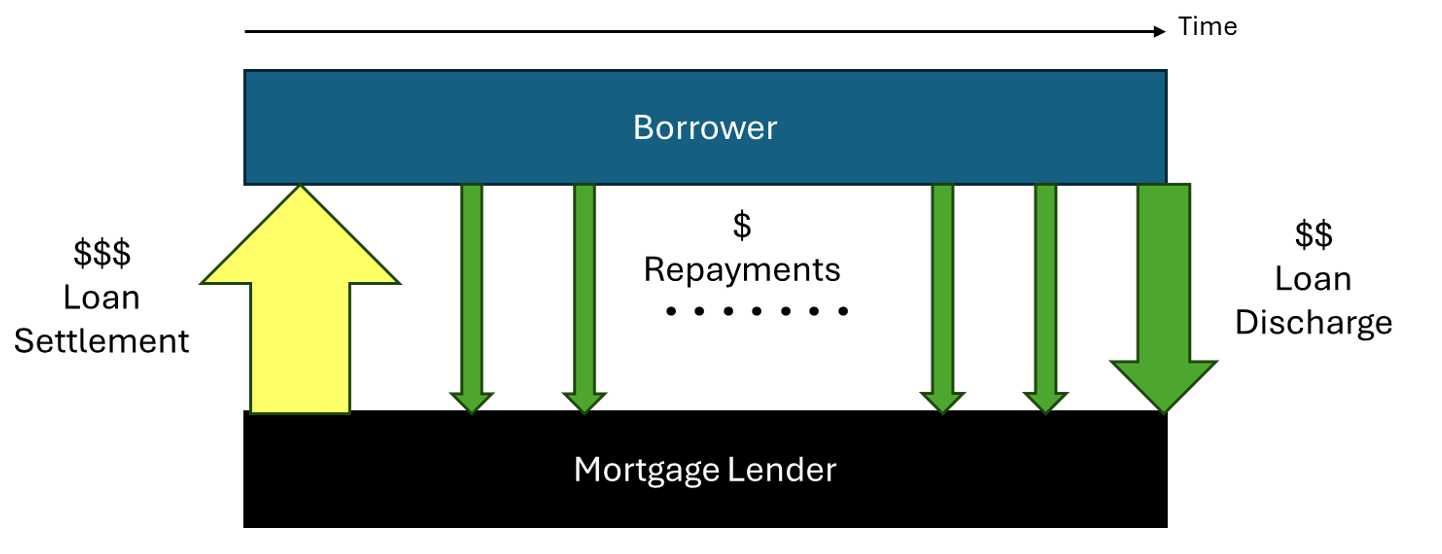
| Characteristic | Pool of lives | Pool of mortgages |
| Risk underwriting |
|
|
| Risk diversification |
|
|
| Repayment profile |
|
|
| Prepayment profile |
|
|
| Arrears |
|
|
A basic securitisation is:
Importantly, the A and B Notes can be rated because the structuring of the cashflows related to the underlying pool of assets meet a set of key rating criteria. Having the A and B Notes rated (highly in this case) allows the Notes to represent an efficient funding source that is not generally possible via more traditional capital structures.
The above describes the basics of securitisation. Whilst there are many variations on this structure, such as variations of assets (mortgages, car loans, equipment loans, interest only loans, etc.), creating more than two classes of notes (A, B, C, D, etc), and unrated securitisations, they all obey the same core principles.
Diagrammatically, and showing some of the additional features required for a properly structured SPV, we can represent the securitisation as follows:
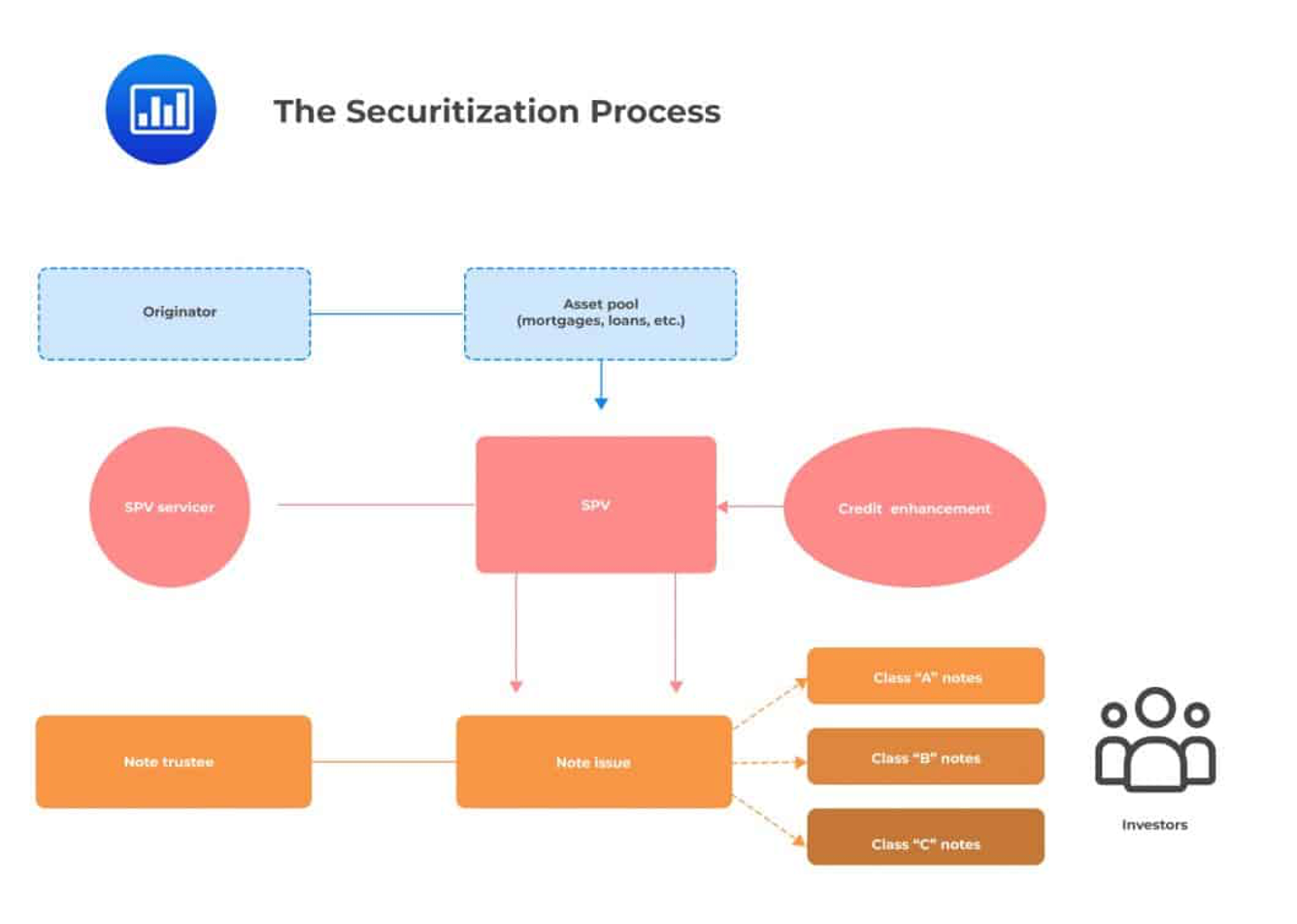
Now that you are familiar with the concepts of securitisation, the next article in this series will explain how the actuarial skillset is highly relevant for this growing industry and explore some of the career opportunities it presents.
The views expressed in this article are those of the author(s) or working group named below, and do not necessarily reflect the views of the Actuaries Institute. This work is licensed under a Creative Commons Attribution-NonCommercial-No Derivatives CC BY-NC-ND Version 4.0.


Explore actuarial perspectives on credit risk, capital management, and the evolving regulatory landscape in Australia's banking sector
Subscribe to Actuaries Digital for free and receive the latest actuarial analysis, research, and commentary direct to your inbox