Superannuation and Investments
Excess Super and Tax Part 2: Lifetime Annuities are a Valuable Part of an Adviser’s Toolkit




Claim your CPD points
In Part 1 of this article series, we highlighted how Australians with superannuation balances above $3 million may soon be subject to additional taxes. Referred to as ‘Better Targeted Superannuation Concessions’ (BTSC), the coming changes trigger an exploration of what alternative options exist for savings above this.
A surprisingly under-discussed option for what is now considered ‘excess super’ is to make use of Australia’s new ‘non-super’ lifetime income products.
Part 2 of this series takes a hypothetical retiree with $5 million of super and shows a worked example of several alternatives to holding superannuation above $3 million. We are not providing anyone with advice – just outlining examples for illustration.
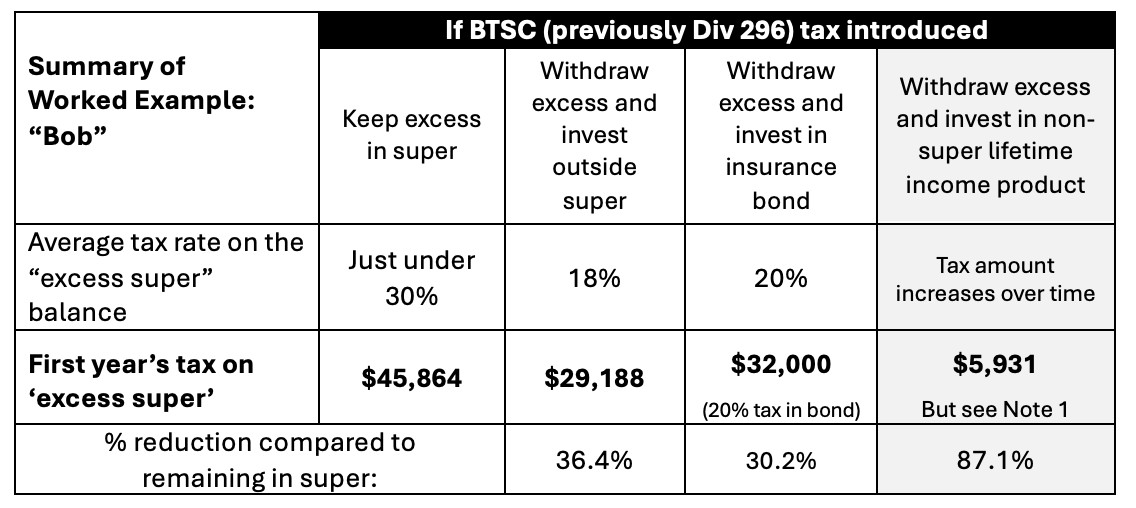
Summary: Retiree with $5 million in superannuation (and minimal other savings):
Summary: Retiree with $5 million in superannuation (and minimal other savings)
[1]The taxable income of a non-superannuation lifetime annuity/pension product works very differently to other investments over time – as explained below.
In our example, we consider a retired male homeowner aged 62. Let’s refer to him as Bob.
Bob has $2 million of super in a tax-free pension account and $3 million in an accumulation account. His $3 million in the accumulation account currently incurs tax on the investment earnings at 15%, although with franking credits and capital gains concessions, his effective tax rate might be 12%.
Under the BTSC tax rules, we refer to his “excess super” as his Total Superannuation Balance of $5 million less the $3 million threshold. This comes to $2 million.
A) If Bob keeps his excess super where it is: If he earns 8% p.a. on his investment mix, then his investment earnings would be $400,000, bringing his Total Superannuation Balance at the end of the year to $5.4 million. The total tax relating to his ‘excess super’ for the year would be:
Other options for Bob include:
B) Remove $2 million from super and invest outside of super: If Bob moved his ‘excess super’ of $2 million into a non-super environment and generated a return on it of $160,000 (8% p.a.), then part of this return would be treated as taxable income.
The portion of this non-super investment income that is taxable might be, say, three-quarters of the $160,000 income (due to the reduction from the capital gains tax discount, for example). This comes to $120,000 taxable income.
He would avoid the BTSC tax as well as the accumulation account tax rate on the $2 million withdrawn from super [1] .
His total tax on the ‘excess super’ he withdrew would, in the first year, be calculated by applying the $120,000 firstly to his 0% tax band, then his 16% band and then his 30% tax band.
(If Bob were instead a higher rate taxpayer e.g. from other non-super financial resources, then his tax would be $120,000 x the highest marginal rate of 47% (including 2% Medicare) = $56,400. This equates to an average tax rate of 35.3% (less than 47% because of things like the capital gains tax discount etc).
C) Remove $2 million from super and invest in an insurance bond: If Bob instead moved $2 million of his super and put this into an insurance bond where the internal tax rate within the bond was 30%, then the tax in the first year might be:
In practice, if Bob used a similar investment mix to his super, then the internal tax rate is likely to be less than 30%. If he holds the bond for more than 10 years, then he can fully encash the bond without paying any further tax personally. He is able to make withdrawals prior to 10 years, but should carefully check the tax treatment.
If we use an internal tax rate of (say) 20%, then his total tax for the first year would be:
D) Remove $2million from Bob’s super and invest in a non-super lifetime income product: If Bob withdrew $2 million from his super, he could use that money to buy a lifetime income stream outside of super, assuming he (and/or his reversionary beneficiary) was in good health. Some insurance companies offer investment-linked versions of this, where the customer can choose an investment mix (e.g. similar investment options to their super) and adjust this over time by switching when they want.
For $2 million, Bob might be offered an annual income from this product type of $135,120 p.a. This annuity rate is based on an investment-linked lifetime annuity offered by Generation Life, with 5% LifeBooster feature [2] .
There is no tax on the investment income within this product type, but part of the annuity payments received by Bob incur personal tax. The taxable component equals the income payment less the Deductible Amount, as follows:
| Position in the first year (only) | Bob |
| Annuity income received | $135,120 |
| Statutory life expectancy factor (LE) | 22.78 |
| Tax free deductible amount (= $2m / LE) | $87,796 p.a. |
| Income above the deductible amount (this is taxable at marginal rates) | $47,324 p.a. |
His total tax on the ‘excess super’ would be calculated by applying the $47,324 firstly to his 0% tax band, then his 16% band and then his 30% tax band.
(If Bob were instead already a higher rate taxpayer e.g. from other non-super financial resources, then his tax in year 1 would be $22,242.)
It is vital to consider the longer-term tax implications of this decision as well. Each option will generate investment income, less tax and less any money that is withdrawn to spend.
The tax calculations can be substantially different for people with marginal tax rates that are higher than the above example. For example, due to other non-super income sources.
Let's touch on how the tax on each product will evolve over time:
A) Keeping money in super: The excess super amount that remains in Bob’s accumulation account would grow with investment income, less any tax that is deducted from the balance, and less any withdrawals they make over time. But the ‘average tax rate’ applying to this ‘excess super’ might remain a little below 30% up to $10 million and a little below 40% for amounts above that.
B) Invest outside of super: The average tax rate applying to the amount Bob moved outside of super will depend on his marginal tax rate and what tax band he’s in. In turn, this depends on how his total taxable assets and income sources change over time. Things that impact this are:
If Bob’s amount of non-super savings stayed broadly level in real terms, then he might remain in the same position relative to the tax bands and his average tax rate on this might remain the same in future years.
C) Invest in an insurance bond: The ‘average tax rate’ applying to the ‘excess super’ that Bob moves to an insurance bond is simply a flat rate depending on investment choice and the tax optimisation strategies that are used by the provider. This could be a maximum of 30% or as low as 15% or less. The actual rate may depend on actual returns generated over time, but it isn’t impacted by how much the customer has invested or their broader financial position.
D) Use a non-super investment-linked annuity: The starting income for an investment-linked lifetime income product gets set by the provider based on actuarial assumptions for the customer’s age and sex (life expectancy) and product design. However, different products increase the income level in different ways. A common feature with investment-linked lifetime products is known as the “hurdle rate”. Hurdle rates play a crucial role in how most investment-linked lifetime annuities operate e.g. as in TIAA-CREF’s products in the USA – one of the largest pension funds in the world.
A higher hurdle rate means a higher starting income is paid, but future income will then rise more slowly, being based on the underlying return on the assets supporting the product relative to the hurdle. Importantly, the hurdle rate is not a fee - it’s a way of bringing forward some of the future expected income to enjoy higher income at the start of retirement and lower income at higher ages, for example, to target an income that broadly keeps pace with inflation.
The product in our example has a 5% p.a. hurdle rate (referred to as the ‘LifeBooster’ feature). If the net return on the assets Bob has chosen is higher than the hurdle rate, then the level of annual income payments will increase. For example, if the net return was 7% p.a. then the income might increase by roughly 2% from $135,120 to around $137,694 [3] .
If Bob’s investment choices generated returns of 7% p.a. after fees etc. then his projected income and projected tax would become:
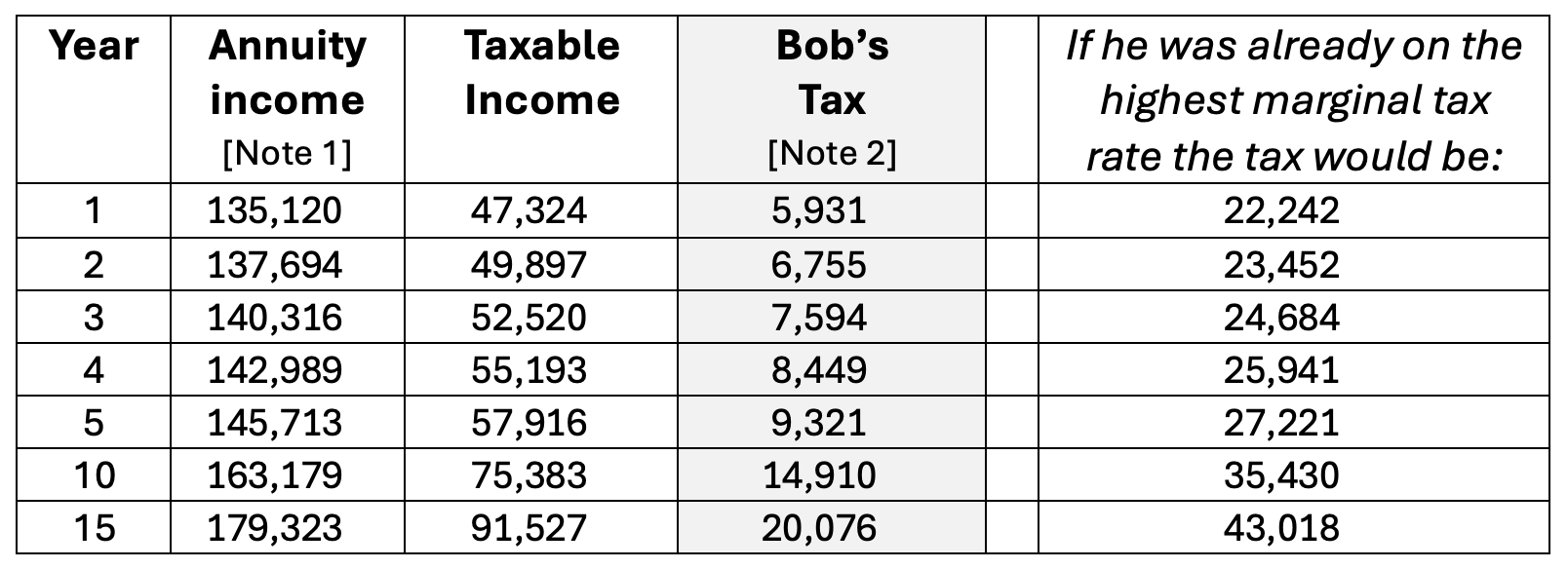
Note 1: Note that for longer living customers, a lifetime product pays a high level of income relative to what’s remaining of the customers' original investment – thanks to the longevity insurance.
Note 2: Bob’s Tax is calculated using marginal income tax rates plus 2% for the Medicare levy. We show for comparison what his tax would be if he were already on the top marginal rate (including Medicare) of 47% e.g. due to other non-super financial resources he held.
With a lifetime income product, the annuity payments start to become very high relative to any measure of investment returns on the remaining purchase amount. This occurs because the annuity payment is composed of:
It hence becomes meaningless to express tax as a proportion of the ‘balance’ per se.
While super remains a tax-effective structure for most retirees, those with balances above $3 million have good reason to explore alternatives.
As our case studies show, moving some excess funds into options such as non-super investments, insurance bonds, or non-super lifetime income products can deliver meaningful tax savings, especially in the first year.
Advisers who understand and can model these strategies will be well placed to help clients optimise their income, protect capital, deliver confidence and navigate the changing retirement landscape.
[1] His remaining balance in superannuation could be expected to increase in future and although the BTSC limit is to be increased, the amount above the limit could increase in future. The BTSC thresholds are proposed to increase in increments over time, maintaining alignment with movements in the Transfer Balance Cap.
[2] https://genlife.com.au/lifeincome
[3] The formula is $67,560 x (1 + 7%) / (1 + hurdle) based on how the LifeBooster feature works.
The views expressed in this article are those of the author(s) or working group named below, and do not necessarily reflect the views of the Actuaries Institute. This work is licensed under a Creative Commons Attribution-NonCommercial-No Derivatives CC BY-NC-ND Version 4.0.