Column
Data Science and AI
When algorithms set your premium



Claim your CPD points
On 9 June 2026, the Wharton School and UNSW Business School co-hosted the Responsible AI & Analytics for Insurance Workshop in Philadelphia, bringing together researchers, practitioners and regulators to examine the most pressing questions at the intersection of AI and insurance.
Co-chaired by Prof. Giles Hooker (Wharton) and myself, the day covered algorithmic fairness, transparency, uncertainty, climate risk and the limits of current regulation. The workshop was opened by Prof. Joao F. Gomes, Senior Vice Dean of Research, Centers, and Academic initiatives, the Wharton School. Here are the key takeaways.
Full details of the workshop, including session slides and recorded videos are available at the workshop webpage .
Mallika Bender (Casualty Actuarial Society) and David Schraub (Schraub Actuarial Consultancy) opened with a taxonomy that every actuary in this space should have front of mind. Disparate treatment is intentional discrimination. Disproportionate impact is a statistical outcome where a protected group pays higher or lower premiums on average, controlling for risk. Proxy discrimination is the use of a neutral variable that acts as a statistical substitute for a protected trait. These are different problems with different legal and technical remedies and conflating them makes both governance and remediation harder.
Schraub added a useful layer. Bias does not only originate in the algorithm. Cognitive and social biases in human judgment shape training data long before a model is built. As actuaries, we tend to focus on statistical and algorithmic bias and underestimate how much the earlier layers matter. And companies are navigating in this uncertain environment with a model risk management approach that addresses regulatory expectations in proportion with the risk and materiality of the models.
In my session, I introduced The Fair Pricing Playbook , a practical framework for algorithmic insurance pricing built around four steps. The playbook moves from defining what fairness means in context, through designing models that pursue it, assessing who gains and who loses, and finally auditing whether the system actually delivers.
Defining fairness is harder than it looks. There is no one-size-fits-all metric and common fairness criteria can be mutually incompatible. Designing a fair model requires recognising that fairness in cost prediction is not the same as fairness in the final price. Making prices equal across groups doesn’t mean the deal is equal. If one group is lower risk but less likely to shop around, insurers can recover the difference through higher markups (potentially using price optimisation techniques if allowed). So fairness in prices does not mean fairness in markups. Assessing welfare impact matters because fairness interventions have financial costs for both firms and consumers, and those trade-offs need to be made explicitly. And auditing the system is where current practice fails most visibly. Standard regulatory audit methods were shown to flag zero of 34 Illinois auto insurers for proxy discrimination, while corrected methods flagged ( read the paper )all 34 as statistically significant, with 16 exceeding the substantive discrimination threshold.
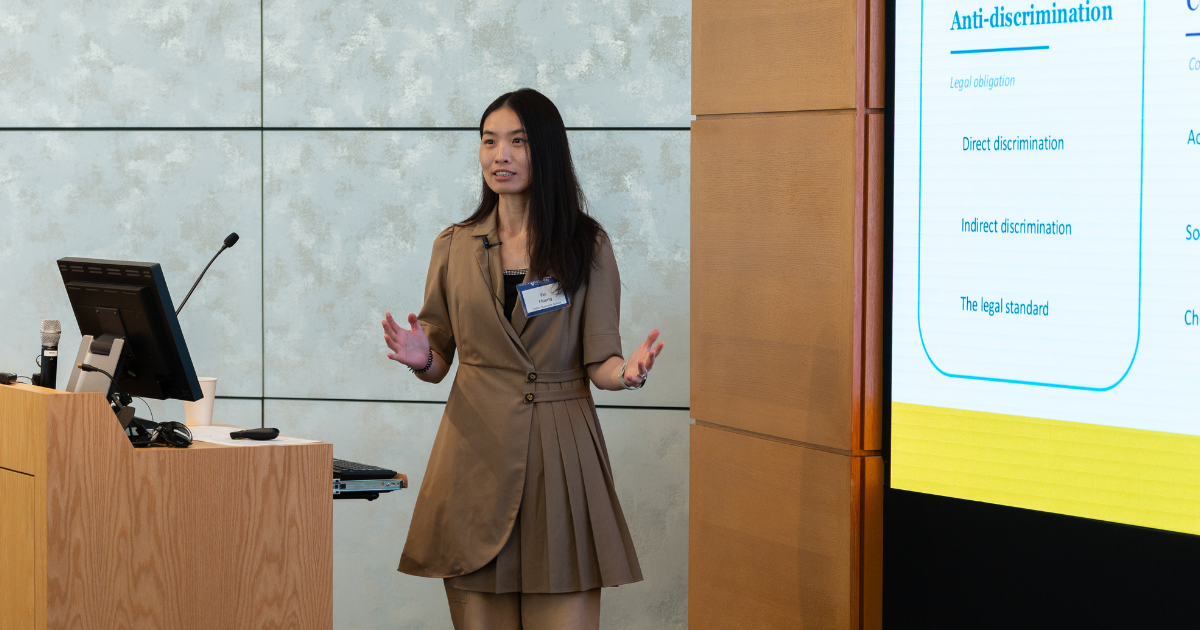
Dr Fei Huang presenting at the Responsible AI & Analytics for Insurance Workshop
Giles Hooker (Wharton)'s session was a timely warning. Widely used interpretability tools, including permutation importance, Partial Dependence Plots (PDP), Local Interpretable Model-Agnostic Explanations (LIME), surrogate models and Shapley values, were built for model development, not legal compliance. Each has known statistical weaknesses that become consequential when used as binding compliance evidence.
More strikingly, Hooker showed that adversarial extrapolation is mathematically possible. A discriminatory pricing model can be engineered to pass a PDP-based audit by constructing a correction in the extrapolation region, covering feature combinations that never appear in real data, while leaving actual pricing entirely unchanged (read the Responsible AI column “ Why AI Interpretations Might Be Lying to You ”). Hooker and co-authors also showed that using Bayesian Improved First Name and Surname Geocoding (BIFSG) to impute race in fairness assessments introduces its own bias into the results, compounding the problem further ( read the paper ).
Adam Solomon (NYU) and Parintha Sastry (Wharton) examined AI's role in insurance market failures on both the supply and demand sides. On the supply side, AI may improve participation through better pricing and faster underwriting, but it could equally erode risk pooling and raise barriers to entry for smaller insurers. On the demand side, the picture is already sobering. Around 70% of insured US homeowners lack sufficient coverage to rebuild after a total loss, with the problem worst for low-income households in high climate-risk areas. Only 4% of Americans hold flood insurance and 56% mistakenly believe flood damage is covered by their standard homeowners policy. AI can help address these gaps by improving household information about risk and contracts, but only if access is equitable and outputs are trustworthy. More information is not automatically welfare-improving, and regulation has an important role to play.
Professor Daniel Schwarcz (University of Minnesota Law School) showed that state insurance law in the US applies unevenly to new technology and innovation, creating risks of both under-regulation and over-regulation simultaneously across three areas. Parametric insurance, which pays out based on objective triggers like wind speed rather than assessed losses, faces a legal paradox where windfalls risk reclassifying contracts as swaps rather than insurance, though workable fixes exist within current frameworks. On rating, ML models will inevitably proxy for protected status whenever it is actuarially predictive, and the old approach of banning suspect traits is no longer sufficient. On claims, AI-powered systems are already making consequential decisions at scale with minimal human oversight. Cigna's PXDX system, which automatically cross-references claims against coverage criteria, generated over 300,000 denials in two months at an average physician review time of 1.2 seconds per claim. Schwarcz's broader point is that AI-powered decisions undermine procedural legitimacy when meaningful human review is absent, and current requirements for a human in the loop remain undefined.
I chaired the keynote panel, which brought together Philip Barlow (DC Department of Insurance), John Johansen (Oliver Wyman), Benjamin Keys (Wharton) and Kevin Werbach (Wharton Accountable AI Lab) for a conversation that surfaced four threads that stayed with me.
AI adoption is K-shaped, both within insurers and across them. Johansen noted that some teams are embracing AI rapidly while others are left behind. Keys described research showing sophisticated insurers cherry-picking the safest risks in wildfire zones, leaving less sophisticated competitors with adversely selected pools. Better data does not make every household better off.
On credit scores, Barlow reflected on his office's experience of moving from wanting to ban them to a more conflicted position after obtaining claims data from insurers and finding it aligned with premiums. His view was that insurers can explain the statistical why behind their models, but not always the rational why, and that gap is a governance problem regardless of outcome. Credit scores are a prime example of this tension, a variable that predicts risk but may simultaneously act as a proxy for race or other protected characteristics, raising fairness concerns that accurate loss prediction alone cannot resolve.
On affordability, an audience poll asking what the most appropriate response to unaffordable insurance would be found the strongest support for risk-based premiums and shared public-private solutions, with opinion divided between the two. The panel reflected that tension. Keys mentioned that risk-based pricing serves an informational function, steering development away from high-risk areas, but that its distributional consequences for lower-income communities require explicit policy responses rather than actuarial accuracy alone. The cross-subsidy debate, weighing actuarial fairness against broader social considerations of who bears the cost of climate risk, was left open as a question the profession and policymakers need to work through together.
Finally, on the US regulatory environment, Werbach noted that federal AI regulation focused on fairness is effectively moribund under the current administration. State-level efforts like Colorado’s and New York's pricing audit requirements may represent a more durable line of defence, which makes the statistical validity of those audit methods more consequential.
The views expressed in this article are those of the author(s) or working group named below, and do not necessarily reflect the views of the Actuaries Institute. This work is licensed under a Creative Commons Attribution-NonCommercial-No Derivatives CC BY-NC-ND Version 4.0.

From model governance to machine learning, explore actuarial perspectives on data science and artificial intelligence
Subscribe to Actuaries Digital for free and receive the latest actuarial analysis, research, and commentary direct to your inbox