Data Science and AI
YDAWG go to the movies




Claim your CPD points
Have you ever heard of the term ‘Oscar Bait’?
It is usually used to describe movies that are specifically created to target the known preferences of Academy voters. Prestige dramas, biopics and period pieces that premiere just before the award season, engineered to stay fresh in the minds of voters. For decades, the thematic themes, story beats and emotional moments of dramas have contributed to numerous Oscar wins, but this year, a different tale is emerging.
The two frontrunners for best picture don’t seem to conform to the status quo. One Battle After Another is a political thriller with dark, comedic undertones, while Sinners is a supernatural horror film rooted in the blues.
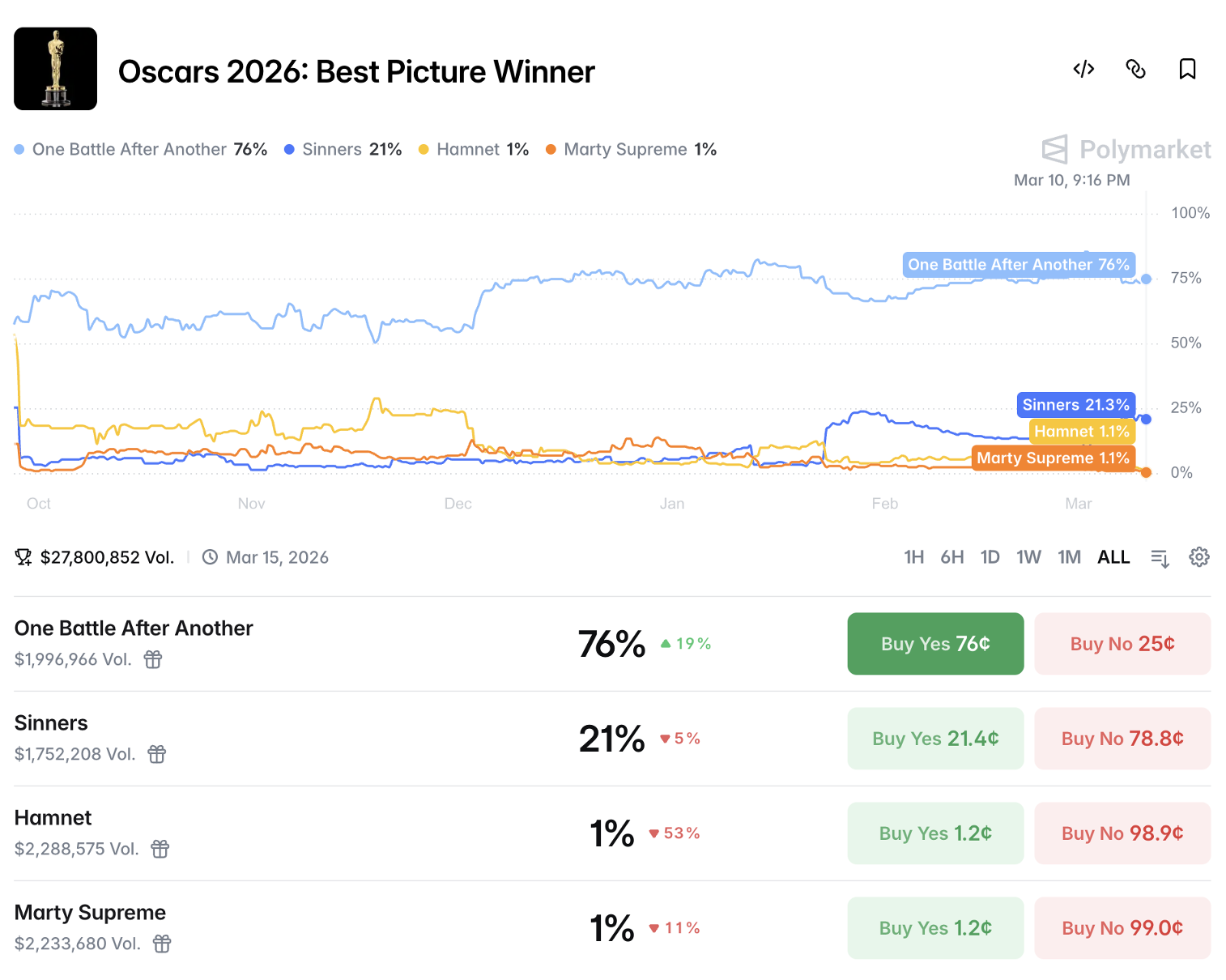
Polymarket betting odds have ‘One Battle After Another’ as a current favourite with ‘Sinners’ as an underdog contender
With the Annual Academy Awards taking place on Monday 16 March (10:00AM AEDT), YDAWG has taken the opportunity to examine the historical trends of Oscar nominees and winners and what this could mean for the two frontrunners. And in particular, whether horror movies now have a better chance of taking out Best Picture.
For our analysis, we have mapped a dataset of historical Oscar nominees and winners to IMDB data containing genre allocations to understand how genre impacts their likelihood of claiming that coveted Oscar.
As part of this data, a film is allocated between one to three genres. For example, romantic comedies would be classified as belonging to both the romance and comedy genres.
For our analysis, we’ve excluded ‘special’ Academy Awards that honour lifetime service or landmark achievements (Who Framed Roger Rabbit) rather than competitive categories. We then mapped genre pairs across all nominees and winners - each film carries up to three pairs of genres, so a drama/comedy/sci-fi film generates three pairs: drama + comedy, comedy + sci-fi and drama + sci-fi.
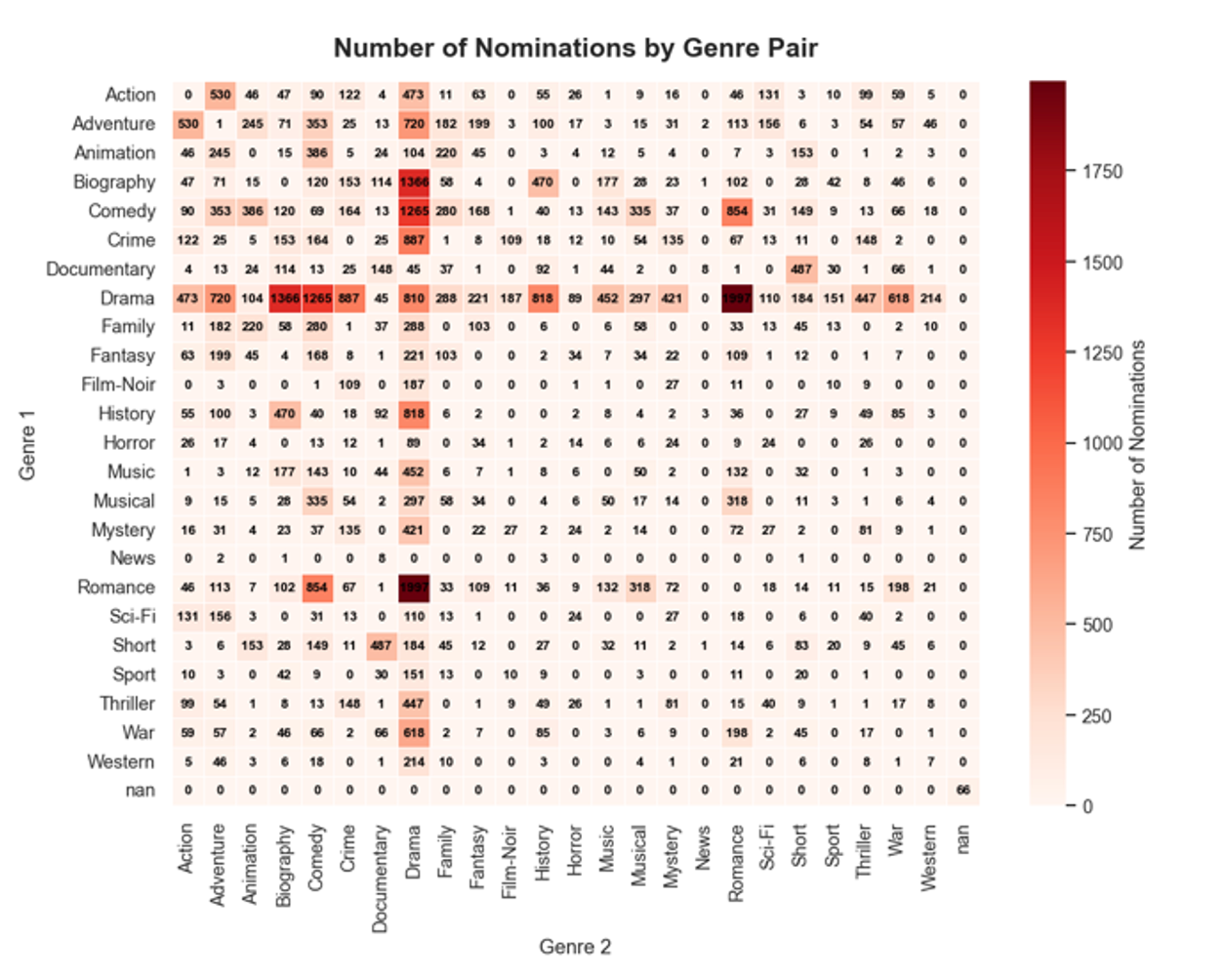
Heatmap examinations of genre combinations for Oscar nominations
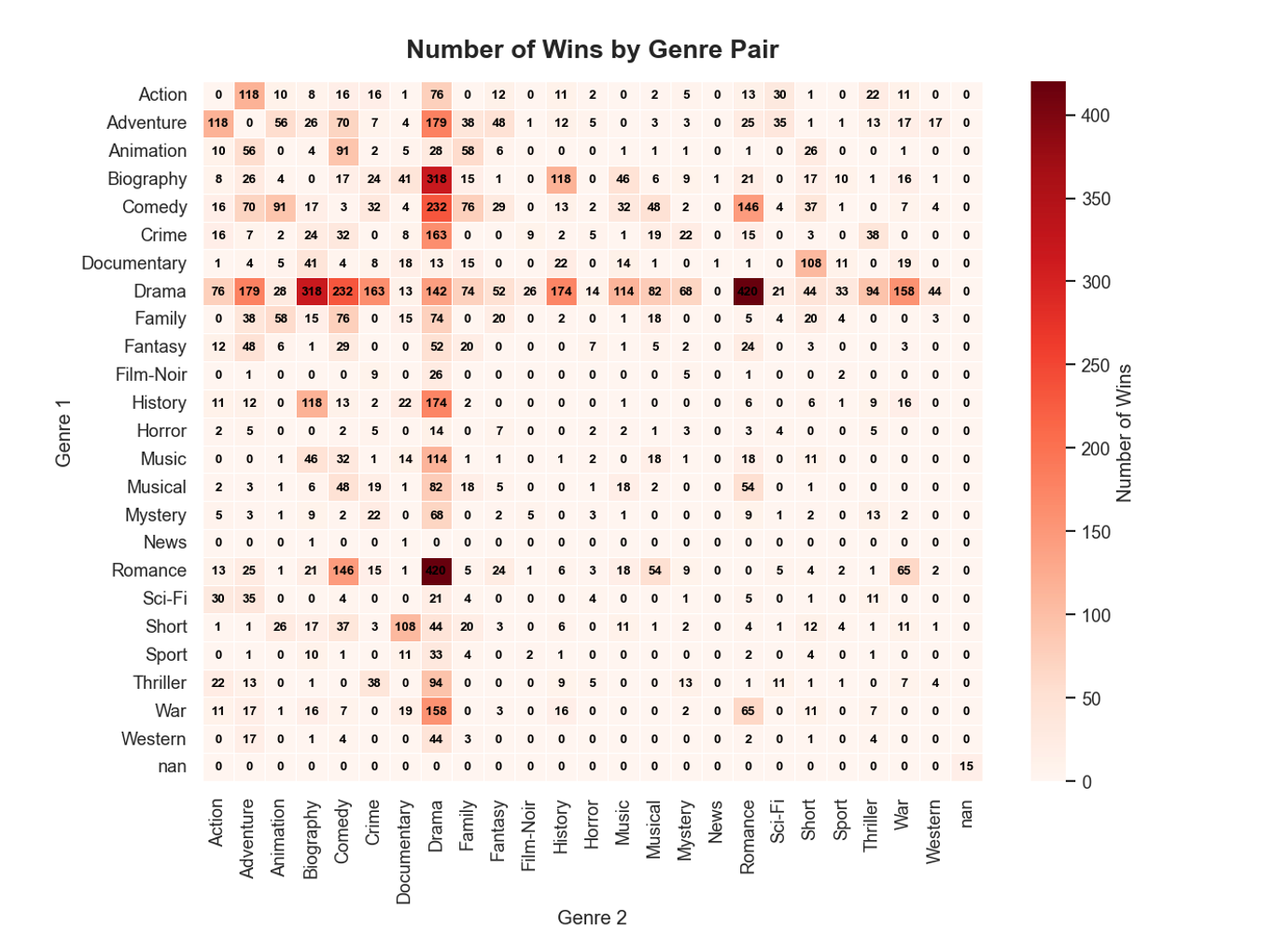
Favoured category of story to win glory
From our results, drama appears to be the favourite of the Academy in terms of both Oscar nominations and wins. Drama + romance is the most common pairing (i.e The American President, The English Patient), while drama + biography (Oppenheimer, 12 Years a Slave) and comedy + drama (The Holdovers, Jojo Rabbit) round out the top three.
As mentioned earlier, drama has been the most nominated genre, while comedy has also been quite popular. However, the type of comedy film that is winning Academy Awards is more often a genre-blend than pure comedy.
In fact, of the 2,678 total nominated comedies, less than 100 are mono-genre (The Odd Couple, Bridesmaids, Borat). The most common pairings with comedy are drama (Jerry Maguire, The Royal Tenenbaums), romance (About a Boy, Silver Linings Playbook), and animation (Ice Age, Surf's Up).
Historically, horror films that have been nominated have also tended to be drama (Interview with the Vampire, The Silence of the Lambs) or fantasy (Death Becomes Her, Sleepy Hollow), with a limited number of nominations for horror films overall.
Since 1927, horror has earned 172 nominations across all categories and most have been in technical categories such as Visual Effects, Original Score and Makeup and Hairstyling – tools that build atmosphere.
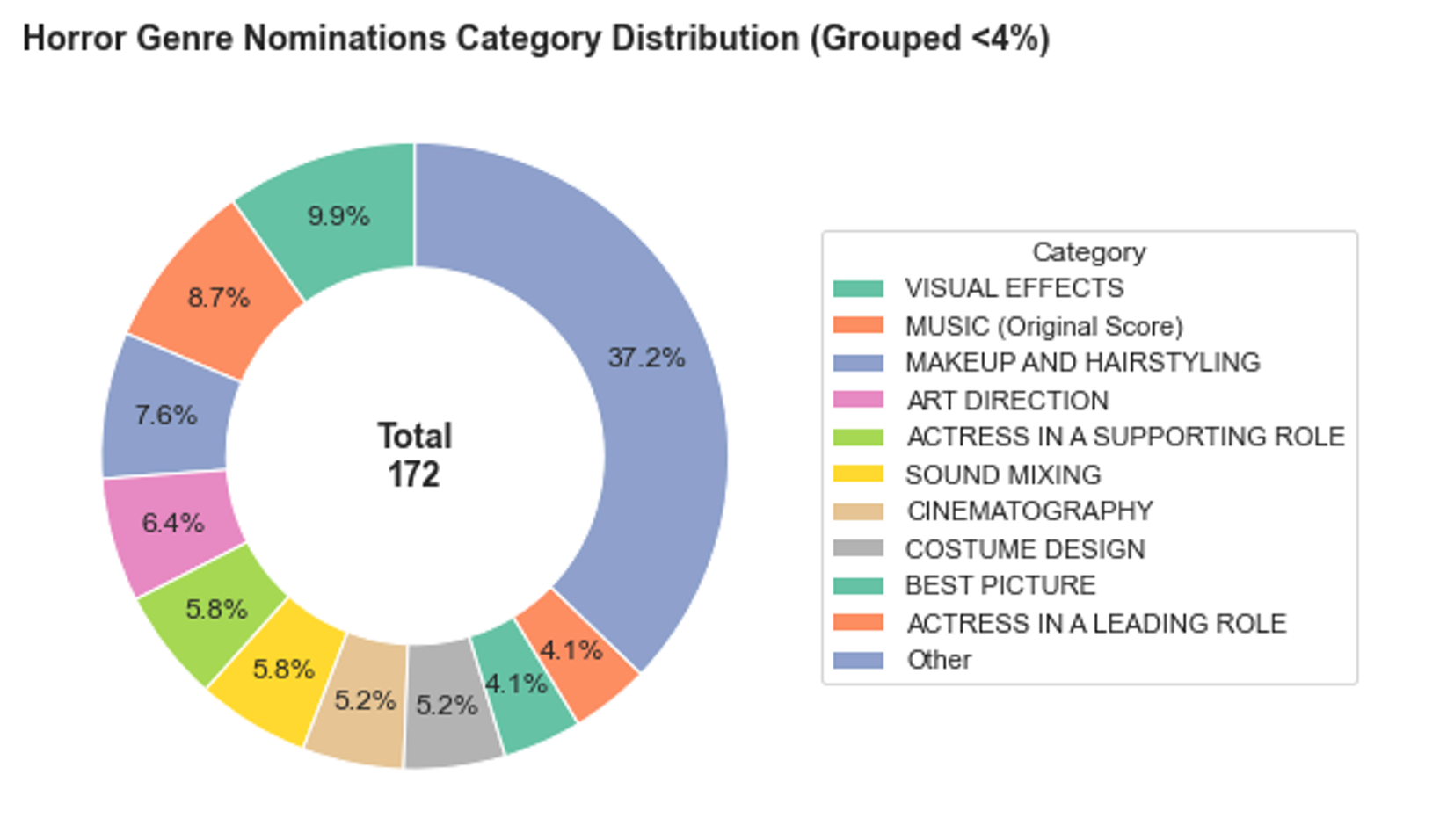
Nominations for horror films tend to be in the categories that build atmosphere
In contrast, comedy movies have been nominated 2,678 times and are more evenly spread across award categories. Some 56.5% of comedy nominations are distributed across smaller categories (those representing less than 4% of their total), compared to just 37.6% for horror.
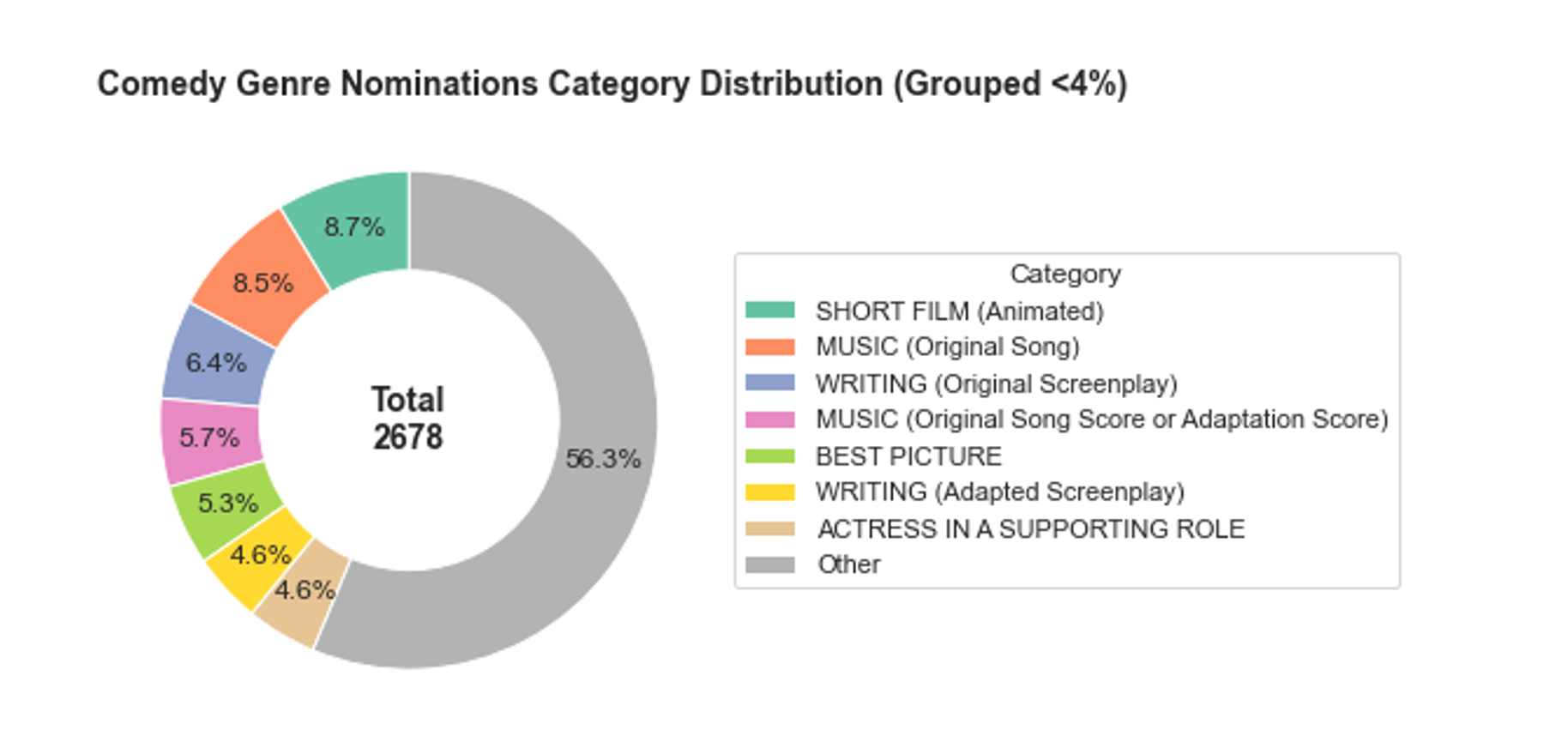
Nominations for comedy films are more varied
Finally, drama films have historically performed the strongest in the key Oscar categories, including Best Picture, Director, Writing and Acting Awards.
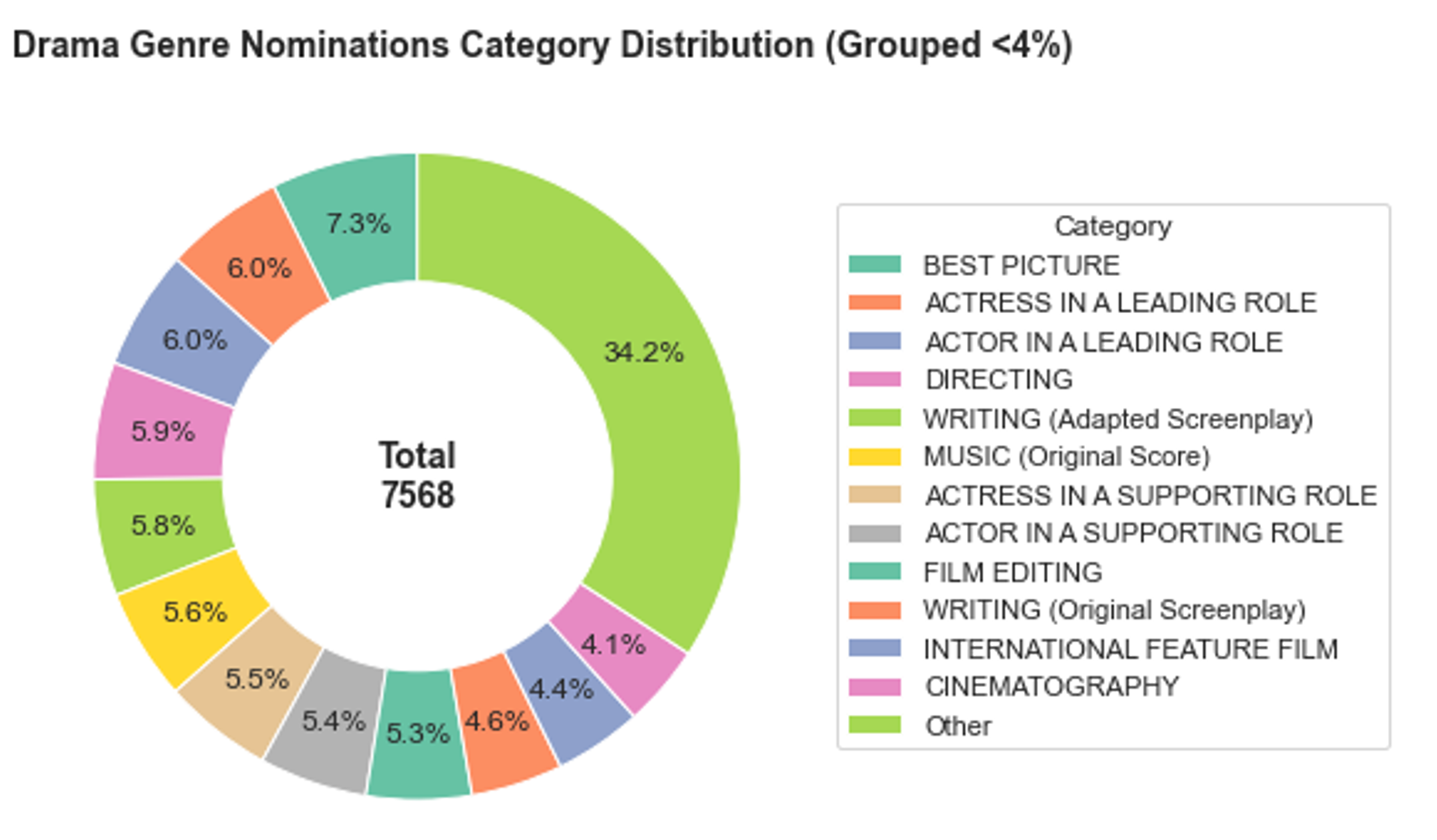
The biggest categories for drama film nominations are the categories the Oscars are most known for
Although horror films have historically tended to do well in the technical categories, recent nominations have been in more categories including Best Picture.
Last year Nosferatu, a remake of the 1922 film of the same name, was nominated for four Oscars, while body-horror The Substance was nominated for five Oscars, including Best Picture and Best Actress.
This year, the increase is even more striking, with four different horror films nominated. Sinners, as mentioned earlier, has been nominated a record-setting 16 times while Guillermo del Toro’s adaptation of Mary Shelley’s gothic horror Frankenstein has 10 nominations. Del Toro’s previous Oscar nominees Pan’s Labyrinth, The Shape of Water and Nightmare Alley, flirted with dark themes but none have ventured as deeply into the horror genre as Frankenstein.
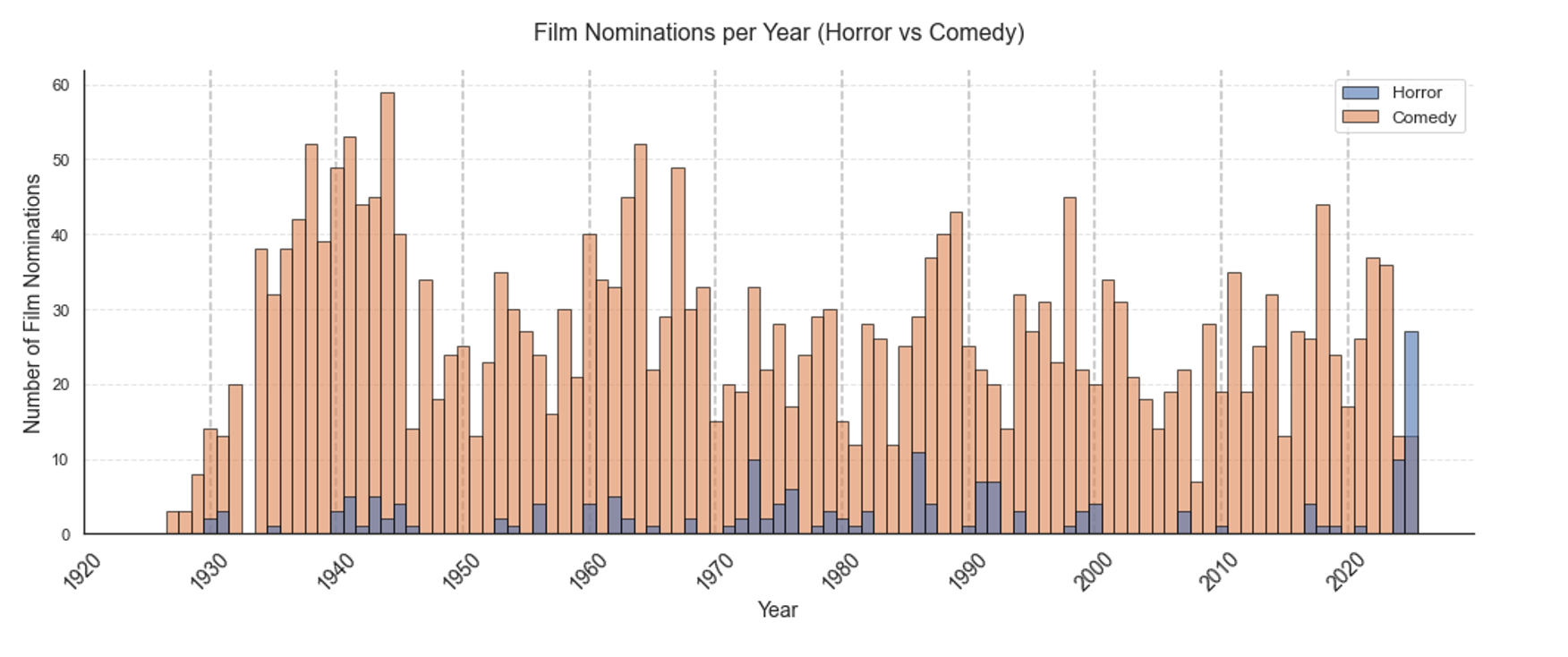
This is the first year there have been more nominations for horror films than comedies
Horror is now one of the largest genres of films with 440 films released last year. Could sheer volume start converting to more Oscar nominations?
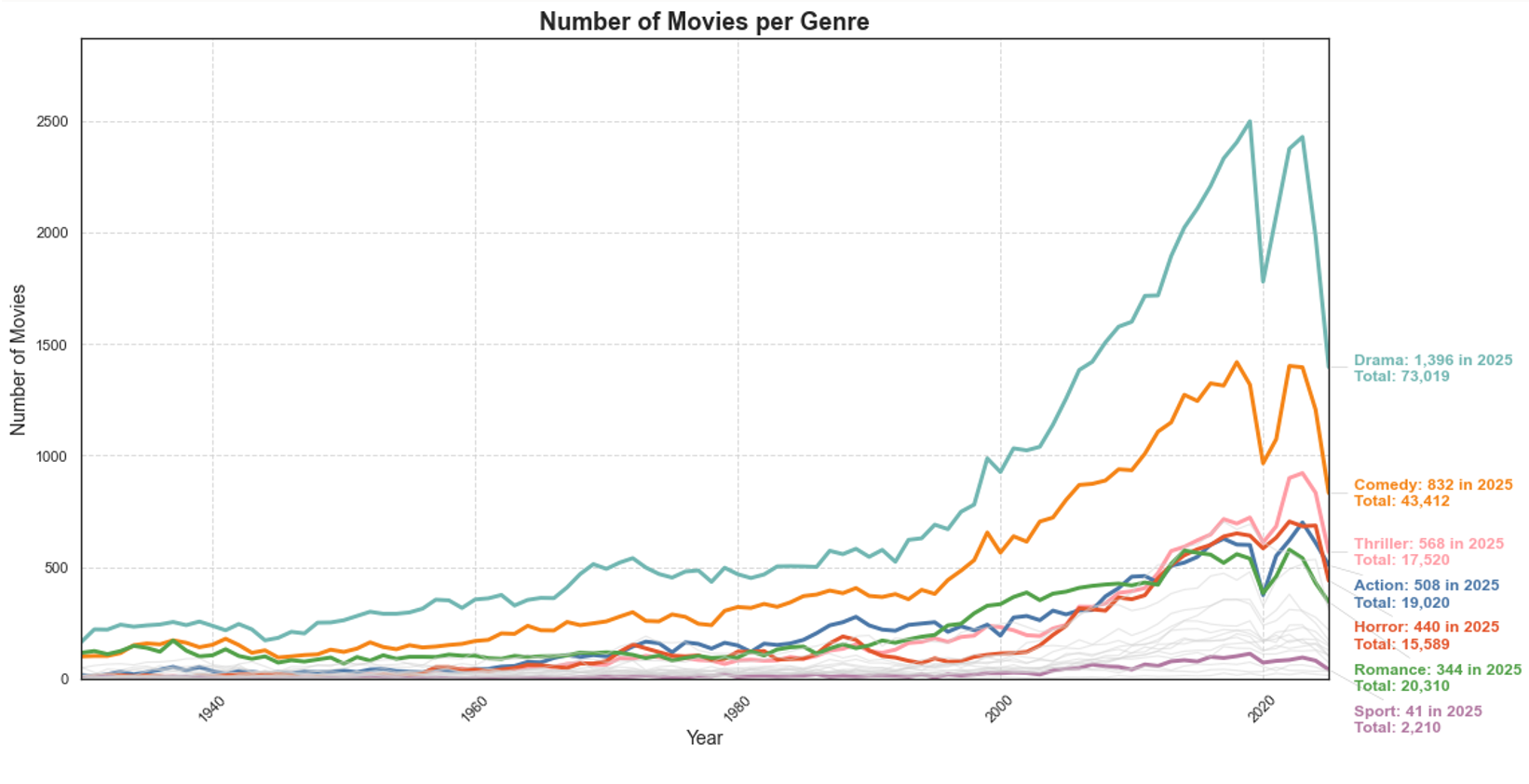
The drop in movie count on IMDB for the latest years is partially due to recent writer strikes, reduced film green lights and delays, but some suspected to be movie RBNR (released but not reported)
The Academy Awards are meant to be a celebration of the best films each year, which is why we expect that films that receive widespread praise and applause are also likely nominees and potential winners.
In the plot below, we have compared the IMDB rating between horror and comedy films.
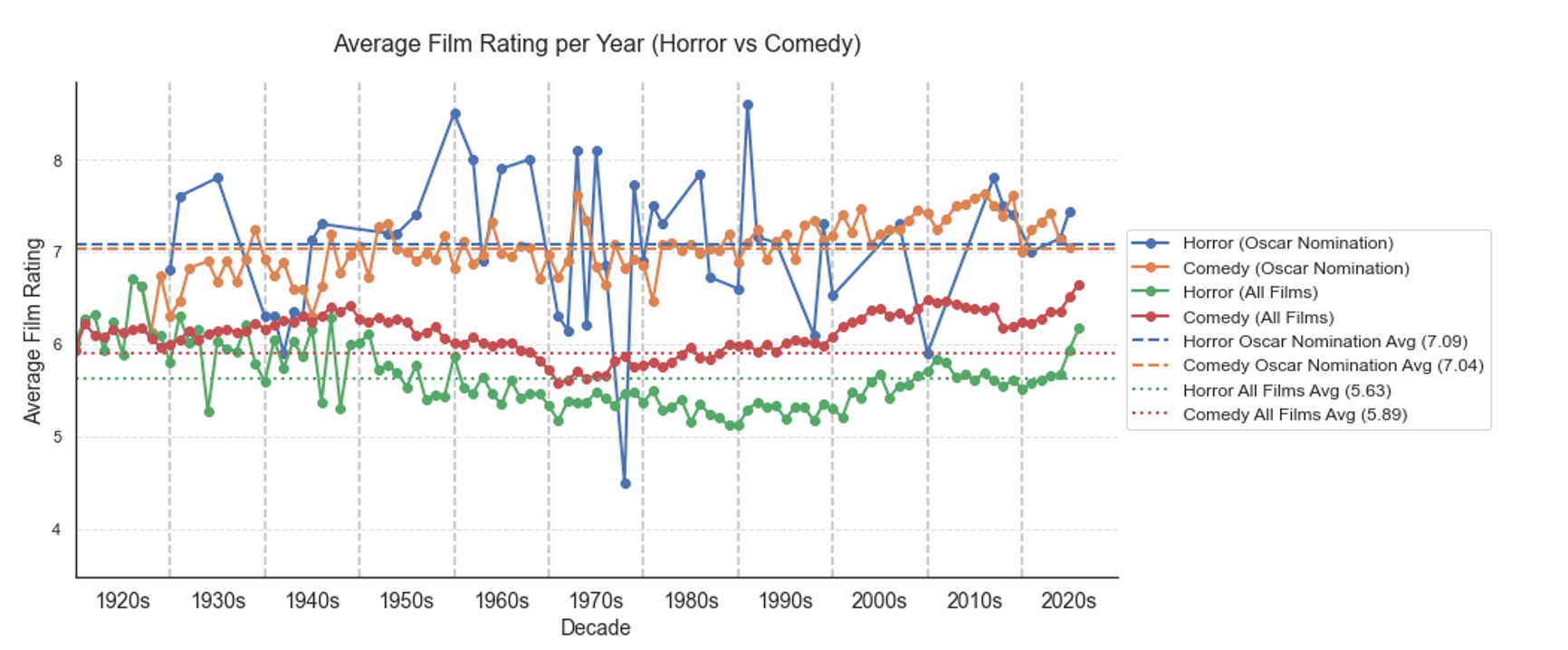
The ratings for Oscar nominated horror films have a greater variance year-on-year than comedy given the sparseness of the nominations with frequent multi-year gaps between nominations
Horror's rating history is volatile precisely because nominations are so rare. In 1978, The Swarm was the genre’s sole nominee and rated just 4.5 on IMDB. By 1991, The Silence of the Lambs - nominated seven times and winner of five, including the ‘Big 5’ (Best Picture, Best Director, Best Actor, Best Actress and Best Writing) – pushed the average to 8.6. One film can move the needle dramatically.
But here’s the twist. When you look only at nominated horror films, they average a higher IMDB rating than nominated comedies. The horror nomination average of 7.09 sits above the overall Oscar nomination average of 6.97 — and just below the winner average of 7.25. Horror may be rare on the ballot, but when it gets there, audiences have already approved.
Drama films continue to be the highest percentage winner of Oscars. Meanwhile, horror is the second-lowest genre behind film noir.
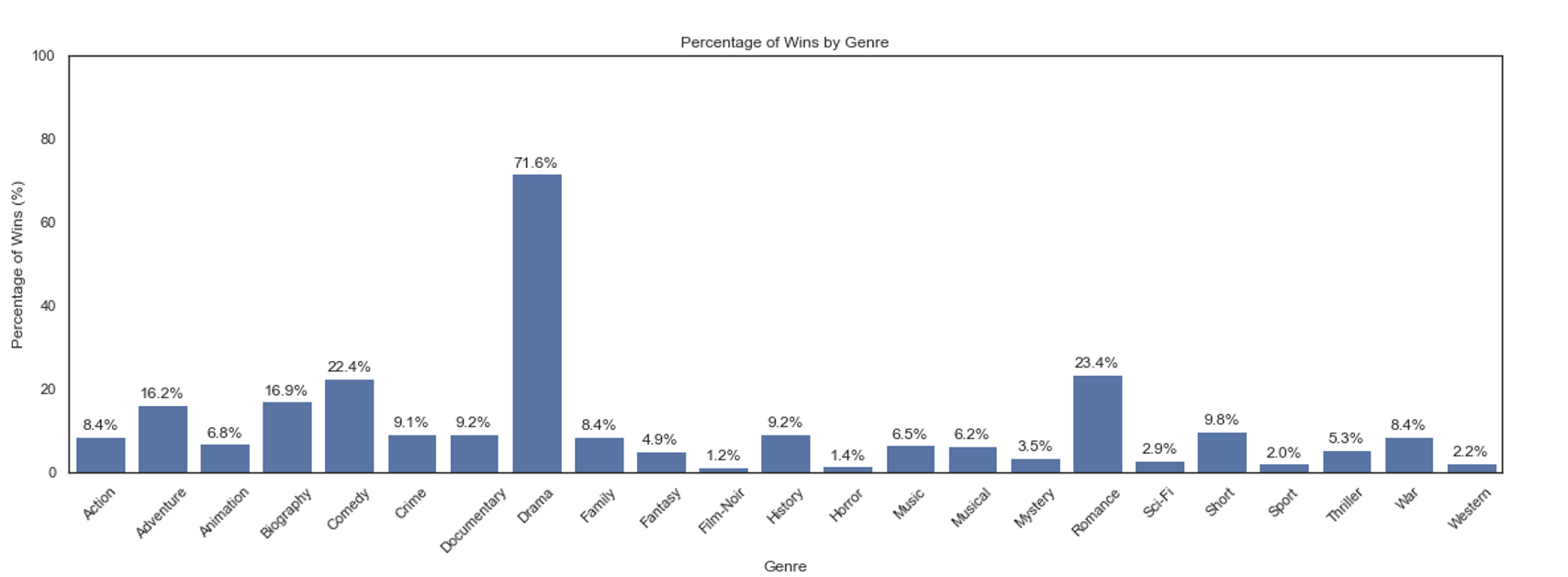
Note that the percentages will add up to over 100 due to the multi-genre definitions allowing multiple genres to be awarded for each win
In fact, horror still trails film noir for total nominations even though a film noir hasn’t been nominated since 1956. The film noir genre is treated as extinct with modern noir films classified as neo noirs, even if filmed exclusively in black and white.
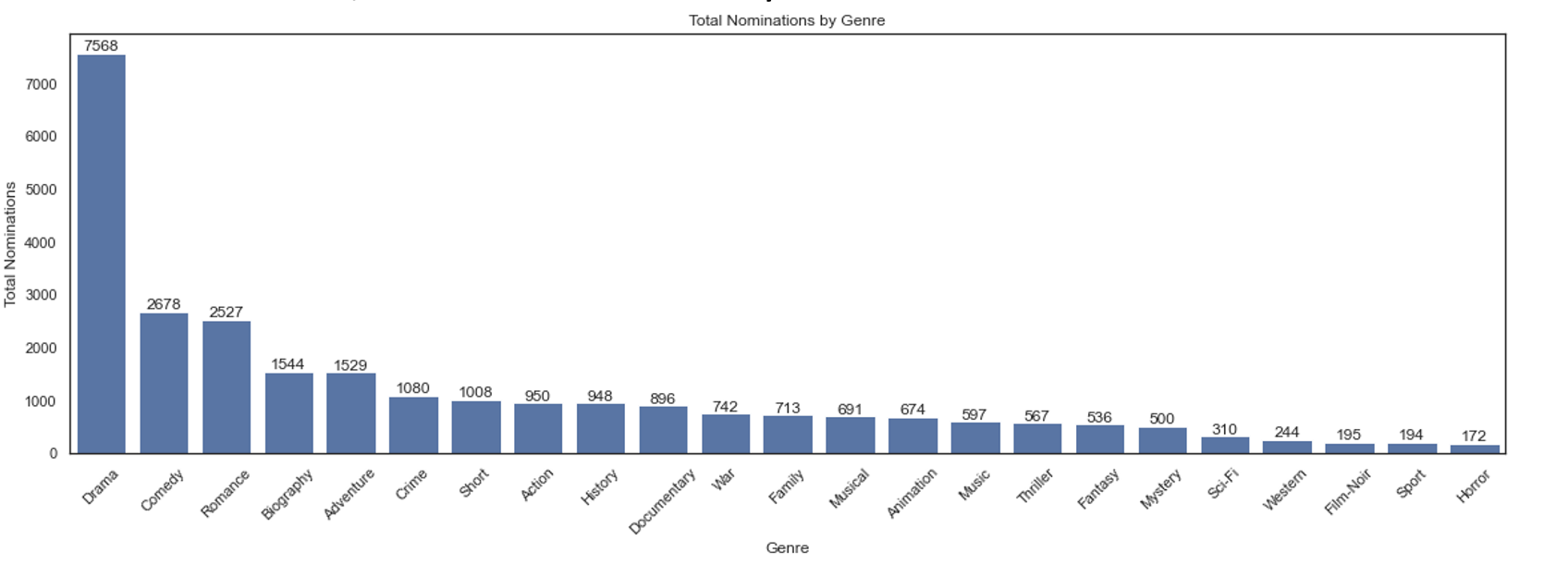
Horror nominations have historically been the rarest of all genres
However, when standardising the number of wins against the number of nominations, drama films tend to become middle of the pack with the family, war and biography genres outperforming. Despite this, horror films are still the third-worst genre in converting an Oscar nomination into a win.
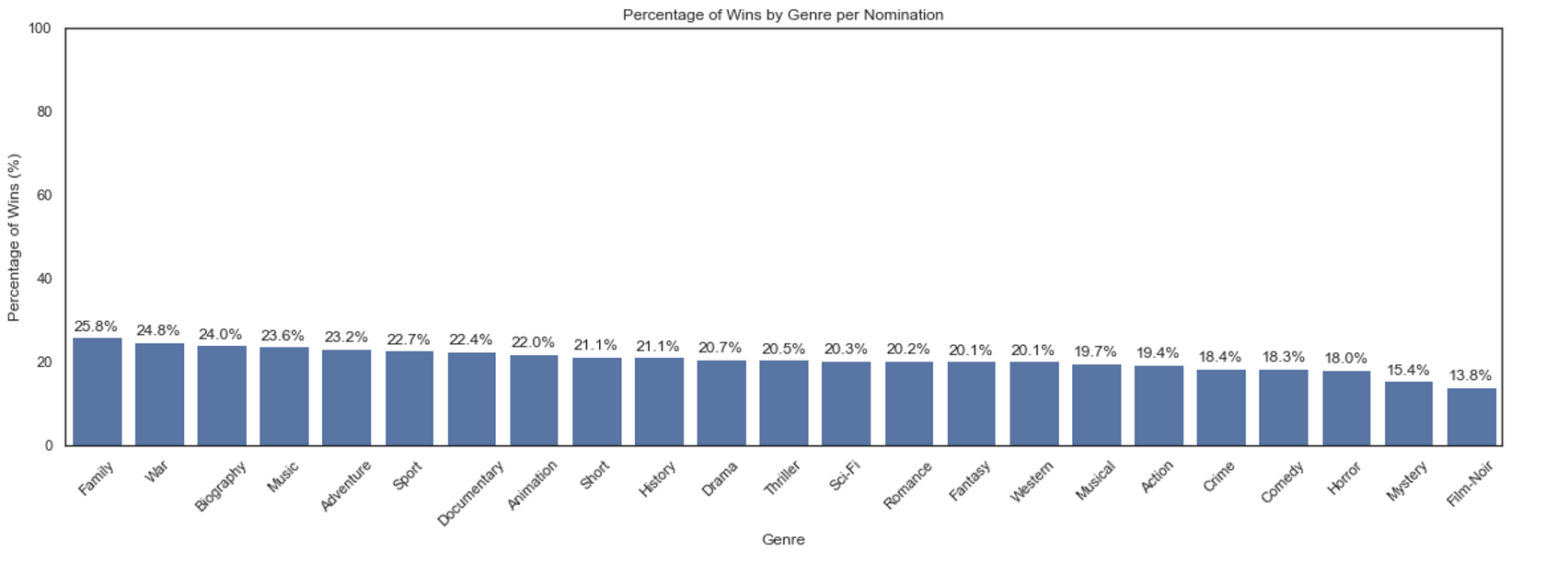
When wins are measured against nominations, drama's dominance fades — but horror still ranks third from bottom, converting just 18% of nominations into wins.
One idea we investigated was to understand whether a film’s popularity contributes to the likelihood of winning an Oscar. For this, we used two different metrics of popularity, the average IMDB rating score (more popular films will be rated higher) and the number of user votes (more popular films will be voted on more often) and looked at the top 10 most popular films for each genre in each year and investigated how they perform on Oscar night.
Initially, when conducting the analysis, the average IMDB rating was used with no adjustment. However, this had the unintended consequence of many films and shorts with very limited ratings being included in the analysis. In our initial analysis of the data, over 60% of the top 10 based on average IMDB ratings had less than 100 votes.
To mitigate this, we filtered and removed films that had less than 100 votes. This did have the unintended consequence of removing 21 Academy Award-nominated films from our data, as they didn’t meet the required minimum number of votes.
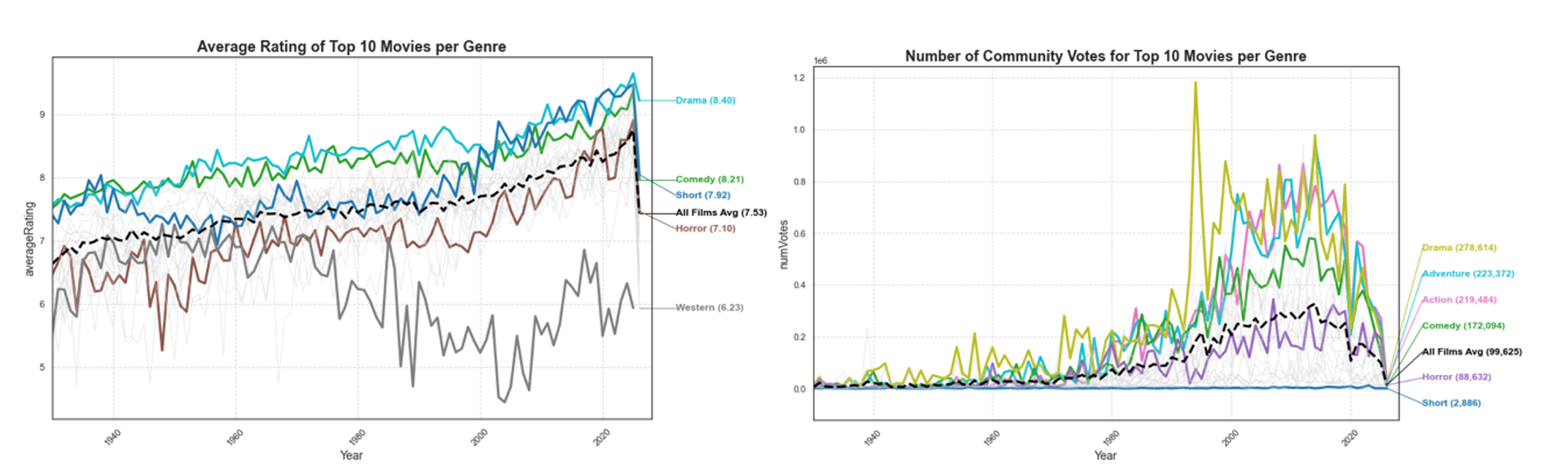
Top-rated horror films score competitively on IMDB — but attract far fewer community votes than drama and comedy, pointing to a narrower audience base that may weigh against Oscar recognition.
The top horror films each year have historically had a lower audience IMDB score than the top films in other genres, which might be contributing to the difficulty in horror converting nominations into wins. Drama films and comedies continue to be highly rated by audience members, playing into their continued success with Oscar nominations and wins.
Recent years have seen horror ratings trend upward, a promising sign for the genre. When measuring popularity by number of votes rather than rating, drama still leads, though adventure and comedy shift in the rankings.
Short films (running for 40 minutes or less) were a clear outlier — highly rated but with very few community votes (an average of 2,886 compared to 278,614 for drama). Since shorts are generally nominated in their own categories rather than competing against feature films, we excluded them from the analysis. Apologies to Tom & Jerry and their impressive 13 nominations and seven wins — along with 45 short film nominations that spilled into non-short categories like Original Song.
If we reproduce the analysis from earlier, we end up with the following graphs which represent the conditional probability that a film in the genre wins an Oscar given the film was nominated and the film was one of the top 10 films of its genre for the year.
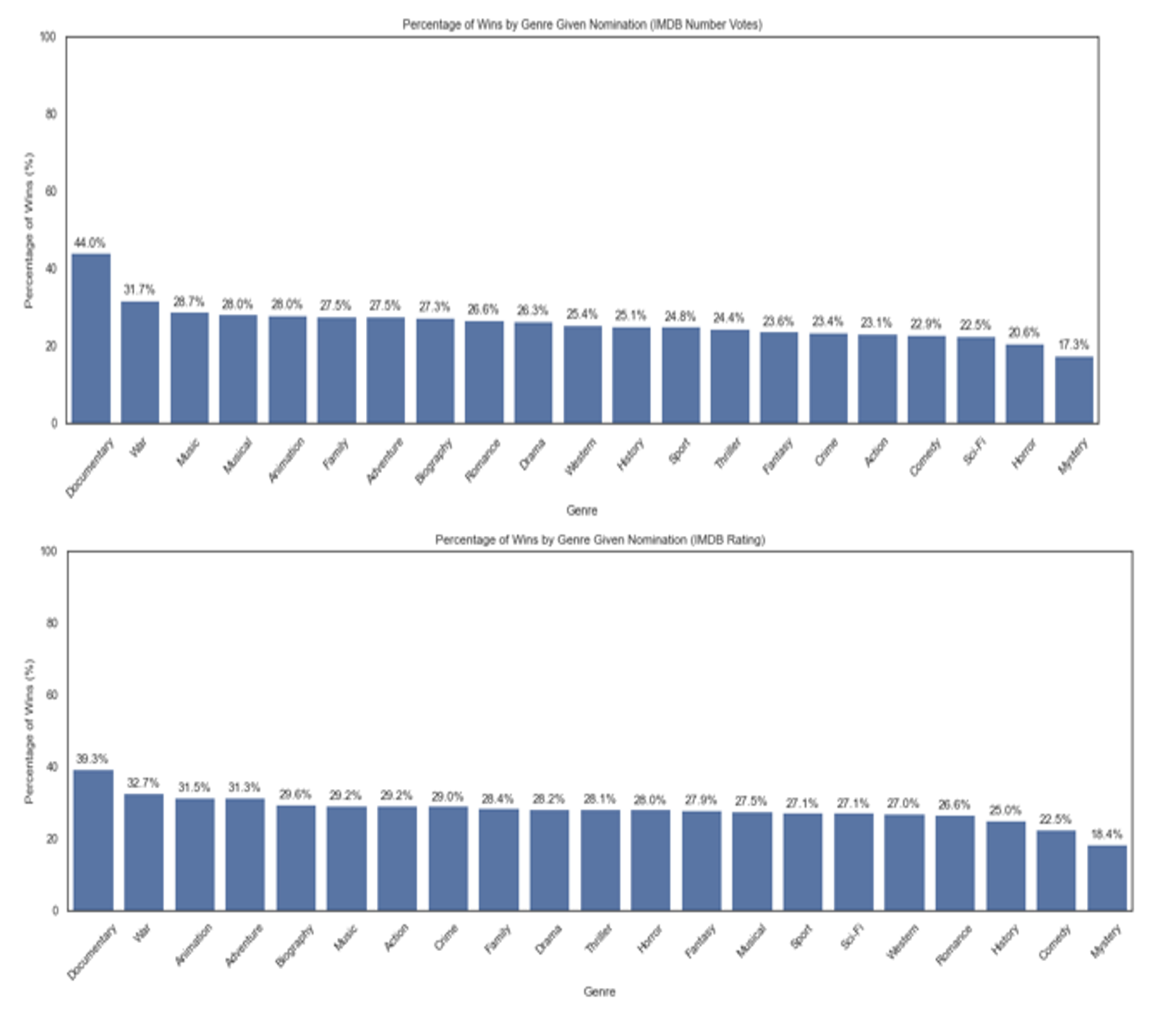
If we look at films in each category that have both critical acclaim (Oscar nominated) and popular following (IMDB rating), then horror win rates start to closely match drama.
Most genres saw a higher likelihood of conversion when the top 10 IMDB-rated films were included in the analysis compared to the top 10 voted films. Conversely, documentary saw a large decrease between the two metrics with popular documentaries more likely to convert a nomination to a win than highly rated documentaries. Short films (not shown in this analysis) followed a similar trend before they were removed from the analysis, which might indicate the difficulty that audience members have in rating these genres.
When comparing the IMDB rating, there was only a 0.2% difference between the conversion rate of drama and horror films (28.2% vs 28.0%). There was also a large gap between horror and comedies in this metric with only a 22.5% conversion rate for top comedy films.
As discussed previously, horror films have tended to perform better in the technical categories rather than major categories such as acting.
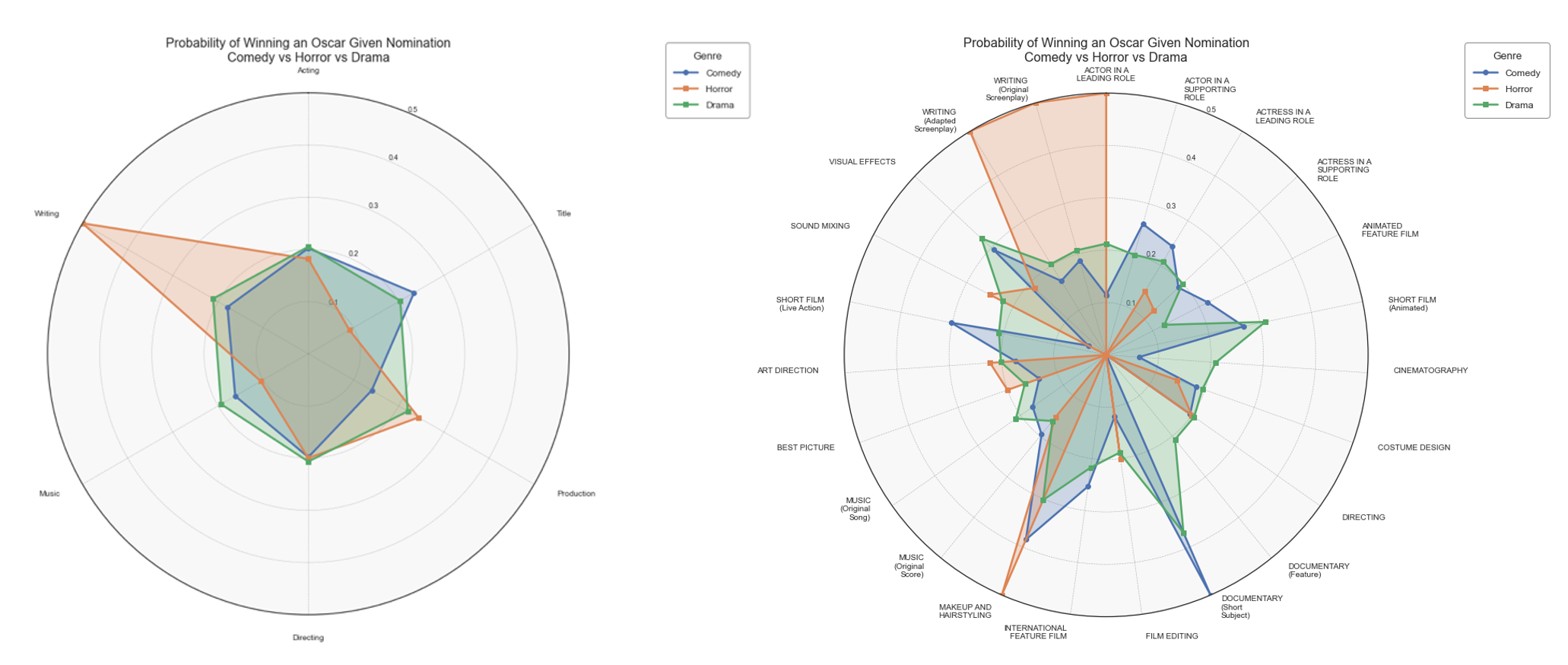
Horror punches above its weight in writing categories — but trails comedy and drama across acting, directing and most major award categories where Oscar races are won.
Surprisingly, horror has tended to perform better than both comedy and drama films in the writing categories. This is heavily dependent on the lack of horror writing nominations with three wins (The Exorcist, The Silence of the Lambs, Get Out) from six nominations (Dr. Jekyll and Mr. Hyde, Rosemary’s Baby and The Substance being the three non-winning nominations). Compared to this, comedy films have been nominated 335 times for 60 wins and drama films have been nominated 882 times for 186 wins.
Similarly, horror has a slight edge in Best Picture race due to the lack of historic nominations. From five previous nominations, horror has won the Best Picture race only once when Silence of the Lambs claimed victory.
Horror has always produced landmark cinema — but the Academy has been slow to recognise it. The data shows that when horror films do get nominated, they earn it, averaging an IMDB rating above the overall nominee average.
With a record number of horror nominations this year, the 2021 expansion of the Academy's voting pool bringing greater diversity, and audience ratings for horror trending upward, the conditions for a breakthrough are arguably stronger than ever.
Will Sinners make history on Oscar night? The data suggests it has a fighting chance.
The views expressed in this article are those of the author(s) or working group named below, and do not necessarily reflect the views of the Actuaries Institute. This work is licensed under a Creative Commons Attribution-NonCommercial-No Derivatives CC BY-NC-ND Version 4.0.


From model governance to machine learning, explore actuarial perspectives on data science and artificial intelligence
Subscribe to Actuaries Digital for free and receive the latest actuarial analysis, research, and commentary direct to your inbox