Data Science and AI
The (Winter) Olympics by numbers: for people who love data and sports (but mainly data)




Claim your CPD points
The 2026 Winter Olympics are officially underway! And while everyone else is debating scores and standings, actuaries are here for the real main event: the statistics. If you’ve ever wondered if you’re built for the luge or just the couch, these graphs have the answers.
In this article we answer your biggest questions. Do people even care about the Winter Olympics? Which Olympic athlete are you? Is Cool Runnings real?
Australia prides itself on being a premier sporting nation and the medal counts usually back that up. Well... the Summer Olympics medal counts, anyway.
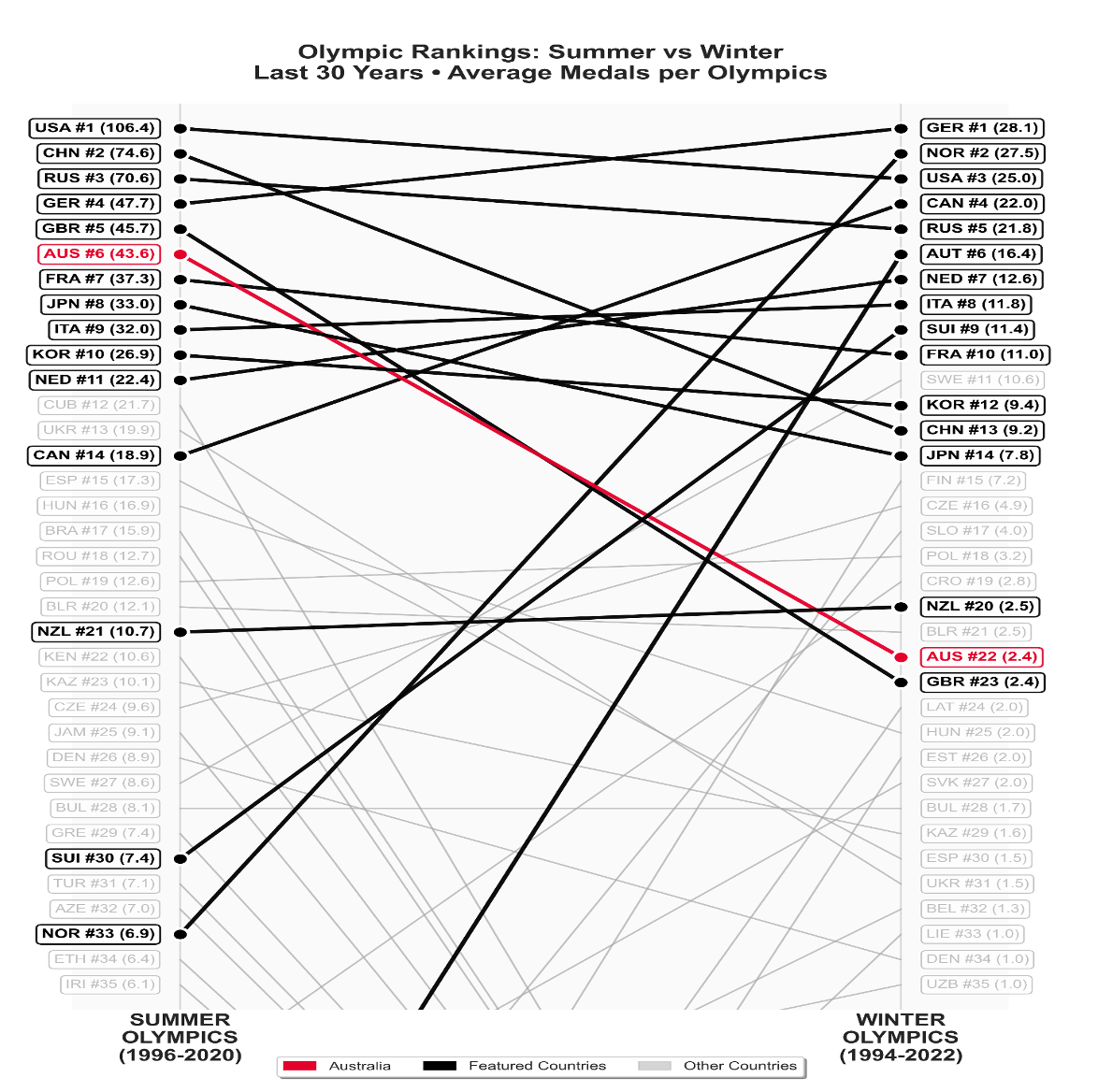
While Australia’s drop from Summer #6 to Winter #22 is a tough pill to swallow, we can’t even see Austria’s full plummet from Winter #6 to Summer #51.
But, it turns out there are plenty of nations (like Norway) that have way more interest in the Winter Olympics than we’re used to here in Australia.
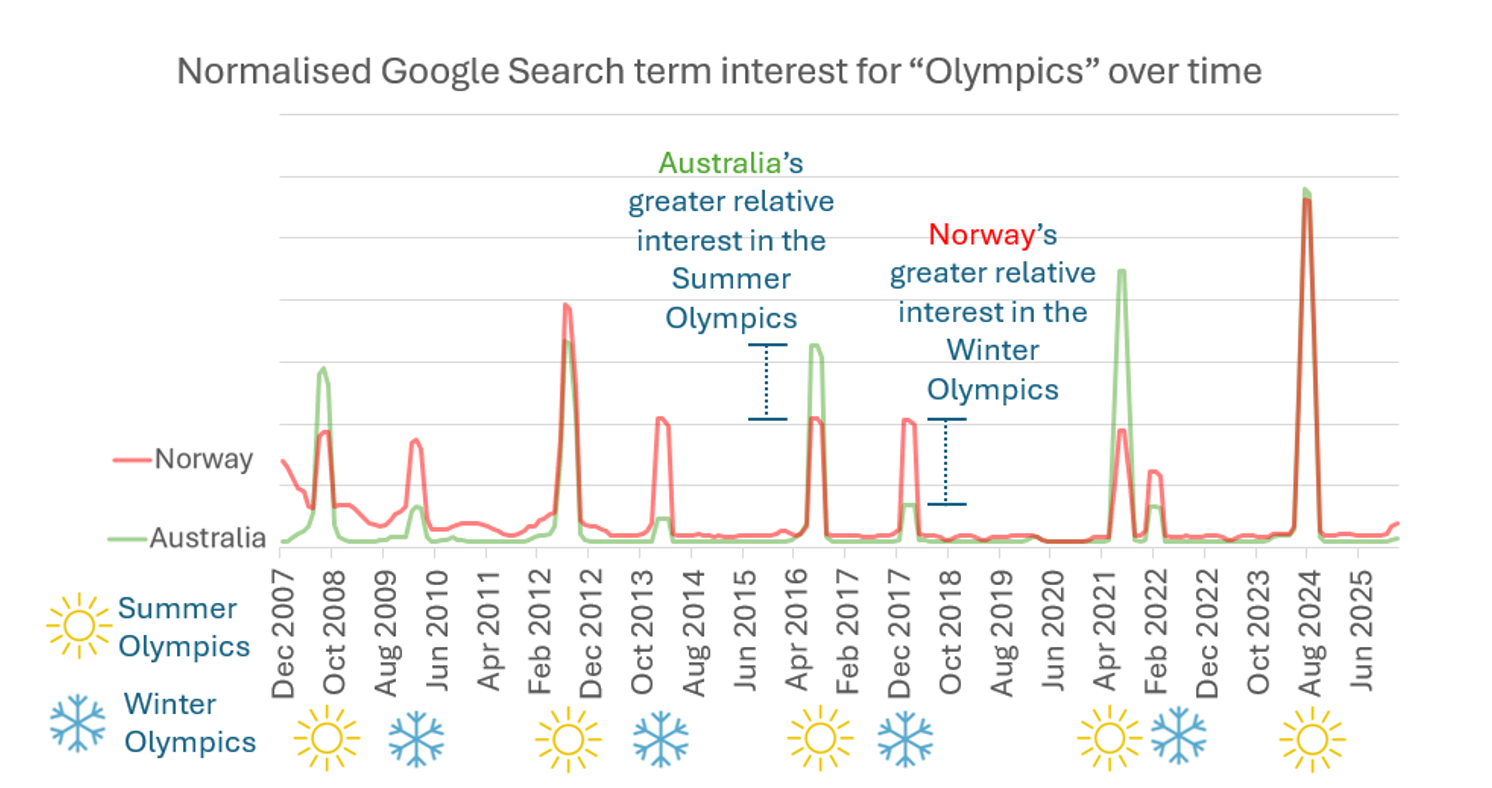
Australians Google search for “Olympics” with a higher spike in Summer years (green line), while Norweigans tend to be searching for “Olympics” content more consistently (red line)
To understand the context of the winter specialists, we can look at where these countries sit on the globe. By plotting nations on a log-log scale of summer vs. winter medals, and overlay latitude using colour, the role of geography starts to emerge.
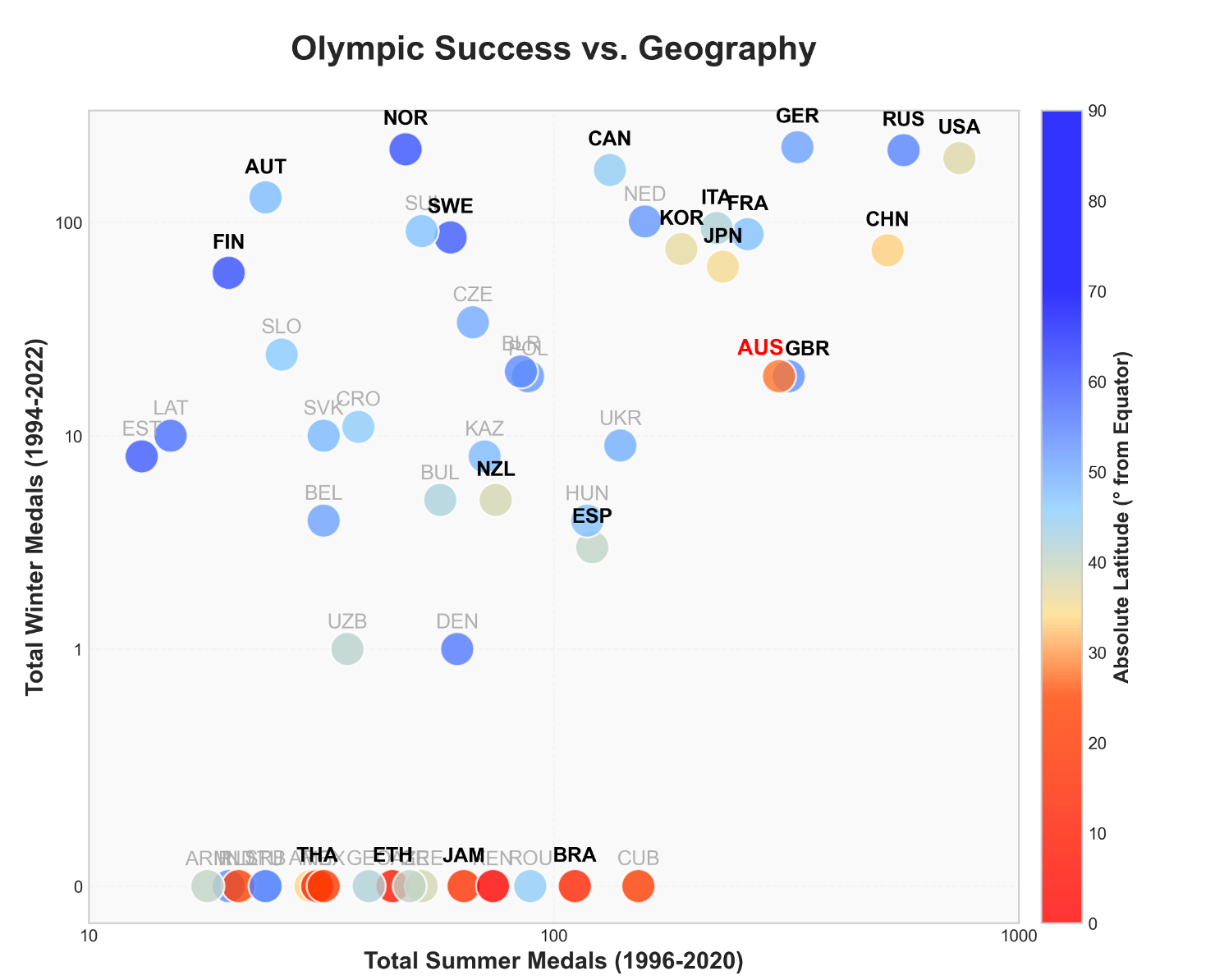
Latitude here is based on the population-weighted centroid of each country (because dirt doesn’t win medals)
There is a strong bluish tilt toward the upper-left, suggesting that those countries that outperform in winter sports are more likely to be further from the equator. There is also a string of near-equatorial countries along the bottom which have struggled to break into the winter medal tallies.
However, location is far from destiny. The map has plenty of outliers that defy their coordinates. Australia and Great Britain, for instance, match each other almost exactly in medal counts despite sitting at completely different latitudes. Australia may be the most unusual country on the picture due to a high winter tally despite an equatorial tilt.
(And a quick note for the purists: We know "Total Medal Count" is a bit of an arbitrary metric - it treats gold and bronze identically and ignores population size. But we’ve been down that aggregation method rabbit-hole before and for this analysis, simple counts give us the clearest picture of national winter vs summer specialisation.)
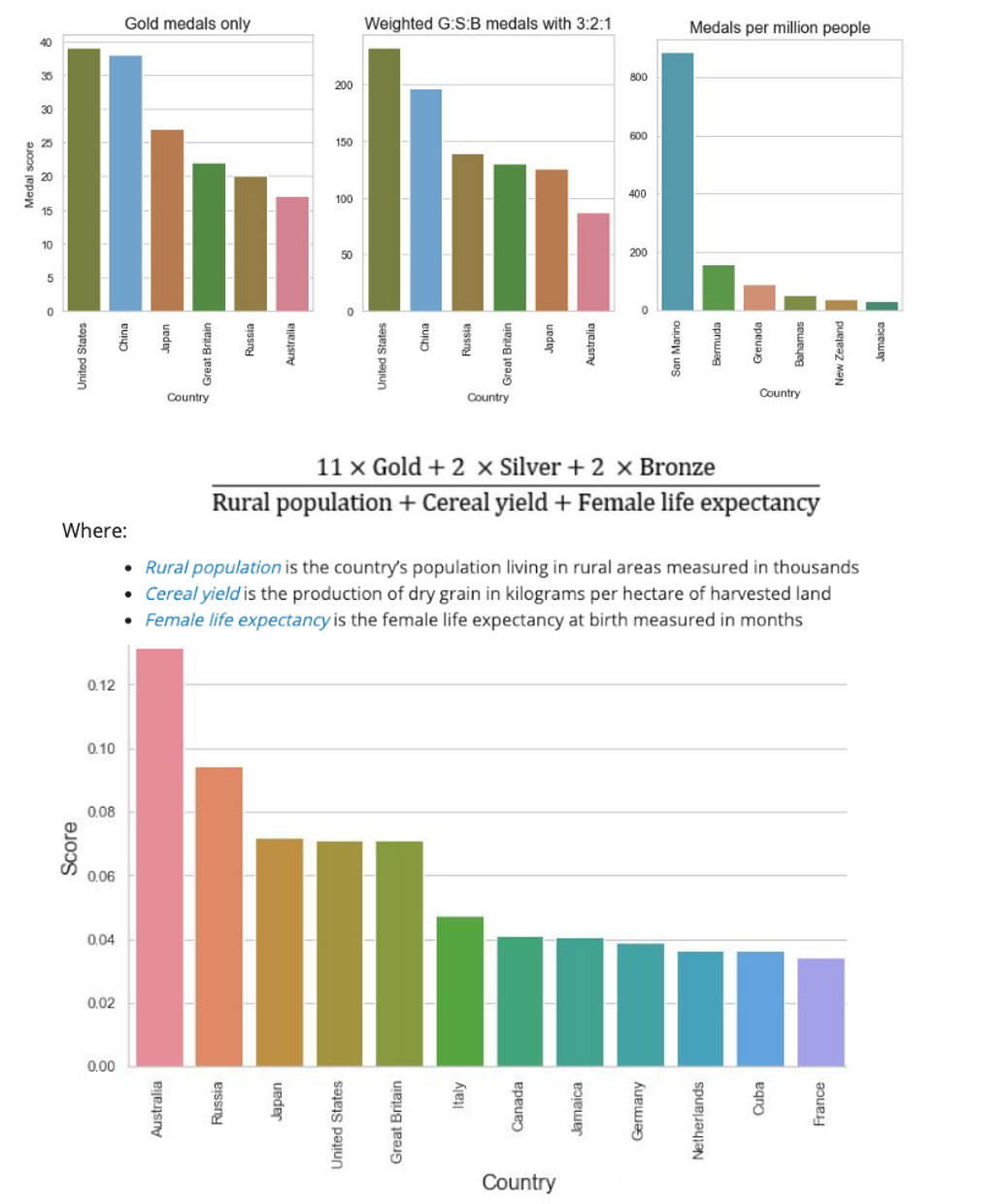
How to overcomplicate medal tally comparisons, from our analysis of the Tokyo Olympic games: https://www.actuaries.asn.au/research-analysis/faster-higher-stronger-the-models-medals-and-medallists-of-the-olympics
Closing the gap between our #6 summer rank and our #22 winter rank isn't just about having everyone start training harder. For each event, Australia must send their strongest winter warriors. To be part of the solution, we need to start looking in the mirror and figuring out which winter niche matches our particular size and shapes. Not sure where to start? We’ve got you covered.
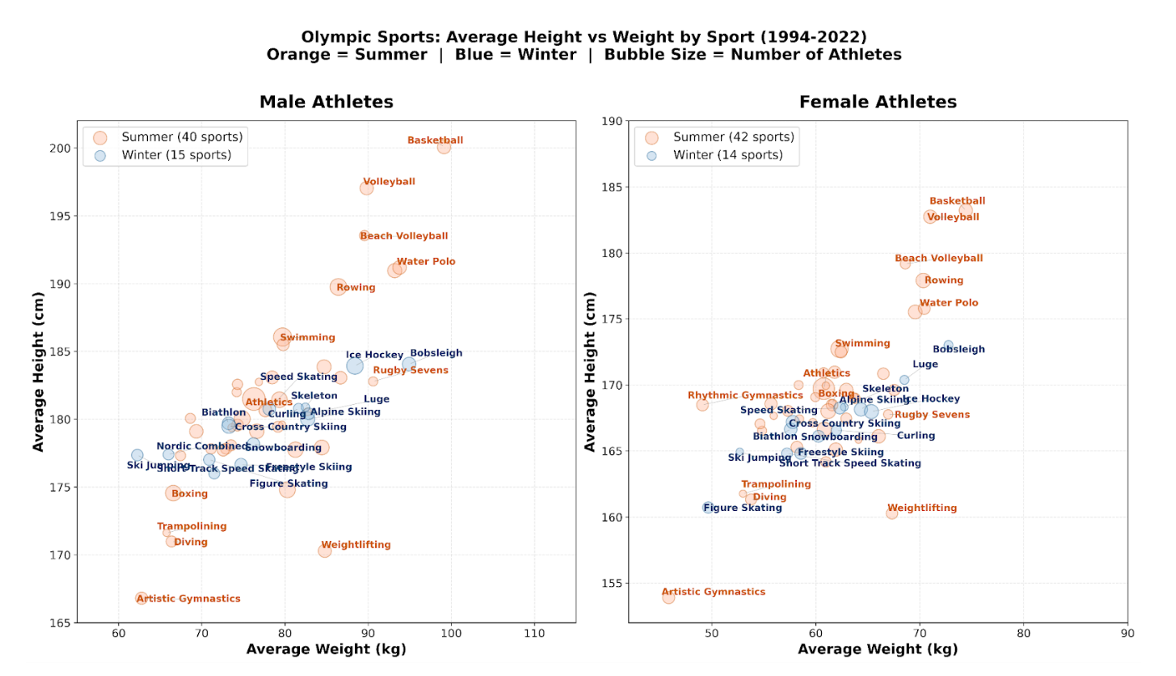
Check the graph to find the best sport for your unique physique!
Lucky for us, the Winter Olympics are at more achievable heights for the average person, whereas summer athletes are much more widely distributed, stretching up to the summer giants playing basketball. Are you a 6’5” man? You have effectively outgrown the Winter Games but if you are a short queen, lace up those figure skates!
However, while the height range is tight, the "density" is where the data gets weird. You have ski jumpers, essentially "human paper planes", who are tall enough to be average but maintain a feather-light weight to catch the wind, and bobsledders, the "gravity hogs" who break every weight rule to ensure mass equals momentum.
The outlier status of the bobsleigh raises a fascinating question. Could a summer athlete actually pivot to the ice without a genetic miracle?
Hollywood famously claimed that a group of Jamaican sprinters could transform into a world-class bobsleigh team, but does the physiology actually track?
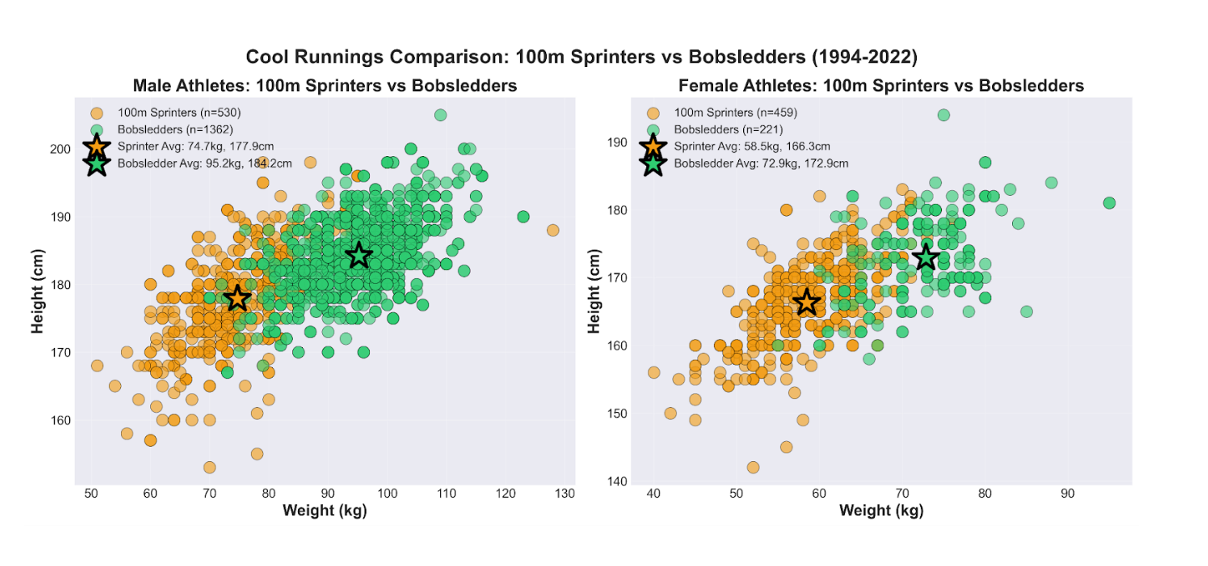
Comparison of 30 years of Olympic athlete data for 100m sprinters against bobsledders to see if the "Cool Runnings" holds up
As the data shows, the transition doesn't require a growth spurt. It requires a buffet. Sprinters and bobsledders share a similar range of heights at its core, but the bobsledders live in a much higher weight class. To make the jump from the orange "summer" cluster to the green "winter" peak, those sprinters didn't need to defy their DNA; they just had to gain roughly 20kg of explosive mass to push off and then let gravity do its job.
And it turns out that this transition from athletics to bobsleigh has happened before for our own Olympians! Australian athlete Jana Pittman is more famous for her performances in the 400m hurdles in the 2000 Sydney and 2004 Athens Summer Olympics, but she later changed focus to compete in the two-person bobsleigh event at the 2014 Sochi Winter Olympics.
So we know now it's possible to go from summer to winter… but what sports match up best? We crunched the numbers on 126 years of Olympic athlete data from Olympedia via Kaggle to find out.
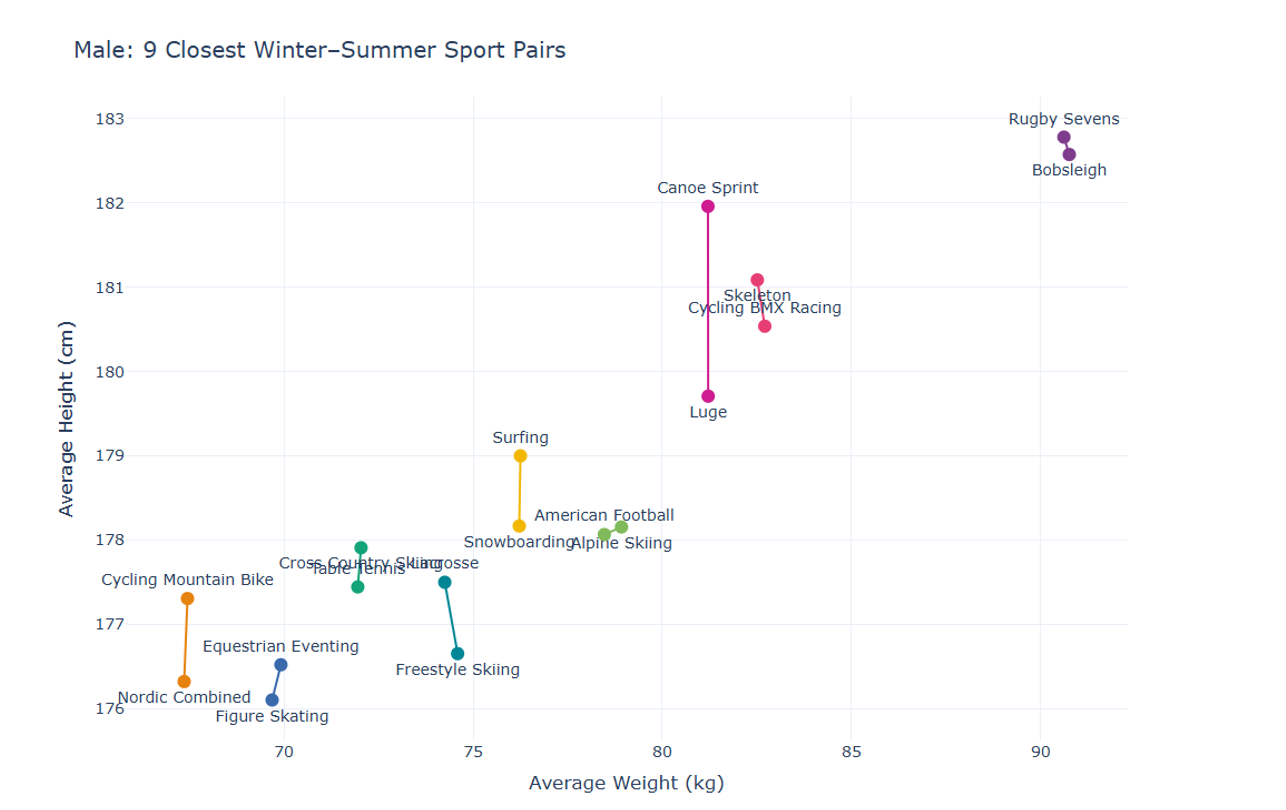
To get the most possible sport pairings to look at, we expanded the range to every Olympics… including the 1904/1932 demonstrations of American Football.
And as it turns out, the bobsleigh is primed for all of our Aussie rugby players to join! And BMX cyclists, you can now reach higher speeds in the skeleton! Table tennis rockstars, trade in those paddles for ski poles, cross country is waiting for you. The least surprising result of this analysis is that surfers are particularly suited to snowboard (see fresh powder waves above).
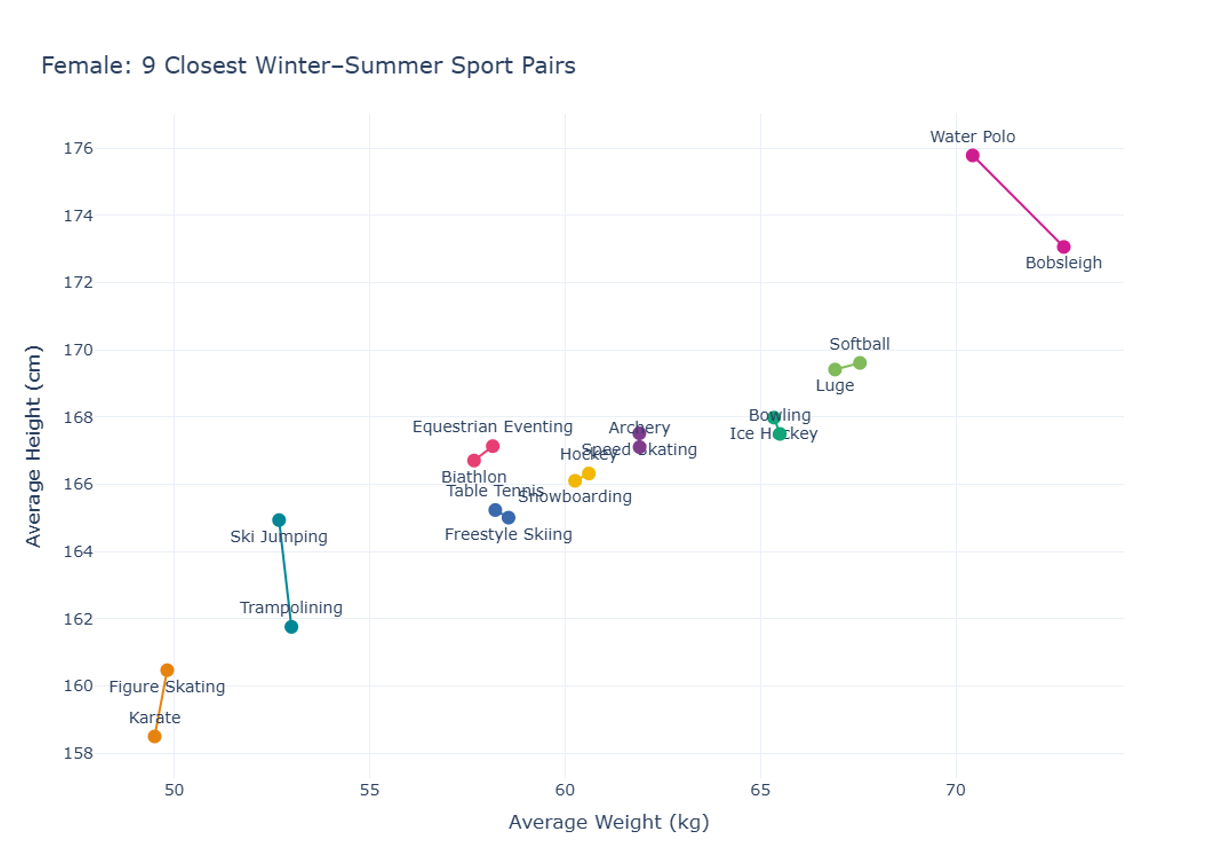
... what I do have are a very particular set of skills…” - Some speed skating archer, probably
Ladies, we’ve got you covered as well. We know you also love putting some spin on the table tennis ball, how about spinning yourself through the air with freestyle skiing? If you spend your weekends high kicking in karate, put those high kicks to use on the figure skating rink!
Of course, smaller sample sizes in some sports mean these matches are suggestive rather than definitive - but they're a fascinating starting point for understanding physiological transferability.
Whether it's an underdog story or a record-breaking run, the next few weeks are about more than just points on a graph; they're a testament to the fact that we are all capable of being part of something extraordinary (but we will still enjoy the points on the graphs).
So, as you watch the 2026 Olympics, enjoy the spectacle for what it is - a beautiful, chaotic and occasionally freezing display of what happens when the right person puts in the time to achieve something incredible. And if you find yourself looking at the screen and thinking, "I wonder what their centre of gravity is," don't worry… you're exactly where you need to be.
Enjoy the Games!
Dive into our Olympic analytics series:
The views expressed in this article are those of the author(s) or working group named below, and do not necessarily reflect the views of the Actuaries Institute. This work is licensed under a Creative Commons Attribution-NonCommercial-No Derivatives CC BY-NC-ND Version 4.0.


Receive industry-leading perspectives, straight to your inbox.