Life Insurance
Life expectancy projections in post-COVID Australia



Claim your CPD points
Two years ago, I found myself drawn to what initially seemed like a simple, but important question:
My original motivation for exploring this question was grounded in lifetime income pricing, where even small changes in long-term mortality assumptions can have meaningful financial implications. But the significance of the question extends well beyond longevity product pricing.
So, the question became the foundation of my paper , Understanding Cohort Effects in the Australian Population, which I presented at the All-Actuaries Summit 2024.
What emerged was something worth noticing. First, recent mortality improvements were on average lower than the Australian Life Table (ALT) 25-year historic average for Australians in early retirement, especially for males. Secondly, projected mortality improvements would continue to remain below the ALT 25-year averages in the near future.
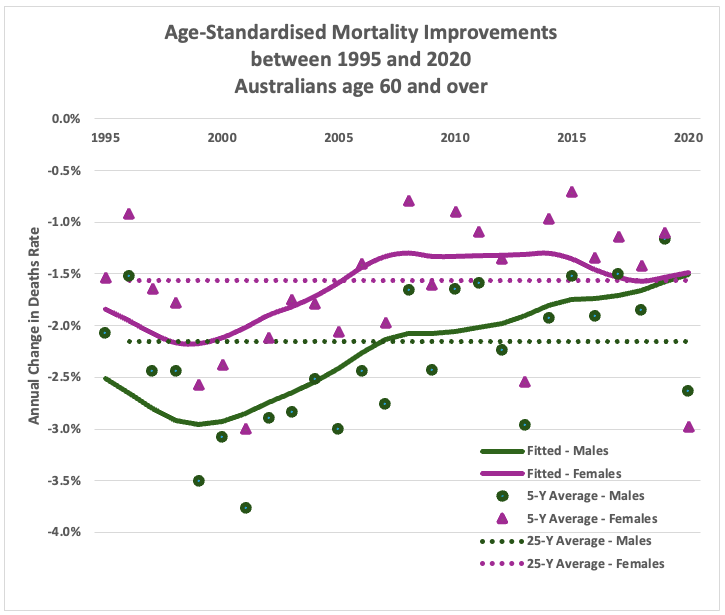
And importantly, this wasn’t a pandemic phenomenon. The slowdown was already observable, embedded in the data well before the pandemic. When the ALT 2020–2022 were released in December 2024, it came as little surprise that death rates for Australians in early retirement were higher than previously projected using the 25-year average mortality improvements from the 2015–2017 Australian Life Tables.
Both cohort effects and temporary excess mortality in 2022 contributed to mortality outcomes coming in higher in the ALT 2020-2022 than projected.
Talking about cohort effects, some generations have been fortunate. The so-called “golden cohorts,” born around 1930, benefited from extraordinary gains in cardiovascular health. But those that followed — particularly the cohorts born between 1955 and 1965 — have not experienced the same tailwinds.
In fact, quite the opposite: These later cohorts, now entering retirement, show weaker mortality improvements at the same ages, in particular as cardiovascular risk is no longer driving the increase in life expectancy.
I’m extremely grateful to the Actuaries Institute for recognising this work on cohort effects through the Melville Prize.
There was an important caveat in that original work, one that deserved, revisiting as I deliberately excluded mortality data from 2021 onwards. That decision was a constraint of the modelling framework itself.
The classic APCI (Age Period Cohort with Improvement) stochastic mortality projection model is powerful when it comes to identifying long-term trends. But it struggles with a sudden, temporary mortality shock at the end of the observation period. Including pandemic data at the time risked distorting the projections; forcing a long-term model to interpret what was a short-term disruption. So, I chose to leave out the 2021 and 2022 data. In hindsight, it was fitting to consider the 2022 excess mortality as transient and exclude it from the modelling.
Fast forward to today, and the picture looks different.
First, mortality experience from the Australian Bureau of Statistics extends through to 2024 (There is a delay in getting the granular data). We can observe not just the shock itself, but what comes after it. And importantly, we are starting to see signs of stabilisation following the peak of the pandemic.
Second, the modelling has evolved.
The updated model used in the projections introduces something that was missing before - the ability to explicitly model a temporary mortality shock, and to allow that shock to fade over time in a controlled way. Fast forward two years and it is possible to use four more years’ worth of data by fitting the peak of the excess COVID mortality.
Today, the core message from two years ago still stands.
In early retirement, projected mortality improvements remain below the historic 25-year averages, now updated with the ALT 2020-2022 publication. The cohort effects identified earlier are still flowing through and the COVID shock has not materially altered the underlying cohort dynamics. What remains of the “golden cohorts”, now in their 90’s, continue to perform strongly, while late baby boomers are still experiencing very limited improvements.
Below, we compare mortality improvements by age under the Australian Life Tables 2020–2022, based on historic 25- and 125-year averages, with forward-looking projections derived from a prospective, cohort-linked approach based on an APCI mortality projection model with mortality shock (See reference).
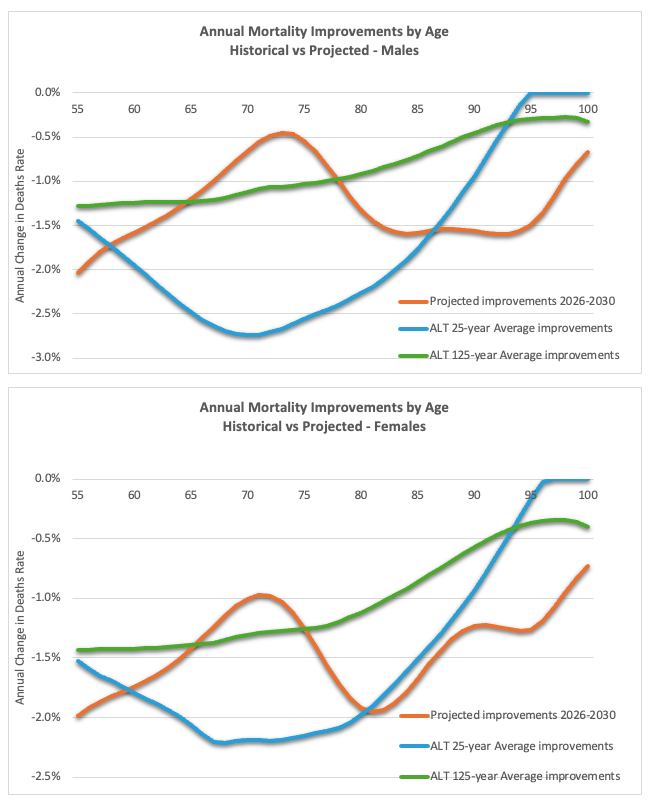
The strong mortality improvements observed in the ALT 2020–2022 25-year averages around ages 65–75 are not lost in the forward-looking projections, they are simply shifted to older ages. In a cohort-linked framework, these improvements follow the generations that experienced them, emerging at ages 85+ rather than remaining fixed at specific ages.
This has important implications for both cohort life expectancy at retirement and the mortality assumptions underpinning lifetime income products.
By period life expectancy, we mean life expectancy calculated using mortality rates observed at a single point in time, essentially a snapshot of mortality conditions.
By contrast, cohort life expectancy allows for future mortality improvements, reflecting how longevity is expected to evolve over an individual’s lifetime, and used in Lifetime Income Valuation, for example.
Having compared historical mortality improvements with the projected, cohort-linked, path going forward, the natural next step is to consider what this actually means in terms of life expectancy.
After all, cohort life expectancy is where these assumptions become tangible. It is the lens through which mortality improvements are translated into how long people are expected to live.
With that in mind, the next graphs explore how these updated improvement assumptions, shaped by persistent cohort effects and a post-pandemic environment, flow through into remaining life expectancy calculations.
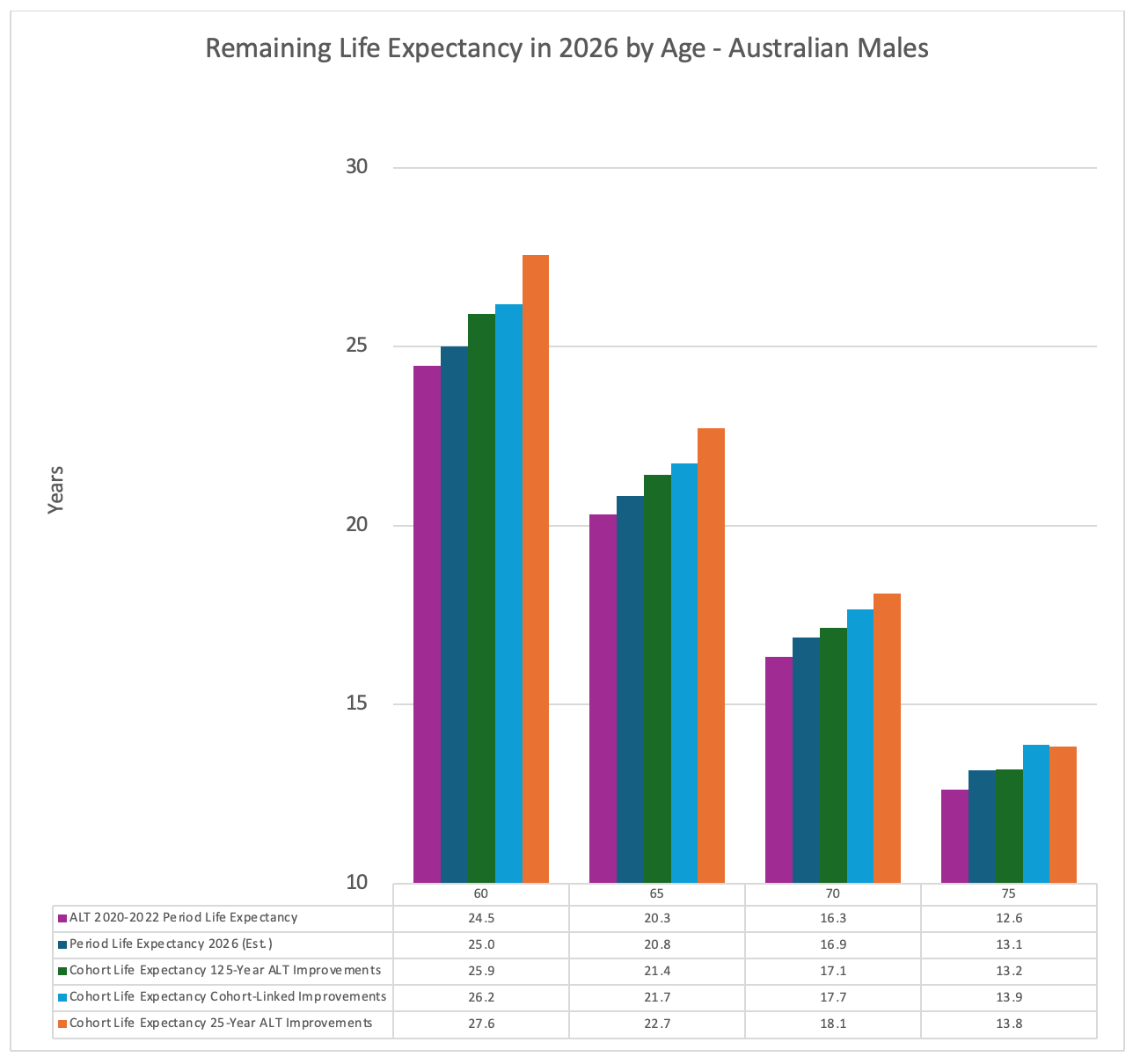
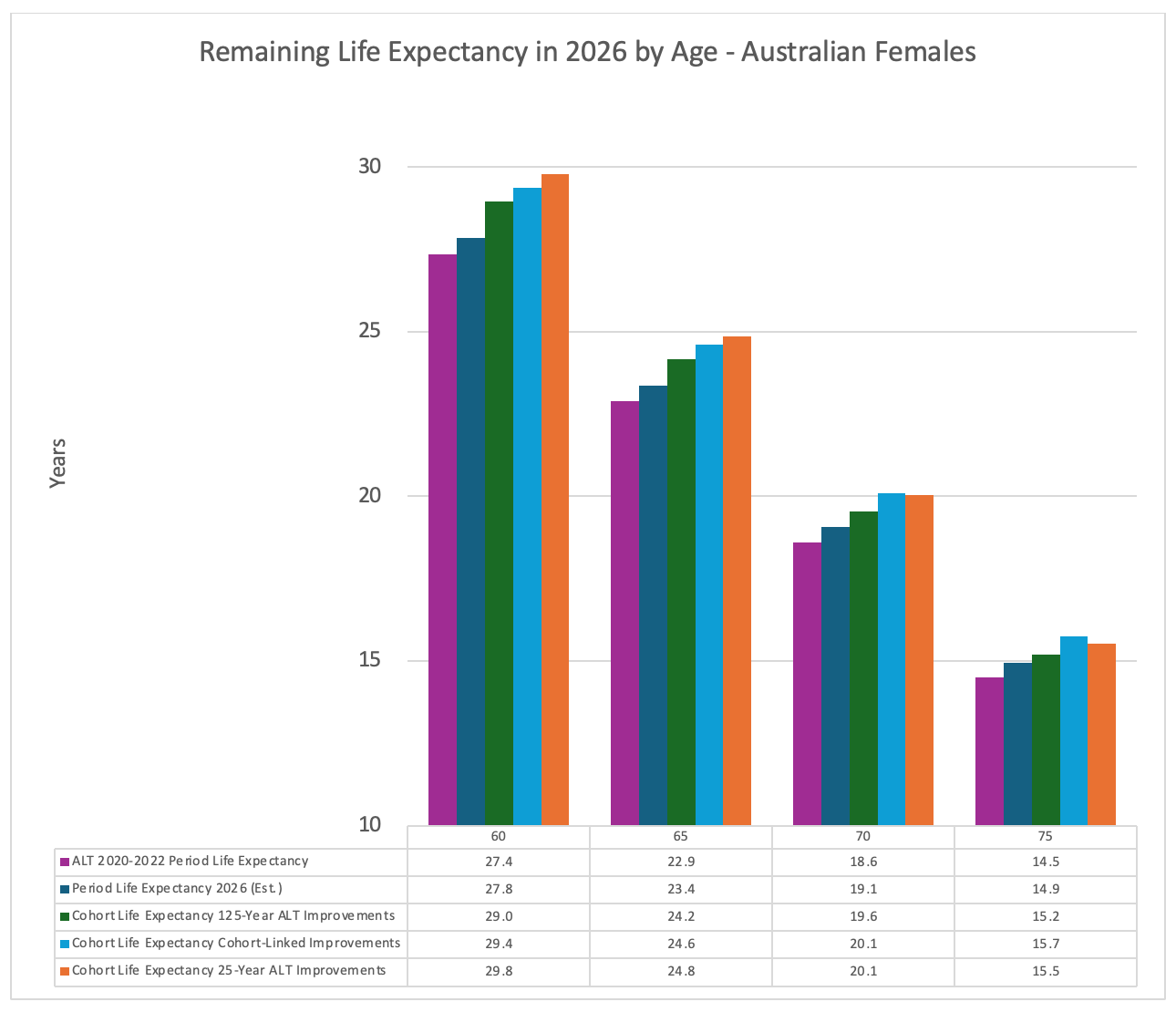
The charts bring together five different views of life expectancy by age, each reflecting a distinct way of thinking about life expectancy.
We start with period life expectancy based on the ALT 2020–2022. This is our starting point for calculation, making sure they match life expectancies from the Australian Life Table publication.
We then roll this forward to 2026 using an APCI framework that incorporates a mortality shock, effectively stripping out the temporary excess mortality associated with COVID as per the approach presented in the follow-up work last year.
From there, three perspectives are shown:
Taken together, these five measures span a spectrum, from more conservative to more optimistic views of longevity.
Some insights emerge from these comparisons:
We asked a question, wrestled with cohort effects, survived a pandemic, and used a forward-looking model that behaves when the data doesn’t, and along the way, arrived at a few practical takeaways.
It’s also been a genuine adventure to share these results with the actuarial community.
And after all that work, the conclusion is refreshingly simple:
Of course, these remain general population estimates, so lifetime income pricing may need to account for select effects and other refinements that affect base mortality assumptions. But as a rule of thumb, it’s more than enough to impress your newly retired parents at the family dinner table who stay up at night wondering how their life expectancy has changed since the publication of the Australian Life Tables 2020-2022 by the Australian Government Actuary.
Clark, P. (2024). Understanding cohort effects in the Australian population (Melville Prize paper, All Actuaries Summit 2024, Actuaries Institute). Actuaries Institutes. https://content.actuaries.asn.au/resources/resource-ce6yyqn64sx3-786882053-7186
Clark, P. (2025, June). Post‑pandemic long‑term mortality in Australia (Paper presented at the Actuaries Institute 2025 All‑Actuaries Summit). Actuaries Institute. https://content.actuaries.asn.au/resources/resource‑ce6yyqn64sx3‑786882053‑16098
The views expressed in this article are those of the author(s) or working group named below, and do not necessarily reflect the views of the Actuaries Institute. This work is licensed under a Creative Commons Attribution-NonCommercial-No Derivatives CC BY-NC-ND Version 4.0.

Explore actuarial thinking on life insurance pricing, product design, regulation and the evolving risk landscape
Subscribe to Actuaries Digital for free and receive the latest actuarial analysis, research, and commentary direct to your inbox