Life Insurance

Appointed Actuaries, AI and an industry in the spotlight

Back view of large group of business people attending a meeting.

Claim your CPD points

The profession faces significant challenges in life insurance, not due to a lack of insight, but because actions are seemingly constrained by current industry settings. What is to be done?

"Sustainability" and "AI" have become familiar terms for professionals working across the life insurance industry, featuring in discussions from morning coffees through to Boards. Both topics were also front and centre at the annual Life Insurance Appointed Actuaries forum held in May this year.

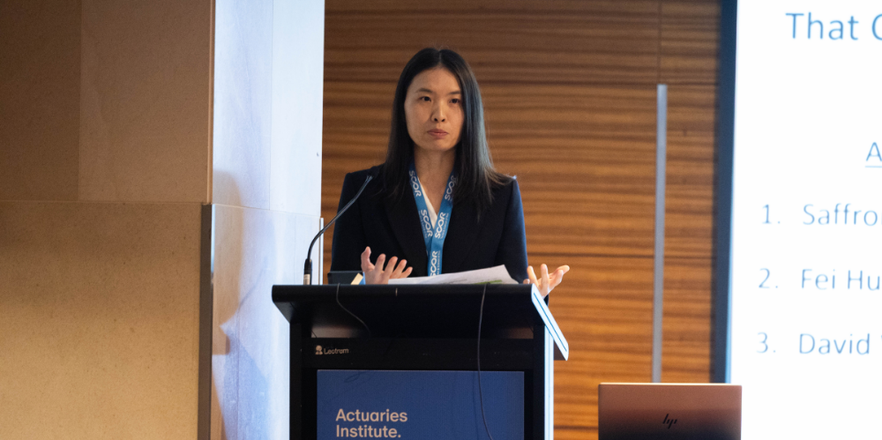
Held at the Actuaries Institute's office in Australia Square and chaired by Stuart Mainland, Appointed Actuaries and their deputies from across the life insurance industry gathered to discuss current industry issues and opportunities, the role of the Appointed Actuary and the actuarial profession.

APRA’s perspective on sustainability and capital

Colette Reid from APRA presented on two important topics for the regulator: the consultation on longevity capital requirements and concerns regarding the sustainability of the life insurance sector.

The opportunity to hear directly from and engage with, the regulator was appreciated by the room. Longevity capital changes are well understood, with the intention of avoiding undue dampening of future growth in the annuity sector. In contrast, life insurance sustainability remains a more complex issue, with the regulator expressing a clear preference for solutions to be industry led.

Life insurance sustainability

The topic of sustainability led into a broader discussion led by Jas Singh and Kent Hopper representing the Carpe Diem Working Group. Several structural factors are driving low new business volumes and poor portfolio performance:

  1. A lack of growth opportunities, particularly the challenge in growing direct and bancassurance channels.
  2. Material declines in financial adviser numbers, driven by a range of factors including successive advice reforms, higher education and professional standard requirements, and the increasing cost of providing advice.
  3. Impact of Life Insurance Framework reforms on adviser commissions, capping upfront and renewal commissions, reducing the economics of selling insurance.
  4. Product design challenges associated with living benefits, particularly lump sum TPD, driven by product complexity, evolving medical definitions and the difficulty in maintaining stable pricing.
  5. Fiduciary obligations leading advisers to recommend legacy products over newer offerings.
  6. Reputational impacts following the Royal Commission, affecting consumer trust and engagement with life insurance.

Several key themes emerged from the discussion. First, the challenge is not a lack of understanding among key decision makers, as the issues are well recognised by executives and their Boards. Second, the absence of a single solution, combined with first-mover disadvantage, has reinforced a status quo in which change is rationally deferred. Third, a historic focus on new business growth and heavy reliance on repricing have delayed addressing the underlying weaknesses in the current system.

Unsurprisingly, it was recognised that there are no easy solutions. The discussion reinforced that progress is often constrained by structural and commercial realities, rather than a lack of understanding.

How is AI being used in life insurance today?

Tim Lam from the Life Insurance Data and AI Working Group presented on practical uses of AI observed within the life insurance industry. Several current applications were highlighted, including:

  1. Medical evidence summarisation: Condensing GP reports, medical histories and attending statements into structured underwriter-ready briefs.
  2. Claims case summarisation: Collapsing months of notes, medicals and correspondence into an assessor-ready narrative.
  3. Financial advice assistance: Support advisers in day-to-day operations, superannuation funds embedding AI into limited-advice journeys.
  4. Pre-assessments: Triaging broker and adviser pre-assessment submissions extracting disclosed conditions, medications and risk factors to give underwriters and an early, indicative view.
  5. Vulnerable customer identification: routing cases to specialist handling.
  6. Corporate quote generation: producing tailored corporate insurance quotes into a first-cut proposal.

The next frontier isn't smarter AI models — it's agentic AI that chains steps, calls tools and hands back complete deliverables

The efficiency benefits of AI are easy to see and may help alleviate some of the commercial pressures currently facing advisers in relation to life insurance. Yet for all its promise, AI presently appears to help us do existing tasks better rather than paving a new way forward.

What is to be done?

This brings the focus back to sustainability and the role actuaries have to play in driving change. If actuarial tools alone are not sufficient, what is to be done?

  • Challenge the status quo: As actuaries, our familiarity with the control cycle has made us highly effective at calibrating and refining existing parameters to optimise outcomes. However, systemic issues often require different framing altogether. Rather than asking "how do we fix TPD pricing?", we might instead ask "can this product be priced sustainably at all?" or "is this product still fit for purpose?".
  • Lead within your circle of influence: The outcomes of our analysis may demand healthy tension between colleagues, departments, insurers and their reinsurers, or even the business and the Board. Holding the line on technical discipline may mean not supporting certain product features, a headline price that is out of line with the market, or material write-downs on newly written business. These decisions are rarely visible externally but collectively shape the direction of the industry.
  • Develop a considered view: Most actuaries working in life insurance have direct exposure to the adverse consequences of the sustainability challenge and will have an intuitive sense of the issue. However, this is not the same as having a clear point of view. What precisely is broken and why? Where are the key tensions, for example, between affordability and coverage, or between sustainability and competitiveness? What role should life insurance play within broader societal support systems? The answers and emphasis may differ depending on where an actuary sits within the system.
  • Contribute to the dialogue for change: Discussion now includes a growing body of analysis describing the problem. While valuable, there remains a relative shortage of clearly articulated proposals that can be debated, refined and built upon1. What is needed are papers, proposals and thought pieces that anchor discussion — recognising that even imperfect or narrow contributions can help move the conversation forward.

The implications of the sustainability issue go beyond profitability for insurers and contribute to underinsurance and adverse policyholder outcomes among Australians. There is an imperative that this issue be addressed. No single actuary can resolve these challenges alone. But disciplined actions and sustained contributions across all parts of the life insurance ecosystem together drive progress. Actuaries have a critical role to play

References

1. For an example, see the recent dialogue paper authored by David Knox AM and Nick Calil, It’s Time: Here’s How to Turn Superannuation into a Retirement Income System .

This work is licensed under a Creative Commons Attribution-NonCommercial-No Derivatives CC BY-NC-ND Version 4.0.

About the authors
Headshot of Daniel Ch'ng
Daniel Ch'ng
Daniel is a Senior Actuary at Swiss Re, responsible for leading the Life & Health local reporting function. He has over 15 years’ experience in the life insurance industry across corporate and consulting roles, with experience spanning the value chain. He is passionate about the role of the actuarial profession in contributing to society, particularly in insurance and retirement.

What's driving life insurance today?

Explore actuarial thinking on life insurance pricing, product design, regulation and the evolving risk landscape

Never miss an article

Subscribe to Actuaries Digital for free and receive the latest actuarial analysis, research, and commentary direct to your inbox


Woman working on her laptop across the Actuaries Institute logo and blue background