Professionalism Training
Peering into peer review



Claim your CPD points
| Key points:
|
Peer review is a fundamental element of professional behaviour and critical to the Code of Conduct Principle of Competence and Care. The Guidance Document supporting the Code has recently been updated, among other things, to elaborate on considerations regarding peer review practices. There are many forms of peer review and the practice can vary for different actuarial environments.
At an Insights Session on 27 November 2025, three speakers outlined their perspectives:
Each addressed a number of questions, including:
For both formal and informal reviews:
There were also broader questions posed for each speaker to ponder:
It was fascinating to hear the common themes—one of which was the value of learning derived from an insightful review—alongside the very different considerations of how to determine who should peer review the work. Tracy shared a framework (shown below) detailing four quadrants she uses to help consider the formal and informal and internal and external considerations.
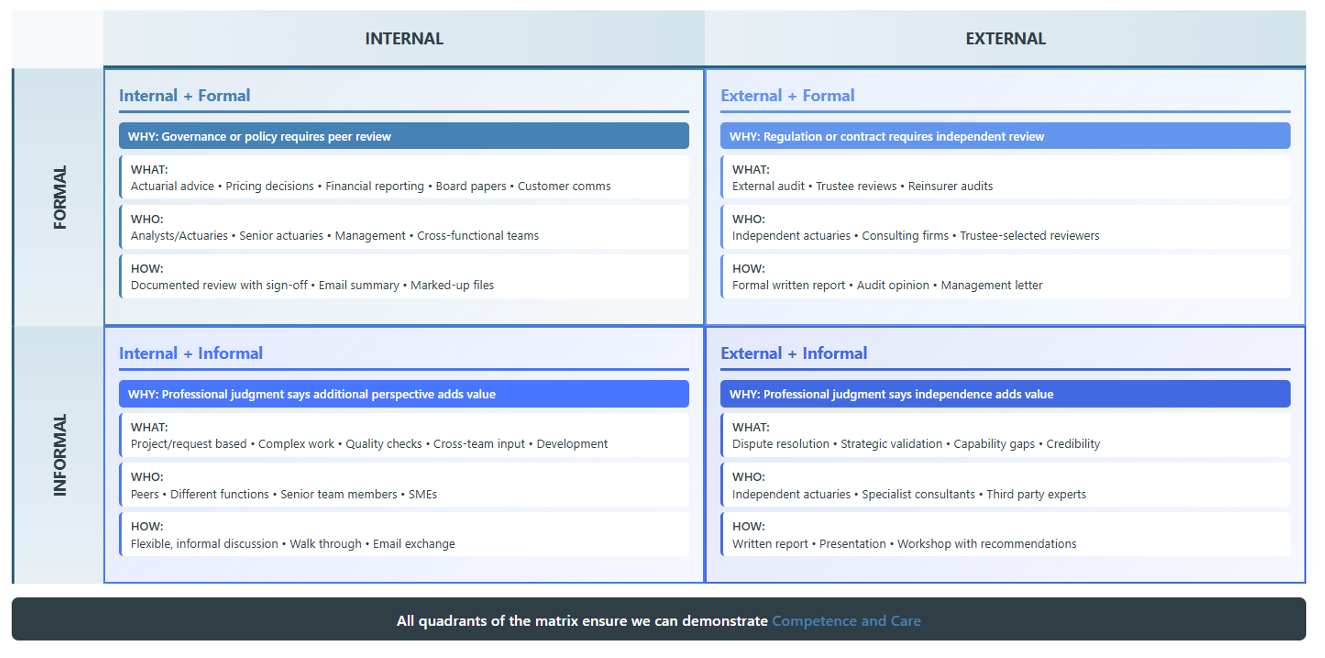
Four quadrants to help you consider the formal and informal and internal and external considerations.
When requesting a peer review, Simon tries to explicitly identify and document the known unknowns – areas where information is currently unavailable or uncertain, such as emerging regulatory changes, incomplete data, or evolving client requirements – and seek input from the reviewer.
Equally important is maintaining awareness that unknown unknowns can emerge during the engagement, which the peer reviewer may discern at that semi-final stage and then may recommend establishing clear communication protocols with the client. He suggested that using the client’s own staff can sometimes serve as a peer-review resource.
The panel discussion addressed questions from both the live and online audiences. As to what constitutes a “fantastic” peer review, each panellist valued reviews that challenged their thinking in some way, with none accepting that a perfect tick was the best result.
The importance of factoring in enough time for both the conduct and incorporation of the peer review was a key point that each stressed. The significance of sufficient time is often understated and Saffron presented a flowchart to remind the audience of allowing for all stages in a client project:
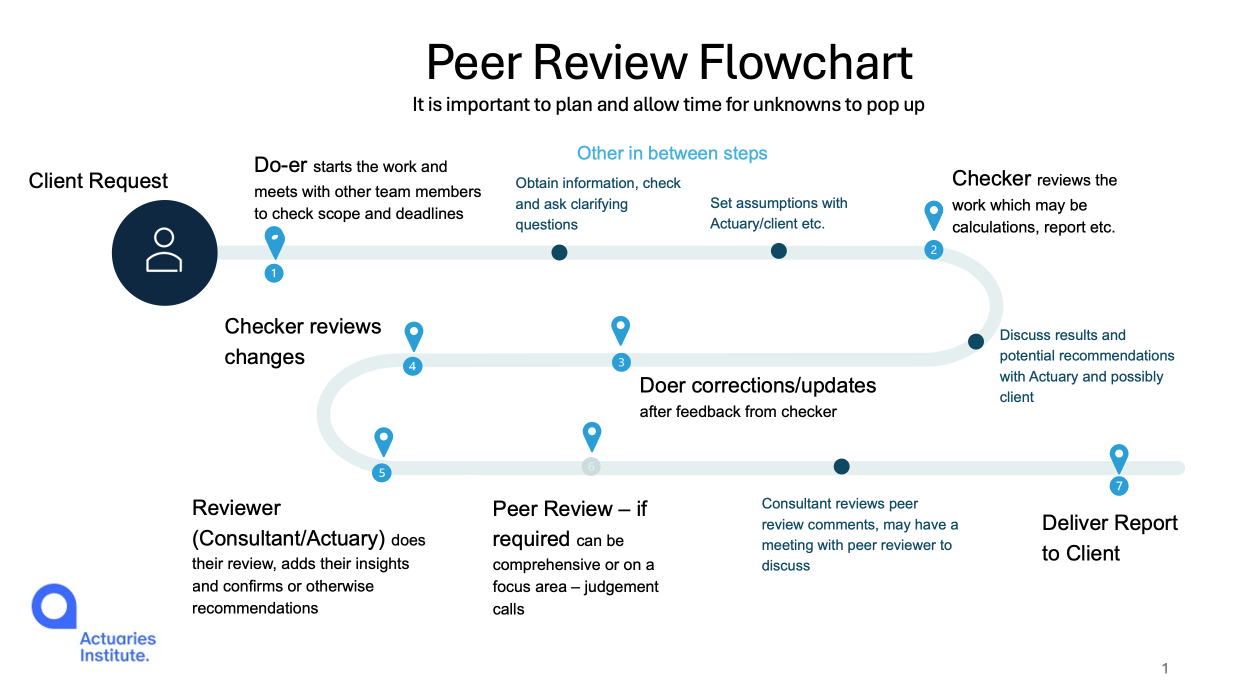
A useful flowchart to remind the audience of allowing for all stages in a client project.
Peer review is an important component of our professional behaviour. One question from the audience was whether this practice is genuinely ingrained in our culture or still relies on frameworks and processes set by employers.
This is probably a question each reader should reflect on. In short, do you naturally seek to have your work reviewed, or only when required?
Catch up on the Insights Session below.
Further resources:
Actuaries Institute. (n.d.). Professionalism: The Role of Peer Review. https://www.actuaries.asn.au/research-analysis/professionalism-the-role-of-peer-review
Actuaries Institute. (n.d.). Code of conduct. https://www.actuaries.asn.au/professional-standards-and-regulation/code-of-conduct
The views expressed in this article are those of the author(s) or working group named below, and do not necessarily reflect the views of the Actuaries Institute. This work is licensed under a Creative Commons Attribution-NonCommercial-No Derivatives CC BY-NC-ND Version 4.0.

Explore the standards, obligations and ethical challenges that define actuarial professionalism
Receive industry-leading perspectives, straight to your inbox.