Health
Why does the risk equalisation system need reform?



Claim your CPD points
Although the principles behind risk equalisation (RE) are foundational in supporting the private health insurance (PHI) industry’s financial stability and its community rating, the current scheme is drifting. This article explores the important consequences arising from this drift and the case for reform.
If recent trends continue, more than 55% of hospital claims are projected to be subject to RE within 10 years.
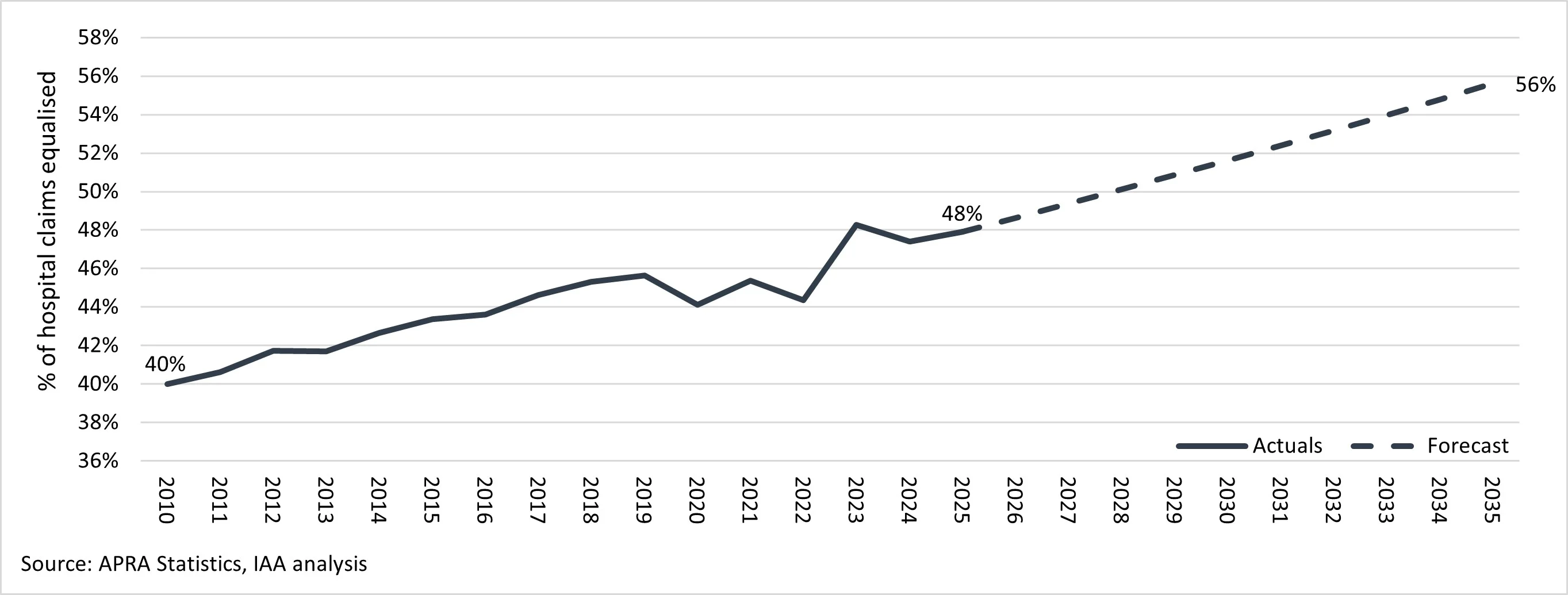
Hospital claims subject to risk equalisation
The table below compares the historical growth in industry hospital claims and gross deficit (GD), which represents the component of hospital claims that is subject to risk equalisation. GD’s higher inflation is indicative of an aging population and declining youth participation.
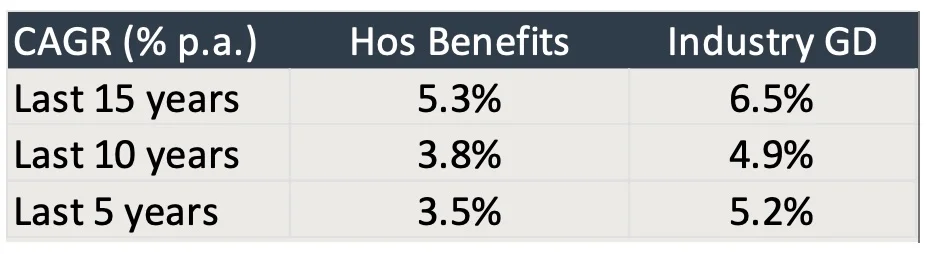
Growth in industry hospital benefits, gross deficit and its proportions
An outcome of community rating is that it incentivises risk selection as other typical insurance levers such as pricing and underwriting are restricted. The current RE scheme is retrospective, i.e. based on historical claim payments. Although stable and predictable, this reduces the incentive for insurers to efficiently manage claim costs and therefore is less effective in mitigating this selection bias, because they share a significant proportion of any cost savings with the industry. These limitations have contributed to the industry’s less-than-ideal investment in prevention, alternative care settings or claims leakage initiatives.
When the scheme was first introduced in 2007, less than 40% of hospital claims were captured. This proportion may be a reasonable balance between stability and efficiency, but by 2025, it has risen to 48% and, at recent growth rates, is projected to rise to 56% within the next 10 years.
Using a typical basic hospital policy from a major insurer as an example, in 2020, only 23% of the annual premium of $1150 represents the cost to insure a young policyholder, including the claims, expenses and profit. In contrast, 77% of the premiums relate to the calculated deficit expenses, which are essentially subsidies paid by the young policyholder to the risk equalisation pool.
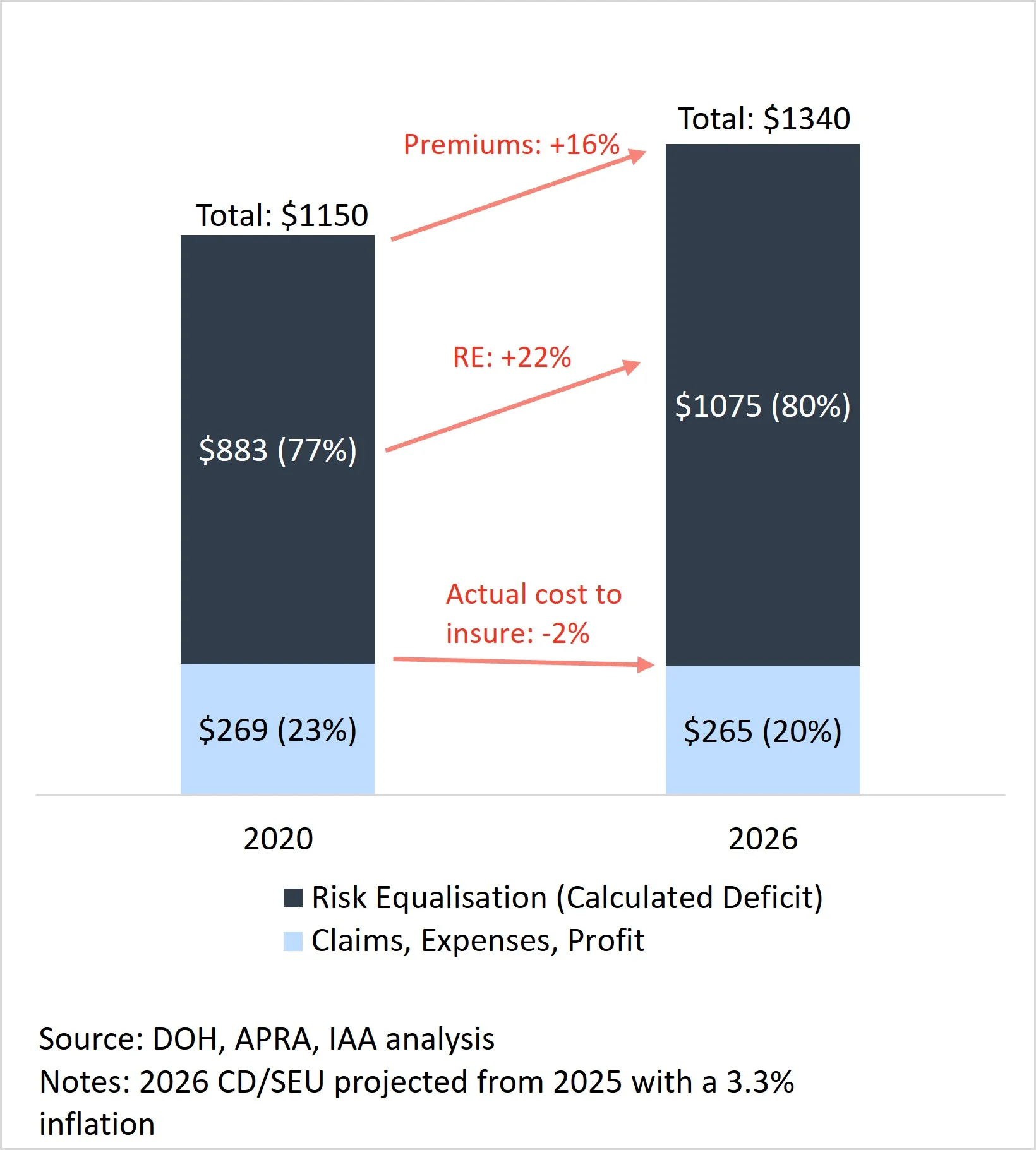
Illustrative breakdown of basic hospital policy annual premium (Before rebates, loadings and discounts)
Although an element of subsidisation must be accepted as the cost of community rating, it has resulted in views that for young and healthy policyholders, private health insurance often provides little value [1] , since most of the premiums paid by young policyholders are used to subsidise older policyholders rather than funding their own claims.
In 2026, this issue has become worse. Premiums on this policy have risen by 16%, yet because the calculated deficit share has grown from 77% to 80%, the policyholder’s cost to insure has declined by 2%. Using industry data to estimate the claims component, a FY25 net margin of 4.6% and a management expense ratio of 10.9% only leaves less than 5% of the premium for claims, with limited extent for the insurer to mitigate rates with lower margins. Such trends challenge the viability of PHI as an insurance solution for young people because they will increasingly view the product as a tax-driven forced purchase, equivalent to simply being an additional income tax.
Modelling suggests that each 10% reduction in the under-55 mix increases premiums permanently by 5%. This is because, as shown by the figure above, the majority of premiums from young policyholders are used to subsidise industry premiums rather than paying their own claims. Reductions in the mix of these age groups result in a loss of industry revenue without a commensurate reduction in claims.
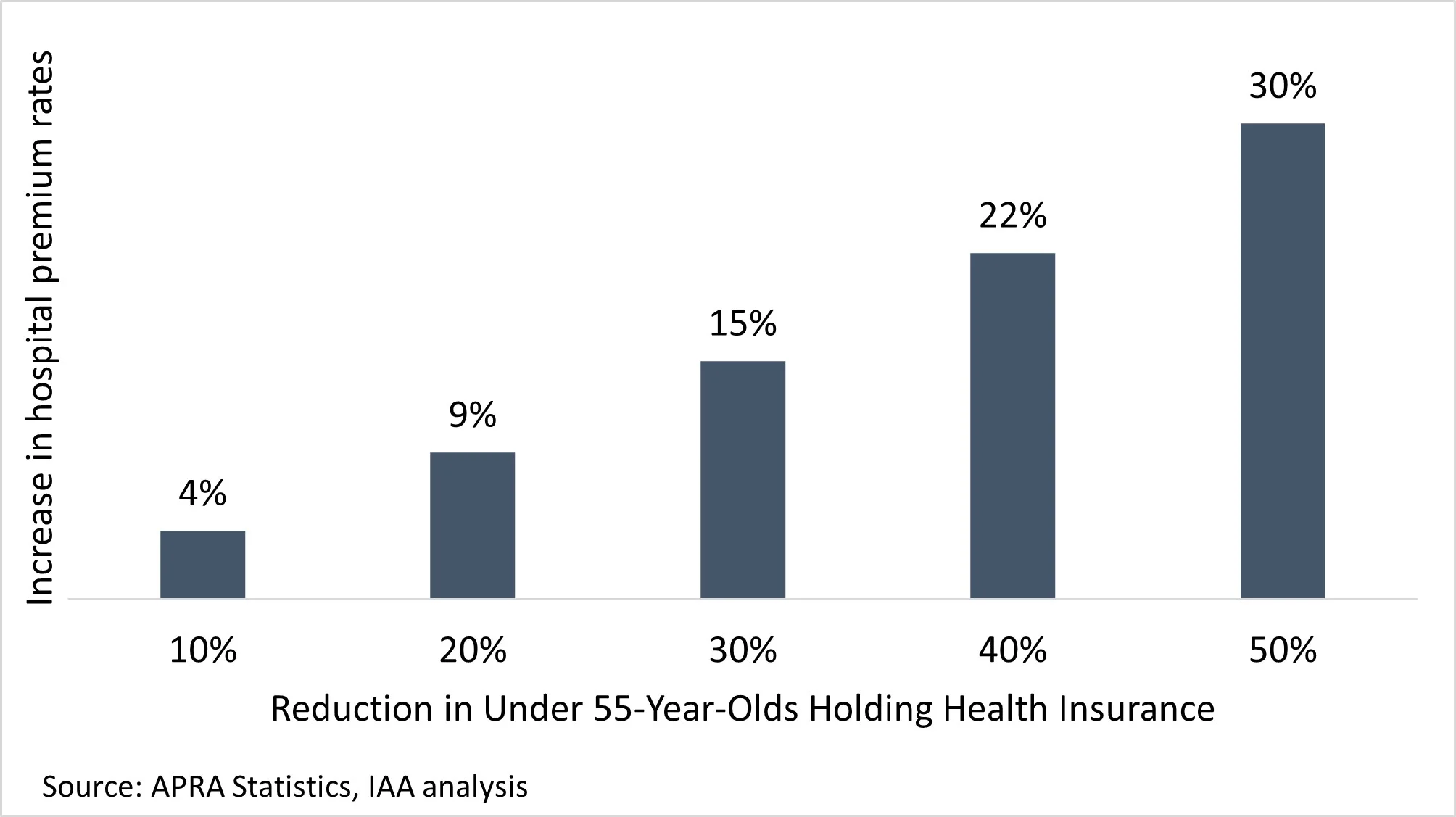
Premium increase due to reduced participation
Prospective risk equalisation is one solution to the problems faced by the current scheme. Under prospective RE, payments between the RE pool and each insurer are derived based on the expected cost of the insurers’ portfolio, which would in turn be a function of each insured’s risk profile (with relevant adjustments). The factors underlying the risk profiles are a key design consideration, and may include age, health status, prior claims history or even health-related behaviours.
Once RE payments are made, subsequent actual claim savings would accrue to the insurer as long as the policyholder remains a customer over the RE period. The latter point on customer retention is a key feature of the Australian PHI system – portability and high propensities to switch. This improves the incentive for the insurer to reduce claim costs and improve the health of its policyholders.
The overall aim of prospective RE is that over the medium and long term, the successful reduction of claim costs will reduce industry premiums. Its design should target the following key goals:
With the case for reform and the goals of a prospective RE system made, a subsequent article will explore its design and implementation considerations. These include:
[1] https://www.abc.net.au/news/2025-06-30/private-health-insurance-is-it-worth-it-tax-time-surcharge/105121592
The views expressed in this article are those of the author(s) or working group named below, and do not necessarily reflect the views of the Actuaries Institute. This work is licensed under a Creative Commons Attribution-NonCommercial-No Derivatives CC BY-NC-ND Version 4.0.

From risk equalisation to claims analytics, explore actuarial perspectives on Australia's health insurance sector.
Subscribe to Actuaries Digital for free and receive the latest actuarial analysis, research, and commentary direct to your inbox