Health
From strong to adaptive: What FY25 data quietly reveals




Claim your CPD points
"Look backwards while moving forwards to learn from the past."
Not to repeat the past, but to understand what it is quietly revealing to you about the future.
Each year, the APRA Operational Statistics give the private health insurance sector a snapshot of performance. Margins, membership, capital, costs and member age. But the real value of this data is not the scorecard. It is the signal.
If you are shaping strategy, overseeing transformation, or trying to future-proof your fund, this article uses the FY25 statistics not as a retrospective report, but as an input into forward-looking decisions.
What is the system telling us?
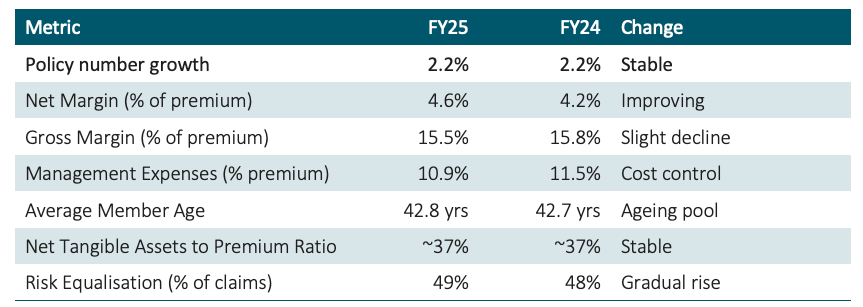
Source: APRA Statistics
On the surface, the industry looks stable. But stability can mask drift. To understand whether this is a strength or stagnation, it helps to step back and ask three questions.
1. Is the balance sheet strong and is it being used wisely?
From a financial perspective, the answer is yes. Capital positions remain solid. Net margins have improved. Management expenses have fallen meaningfully. These are genuine achievements in a tightly regulated and cost-pressured sector.
Here is a graph of capital strength showing both the $ of net tangible capital and expressing this as a percentage of annual premium revenue, so we can compare funds.
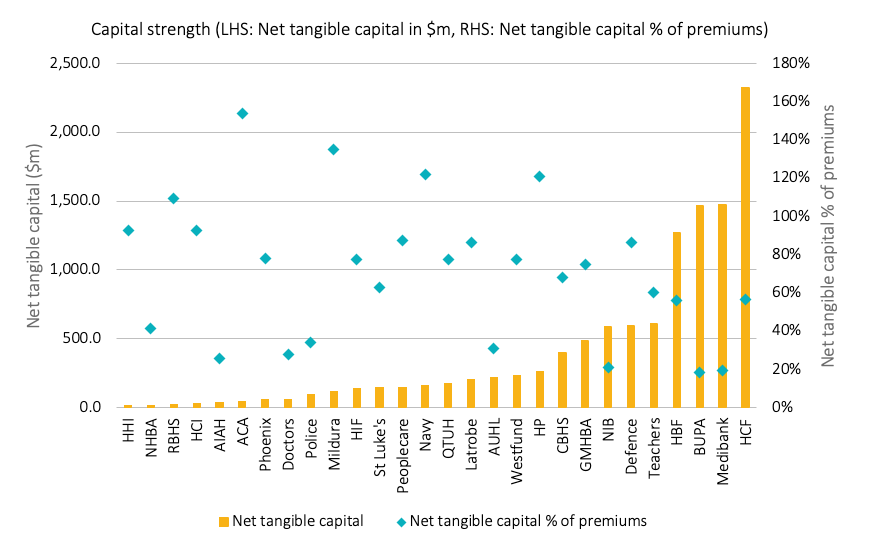
Source: Finity PHI Data FY24 and FY25, APRA Operations of Health Fund
APRA also measure the Capital Adequacy Multiple (CAM). CAM is defined as the ratio of the actual eligible capital base to the APRA prescribed capital amount (PCA). It provides an indication of the solvency strength of the industry.
On 30 June 2025, CAM was 2.55. Our analysis of the CAM disclosed for each organisation indicates a range of 1.7 to 5.3 times. (collated from individual fund disclosures in annual reports and public websites). In comparison, the general insurance industry’s CAM in FY25 is 1.85.
Across organisations, insurers (PHI and General) have different capital management practices reflecting differences in their risk appetite, risk/business profile, investment strategy, ownership/corporate structure and their access to additional capital. As a result, the CAM differs markedly by insurer.
The PHI industry is financially strong, but strength alone is not a strategy. Too often, capital is treated purely as a safety buffer rather than as a strategic lever. The real opportunity is to redeploy balance sheet strength into capabilities that help organisations learn faster and listen better. That includes investing in systematic experimentation, retention testing, feedback-driven improvement and deeper member insight that identifies shifts in behaviour before they appear in data.
Capital creates long-term value when it enables adaptation, not just protection.
2. Are margins holding while trust quietly erodes?
Net margins rose from 4.2% to 4.6%. Management expenses dropped from 11.5%to 10.9%. Operationally, the industry is executing well.
Policy growth of 2.2% is modest. At the same time, the average age of members continues to creep upward. While not published in industry operational statistics, individual funds can assess their own lapse rates and customer retention capability.
This combination matters. It suggests that while funds are running efficiently, this raises a question: Are PHI funds at risk of losing emotional connection with parts of their membership base? Products still feel similar. Value propositions are hard to distinguish. Promotional activity is high, but the long-term impact remains unclear.
3. Is franchise value growing, or quietly eroding?
Historically, franchise strength in private health insurance came from brand, scale, and operational competence. Today, those attributes are expected.
What increasingly differentiates funds is their ability to move with their members. How quickly they sense change. How fast they learn from behaviour. How effectively they adapt products and experiences in response. This is where past data becomes a warning light.
Risk equalisation now accounts for 49% of total claim costs, up from 48% last year. It may appear incremental, but structurally it is significant. In 2005 it was 37% of hospital claim cost shared.
As membership ages and higher-claim members stay longer the system becomes more reliant on internal cross-subsidy. This is a quiet pressure, not a crisis headline, but it matters.
The sustainability of community rating becomes more fragile. Over time, this creates both economic strain and political vulnerability. The future franchise will not be built on defending existing products. It will be built on designing participation, simplicity, and relevance for those currently disengaging.
More sharing may be eroding both the incentive for innovation and the budget discipline encouraged by having multiple PHI organisations.
The FY25 APRA statistics tell us the industry is executing well. Margins have improved. Costs are under control. Capital remains strong. These are signs of disciplined performance.
But APRA industry data focuses on what is measurable. It reflects how well we operate inside known parameters. It does not reveal how effectively we are learning or sensing what is changing around us.
The patterns identified in this article emerged from AI-assisted analysis of FY25 industry statistics. This reflects the growing ability of AI to synthesise large volumes of operational data and highlight standout trends. It represents a form of execution efficiency that is now accessible across the sector.
To explore what the data doesn’t show, we can assess capability across three modes of performance. These modes help reveal not just how well we are performing, but how well we are evolving.
| Capability | Related Metric | Strategic Signal |
| Execution efficiency | Net Margin ↑, Expenses ↓ | The industry is delivering known value well |
| Learning effectiveness | Policy growth low; retention likely a challenge for many. | Are we evolving offerings fast enough to grow engagement? |
| Perception sensing | Member age ↑, Cross-subsidy ↑ | Are we missing emerging needs or subtle shifts in how members perceive value? |
However, strategic advantage will not come from identifying known trends faster. It will come from learning what those trends imply and sensing what they do not yet show.
AI can help reinforce or rebalance the three core capabilities: execution, learning and perception sensing:
The data points backward. Strategy must look forward.
The FY25 data does not suggest a system in crisis. It highlights a sector approaching an inflection point.
Operational discipline remains strong. Financial reserves are stable. However, subtle signals point to emerging risks in:
Future performance will favour those who combine:
Three questions for your strategy conversations
Choose one domain such as pricing, member service or retention and run a small, sensing-driven experiment. Use AI not only to refine what you know, but to uncover what you do not. Adapt based on what your members are quietly showing. Don’t wait for the next industry operational statistics to confirm what your members are already telling you.
The views expressed in this article are those of the author(s) or working group named below, and do not necessarily reflect the views of the Actuaries Institute. This work is licensed under a Creative Commons Attribution-NonCommercial-No Derivatives CC BY-NC-ND Version 4.0.


From risk equalisation to claims analytics, explore actuarial perspectives on Australia's health insurance sector.
Receive industry-leading perspectives, straight to your inbox.