Health
Gold health insurance: the problem we created — and how to fix it



Claim your CPD points
The heart of the issue is that these products are both unprofitable for insurers and incredibly expensive for consumers as high claimers for services typically used by younger policyholders (such as pregnancy and psychiatric care) are concentrated on one product. This dynamic has resulted in less and less policyholders having coverage for these services, with flow on impacts to service providers and access to these services in the community.
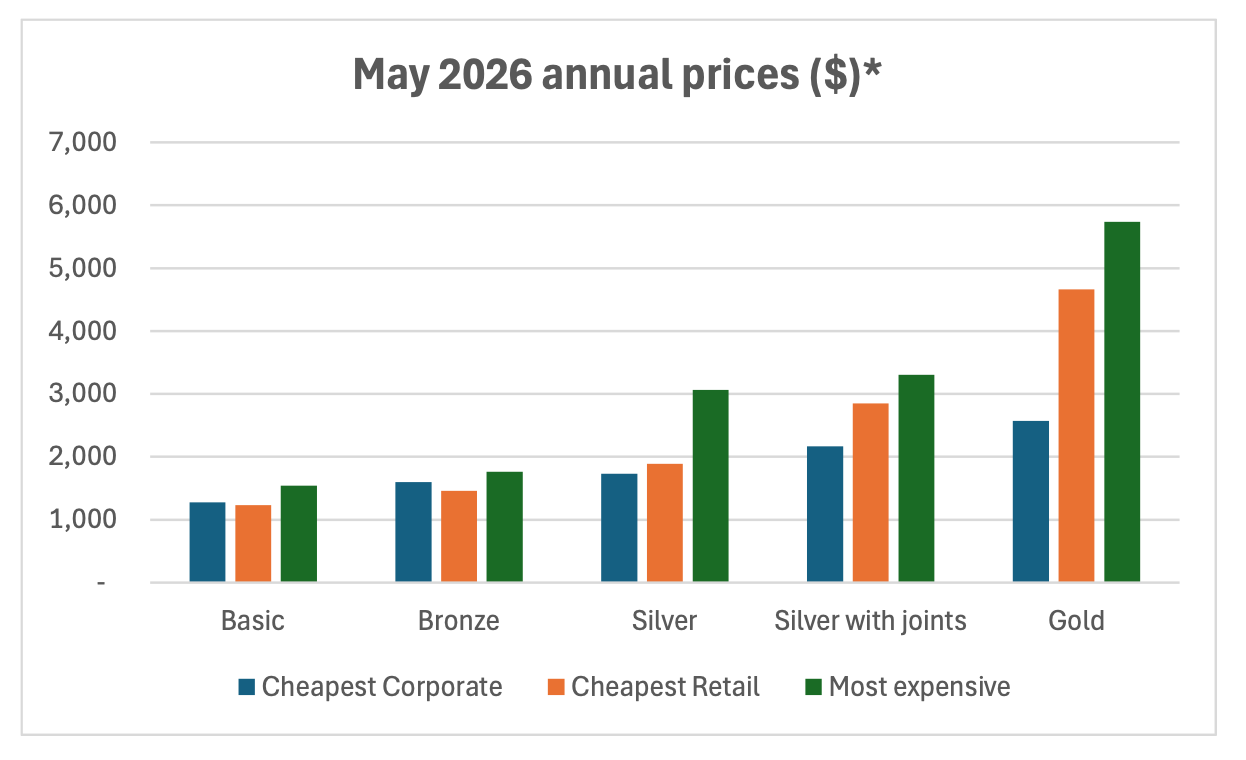
Source: healthslips.com.au | *Single, annual, NSW, $750 excess, before rebate and lifetime health cover loading, largest 5 insurers with 80% market share, open products
By June 2005, nationally, over 95% of products held were Gold and private hospital participation rates were 43%. There were essentially two products:
In June 2018, only 56% of products were Gold and private hospital participation rates were 45%. The introduction of product tiering in April 2019 reduced the proportion of Gold products to 43%, with the latest figures (March 2026) now at just 30%.
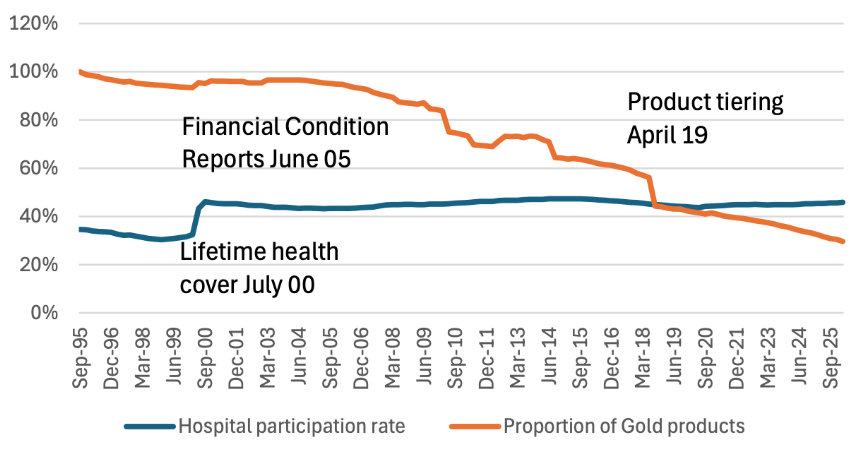
Source: Quarterly Private Health Insurance Membership Trends March 2026
Private health insurance is intended to be community rated, with all paying the same price for cover regardless of age, gender, or health status and the risk equalisation system is in place to support this principle. This risk equalisation system is primarily age based, providing support to policyholders aged 55 and over based on actual claiming rates.
Over time, insurers were increasingly looking for ways to differentiate in the market with innovative products and pricing strategies and looked to actuaries for insights with increasing access to high quality data and analysis to drive decision making.
Exploitable gaps in the regulations and risk equalisation system allowed insurers to target specific groups and effectively get around community rating principles.
High-cost claimers that do not receive risk equalisation support as they are under age 55 were an obvious target. Products, excluding pregnancy, were created to market to older policyholders at a cheaper price. Then came the products excluding pregnancy, psychiatric care and obesity surgery.
At the same time, insurers were introducing products that could only be sold to particular groups, such as corporate groups, that were not available to the general population. This is allowable under the “contribution groups” element of the legislation and as a result these groups could access pricing discounts greater than the allowable 12% for an equivalent product at the same insurer. As those in the working population are typically younger and healthier than the general population, pricing of these products is based on a healthier cohort and prices on Gold corporate products are much more palatable than those available to retail customers.
The below adds an additional line for overall average hospital premiums as well as the average claims in the risk equalisation pool per Single Equivalent Unit (“SEU”). It can be seen that the Basic product is still priced similar to the risk equalisation claims and the overall average premium is similar to the cheapest Corporate Gold product.
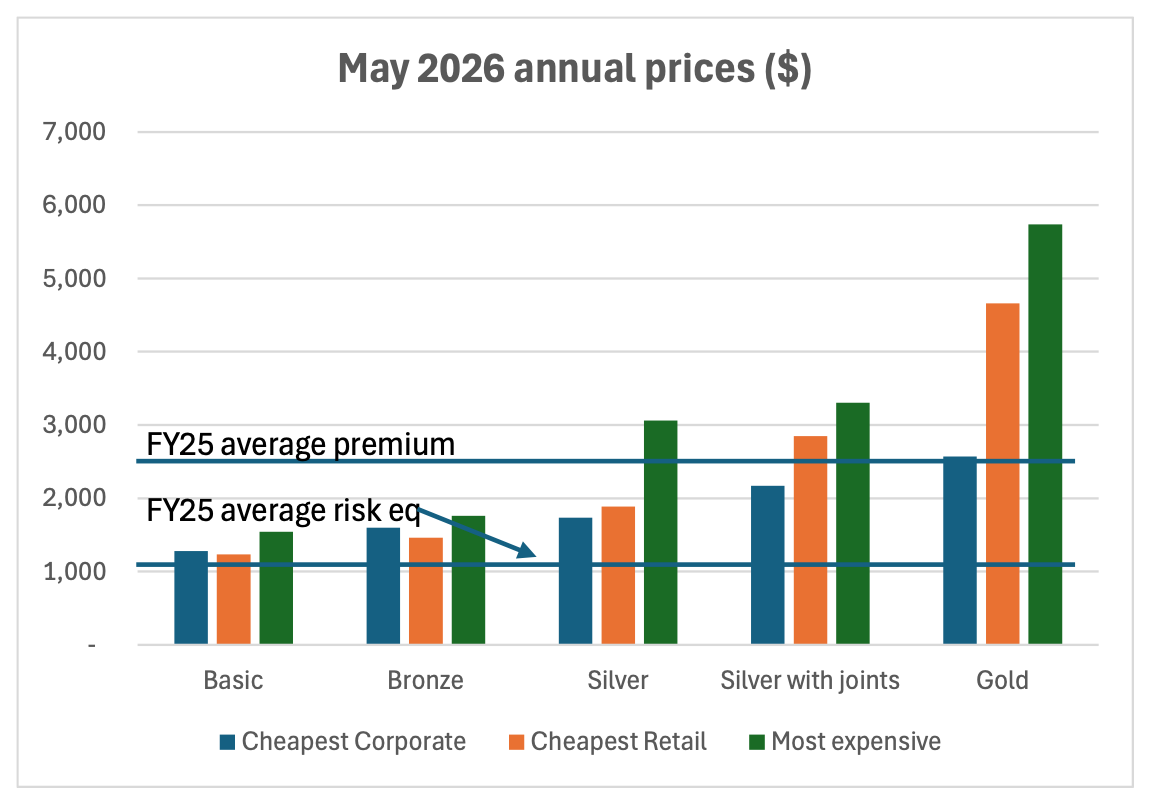
May 2026 annual hospital insurance prices by product tier, compared with the FY25 average premium and average risk equalisation claim per single equivalent unit.
If we were able to return to 5% of products on Basic and 95% on Gold, it is plausible that the premium for those on Gold could be broadly consistent with the overall hospital premium average of around $2,600.
Yes, we might expect more claims and therefore premiums to be higher overall if more have access to full cover, but with the right incentives, there could be efficiency improvements to get to this point over time.
The CAGR [1] in average hospital premiums over FY04 to FY25 [2] matches the annualised cumulative price increases applied at the product level from April 2005 to April 2025 [3] of 4.7%. Had lower-tier products reduced industry claims experience, average premium growth would be expected to have lagged product-level price increases, yet it has not. This suggests that the introduction of Bronze and Silver products has not reduced overall average premium growth, but has instead introduced de facto risk rating within the community rated system, supporting the case for a return to Gold premiums at a palatable price if there were only Gold and Basic products.
Short-term incentives could be introduced to encourage a shift to more Gold coverage and less Corporate products over time. These incentives could encourage efficiencies in the system and discourage inefficiencies. Ultimately deficiencies in current regulations shouldn’t be able to be exploited in a genuine community-rated system.
A move away from the current risk equalisation system towards prospective risk equalisation, is an important step towards improving efficiencies and reducing waste in the current system. But full prospective risk equalisation is complex, so a staged approach could occur.
A simple approach as a first step that creates incentives for a move towards Gold products and prospective risk equalisation is to tweak the current risk equalisation formula, without putting more claims into the risk equalisation pool.
Currently, a proportion of claims for over 55s go into the risk equalisation pool and are shared across all policyholders based on the number of SEUs. This means that those under 55 claiming on high cost Gold services not only receive no risk equalisation support but also contribute to the cost of claims of those greater than 55, further exacerbating the price differential on Gold compared with Silver Plus.
A simple approach is to adjust the definition of SEUs used in the risk equalisation calculation to give reduced weight to policyholders holding Gold cover who are aged under 55, excluding those on corporate products. The precise adjustment would need to be determined through modelling. The adjustment factor could be varied over time to progressively incentivise insurers to shift policyholders from Bronze and Silver products to Gold.
The reason for excluding corporate products is that this change would otherwise further improve the profitability of corporate products and would likely reduce prices even further for this group.
Longer term, it is suggested that the following proposals be considered:
[1] Compound Annual Growth Rate
[2] Average hospital premium per SEU of $984 in FY04 and $2,572 in FY25 based on Operations of the Private Health Insurers Annual Reports (PHIAC and APRA) and Quarterly Private Health Insurance Membership Trends March 2026 (APRA)
[3] Based on average annual price changes in private health insurance premiums (Australian Government Department of Health, Disability and Ageing)
The views expressed in this article are those of the author(s) or working group named below, and do not necessarily reflect the views of the Actuaries Institute. This work is licensed under a Creative Commons Attribution-NonCommercial-No Derivatives CC BY-NC-ND Version 4.0.

From risk equalisation to claims analytics, explore actuarial perspectives on Australia's health insurance sector.
Subscribe to Actuaries Digital for free and receive the latest actuarial analysis, research, and commentary direct to your inbox