Feature
Career and Leadership
General Insurance
Risk Management
Construction of detailed correlation structures across GI business segments



Claim your CPD points
In this article, Benjamin Avanzi, Greg Taylor, and Bernard Wong from UNSW have teamed up to illustrate the uses of large-scale correlation structures in General Insurance.
Who cares about large correlation matrices? Well, the fact is that they can be of considerable use in the construction of risk margins, and, as will appear later, even capital margins. Certain aspects of correlation were examined in our earlier article here . The present article summarises our Insights presentation found here and video here .
In making such statements, one should always maintain an awareness of the limitations of correlation as a measure of dependency. The Pearson correlation coefficient is often well adapted to this purpose in the presence of multi-normally distributed variates. It may provide a very misleading measure in other circumstances (see e.g. McNeil et al, 2005). So the correlation coefficient may allow usefully for dependency between business segments (which might be lines of business) in the construction of risk margins, which typically lie near the centre of the distribution of outstanding claim liabilities.
The outstanding claims of a business segment will usually be estimated in a "lower triangle". In the simple case where such triangles are 10×10, the lower triangle will contain 45 entries. If there are 50 segments, not unusual for a large insurer, there will be 2,250 entries in all, requiring a 2250×2250 correlation matrix, containing about 2.5 million free entries.
This article concerns the construction of such a matrix in such a way that:
The idea used here to create dependency in a model is very simple. Suppose X,Y, Z are independent random variables, and define new variables
A= $$\alpha$$AZ + $$\beta$$AX (1)
B = $$\alpha$$BZ + $$\beta$$BY (2)
where the $$\alpha$$'s, $$\beta$$'s are constants > 0.
Evidently, A and B are dependent provided Z is not degenerate. In fact
Cov(A,B) = $$\alpha$$A$$\alpha$$A$$\sigma_Z^2$$ ≥ 0
Models of this sort are known as common shock models, and form the basis of almost the entirety of this article.
The schema set out in equations (1) and (2) can be extended to an arbitrary number of variates, instead of just A and B, and can be applied to claim triangles. Suppose one is dealing with triangles (in this case, upper triangles) associated with business segments, as illustrated in Figure 1, in which the generic observation is denoted $$X_{ij}^{(n)}$$, representing the observation of claim experience in development year $$j$$ of accident year $$i$$ in business segment $$n$$.
Figure : Claim triangles for multiple business segments
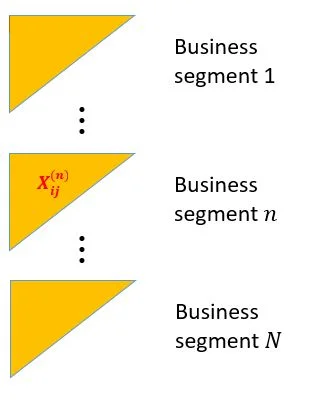
Evidently, one could formulate a common shock model along the lines of (1) and (2), in which A and B are replaced by $$X_{ij}^{(m)}$$ and $$X_{kl}^{(n)}$$ , observations from different triangles. However, with such a large number of observations to be included in the dependency structure, the imposition of some shape on the structure will be helpful.
There are pre-eminent forms of between-triangle dependency that one might wish to include, e.g. diagonal-wise dependency, i.e. between the same diagonals of different triangles, and similarly rows, columns, etc. One may also wish to include some within-triangle dependencies. All of this, and more, can be effected, using the flexibility of common shock models.
Space precludes a detailed discussion of these models. This can be found in our formal paper, for which a web link is provided at the end of this article. But Figure 2 provides an example of a correlation matrix generated by a common shock model with diagonal-wise dependency overlaid by a smaller array-wide dependency.
The figure is schematic only, insensitive to small differences in correlations, but broadly heavier shading (darker grey or black) indicates larger values, with white indicating zero correlation. The matrix covers a number of business segments, and cells have been ordered according to accident year within calendar year within business segment.
Figure : Correlation matrix for simultaneous diagonal-wise and array-wide independence
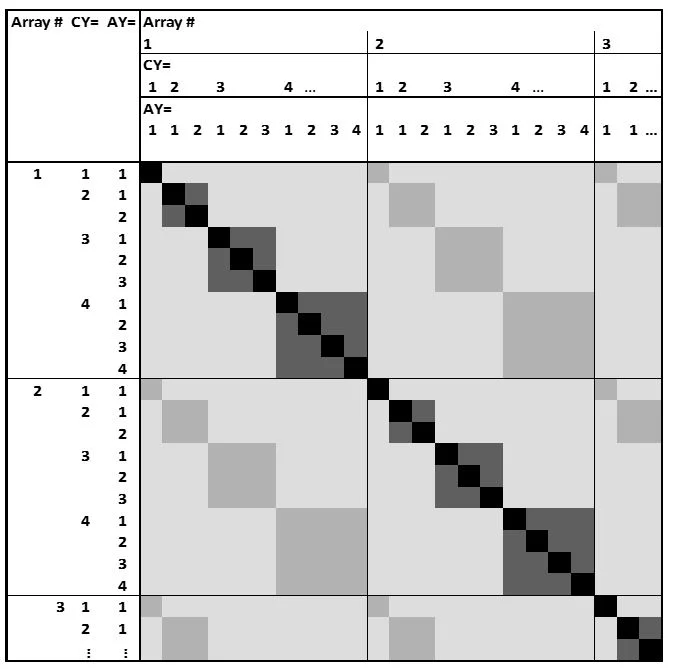
The figure illustrates a reasonably complex dependency structure, but one might well question why dependency between diagonals of different segments exists only for the same diagonals. It might be more reasonable to expect dependency between all diagonals, but reducing as the distance between diagonals increases.
A simple modification of the common shock model introduces AR(1) dependency between diagonals, according to which a parameter Dt associated with diagonal $$t$$ evolves through time according to the following:
Dt = $$\theta$$Dt-1 + $$\varepsilon$$t , E [$$\varepsilon$$t] = 0, Var [$$\varepsilon$$t] = $$\sigma_{\varepsilon}^{2}$$
where $$\theta$$ is a constant, and $$\varepsilon$$t a random quantity.
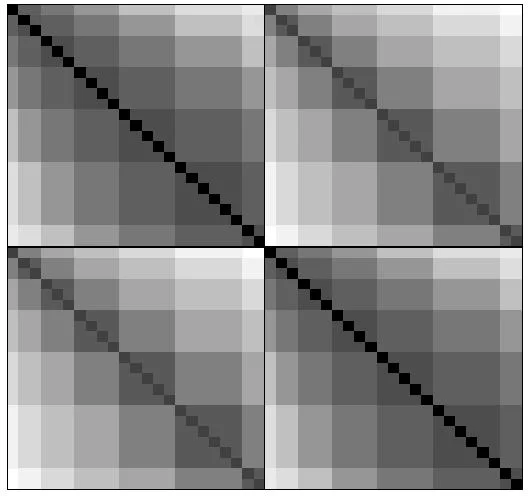
Under such a model, dependency between diagonals reduces roughly in geometric sequence as the distance between diagonals increases. This yields the rich correlation structure illustrated for two business segments in Figure 3.
Figure : Correlation matrix for AR(1) diagonal-wise independence
Although it has been shown that the common shock model can generate a very large and complex correlation structure, it is evident that a price must be paid for each additional feature included in the structure. For practical purposes, it is necessary to contain the number of parameters to a minimum compatible with the desired dependency structure.
Since the parameters will commonly be estimated heuristically (i.e. by informed guesswork), it is also essential that each have a strongly intuitive meaning in order that the practitioner be afforded a chance of reasonable accuracy in estimation. Again, space precludes a recital of the detail, but most of the parameters required by a model can be obtained by decomposition of cell variances into intuitive components.
Details will vary according to the specifics of the model chosen but, in the case of a dependency structure that includes AR(1) diagonal-wise dependency both within and between triangles, one needs to estimate the proportion of each cell's variance that relate to:
The AR(1) parameters, one per diagonal common shock, that describe how dependence between diagonals decays with increasing distance between them, must be estimated separately.
The end result for this model is the estimation of a manageable 3N + 1 parameters. In our earlier example involving an insurer with 50 business segments, this model would require 151 parameters to describe a correlation matrix with about 2.5 million free entries (which would require about 2.5 million parameters in the absence of a model structure).
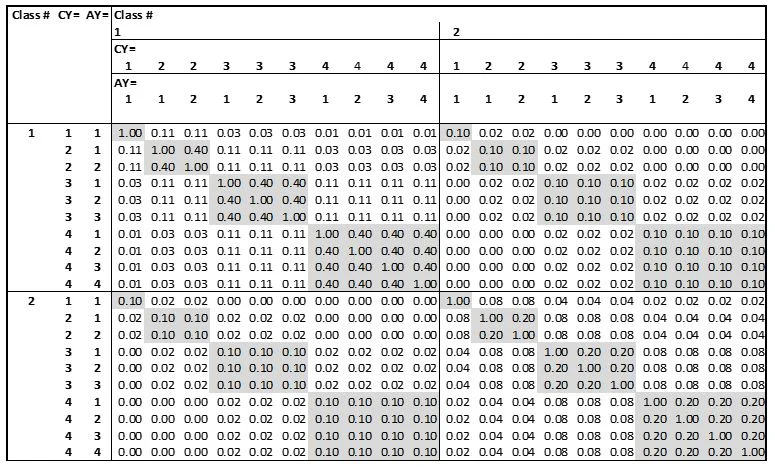
Figure 4 gives a numerical example of the correlation structure just described, for two business segments and on the basis of assumed values of the 3N + 1 = 7 required parameters. Specifically, these are:
Figure : Numerical example
Correlations are, of themselves, of little assistance in calculation of high-quantile capital margins. However, they may be used to inform a copula, e.g. a $$t$$ copula, which may then provide a reliable vehicle for the calculation. See the full paper for details.
Dependency models have been constructed across triangles for multiple business segments. These are flexible models that allow for:
The models can be expressed in a parametrisation that is:
The models are applicable directly to risk margins, but also applicable to capital margins under a simple extension.
This research was supported by an Australian Actuarial Research Grant awarded by the Australian Actuaries Institute to the authors. The views expressed herein are those of the authors and are not necessarily those of the supporting organisations.
McNeil, A.J., Frey, R. and Embrechts, P. (2005). Quantitative Risk Management: Concepts, Techniques and Tools. Princeton University Press, Princeton NJ, USA.
Avanzi, B., Taylor, G., Wong, B. (2016). Common shock models for claim arrays, UNSW Business School Research Paper Series 2016ACTL07, https://ssrn.com/abstract=2881058
The views expressed in this article are those of the author(s) or working group named below, and do not necessarily reflect the views of the Actuaries Institute. This work is licensed under a Creative Commons Attribution-NonCommercial-No Derivatives CC BY-NC-ND Version 4.0.