Climate and Sustainability
A Season of Contrasts Shapes Climate Index in Spring 2025



Claim your CPD points
The Australian Actuaries Climate Index (AACI) recorded its 41st consecutive positive value in the spring of 2025, indicating that the frequency of extreme weather across Australia remained above the 1981–2010 reference period average.
While weather conditions varied significantly across the country, elevated extreme high temperatures in Queensland were a key contributor to the positive index value for the season.
The extreme high temperature index was elevated across most of Queensland during spring, while negative values were recorded in the southern parts of the country.
The Queensland Temperate Coast region, which includes Brisbane, the Gold Coast and the Sunshine Coast, recorded the second-highest extreme high temperature index value. These elevated temperatures contributed to a series of severe thunderstorms and hail events, including storms that produced hailstones measuring up to 14 centimetres in Brisbane’s southeast [1] .
Positive extreme high temperature index values were also observed across the rest of Queensland and parts of New South Wales. This may have contributed to conditions conducive to bushfires destroying at least 20 homes on the Central Coast of New South Wales in early December [2] .
By contrast, Tasmania and Victoria recorded negative values for the extreme high temperature index, indicating that the frequency of extreme high temperature events was below the long-term average.
This aligns with the Bureau of Meteorology’s observation that maximum temperatures were highest on record for parts of north-eastern and southern Queensland and the New South Wales coast, while being below average across the southern mainland and Tasmania [3] .
The extreme rainfall index was negative across most of Australia in spring 2025, indicating fewer extreme rainfall events compared to the 1981–2010 reference period average. However, parts of northern Australia recorded positive values, as shown in the map below.
The Queensland Wet Tropics, Monsoonal Northern Territory and Monsoonal Northwest regions were the only areas to observe a positive extreme rainfall index during the season, reflecting more frequent extreme rainfall events in these tropical regions.
One contributor to these positive values was Tropical Cyclone Fina, which passed alongside the northern coast of Australia in late November as a compact but powerful category three system [4] . The cyclone brought gale-force winds and torrential rain to Darwin and surrounding areas, resulting in positive values for both the extreme rainfall and extreme wind indices in the Monsoonal NT region.
Tropical cyclones are uncommon in November, with named systems more typically occurring from December onwards.
The extreme sea level index remained elevated across Australia throughout spring, although no new records were set. This continues a broader pattern of elevated sea levels highlighted in the recent v2.0 release of the Australian Actuaries Climate Index .
Towards the end of spring, the Bureau of Meteorology declared that a La Niña event was underway [5] . La Niña conditions are typically associated with higher rainfall and cooler temperatures, particularly along Australia’s east coast.
However, the long-range outlook for the summer of 2025 suggests above-average temperatures and near-median rainfall [6] , [7] , as shown below.
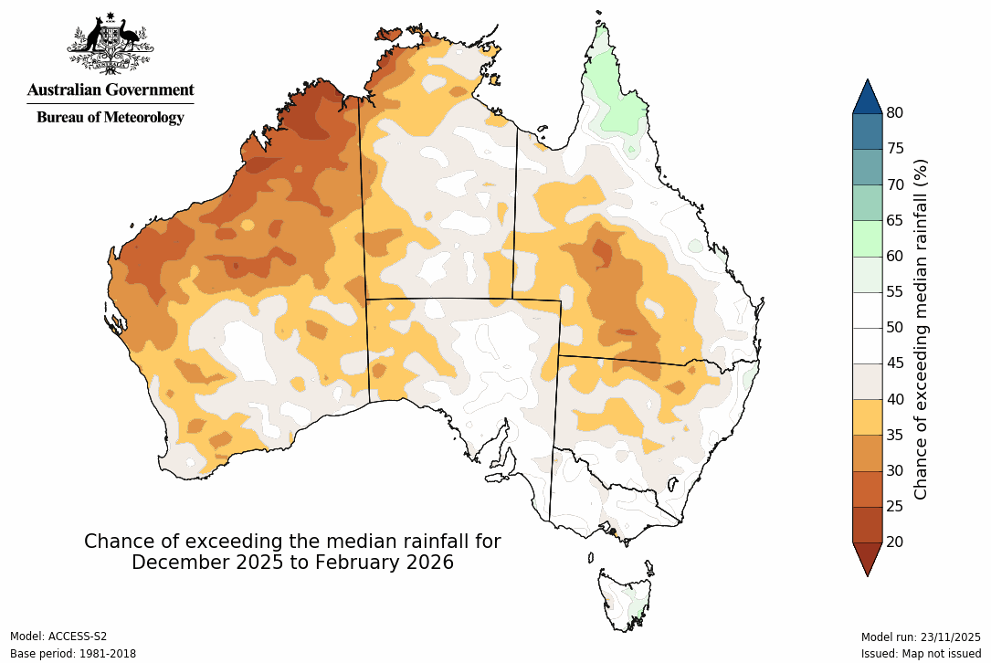
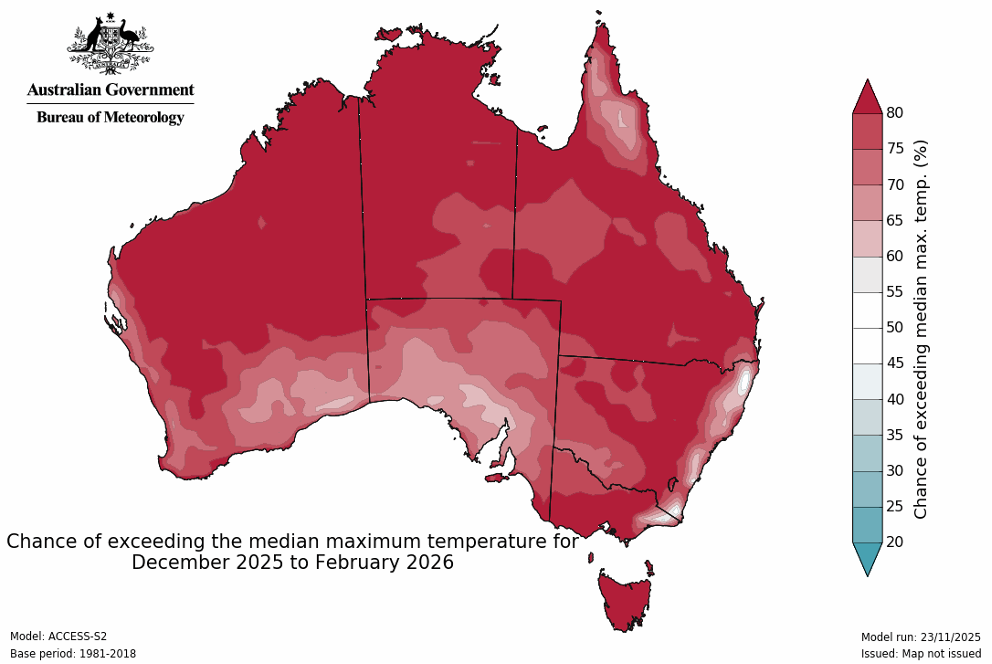
This outlook is influenced in part by the Southern Annular Mode (SAM), which has been in a negative phase since late November. A negative SAM indicates that the westerly wind belt has shifted north of its usual position.
During summer, a negative SAM can reduce rainfall and increase temperatures, as warmer, drier inland air is drawn eastward while moister coastal air is pushed offshore. The interaction between La Niña conditions and a negative SAM highlights the complexity of climate drivers influencing Australia’s weather as the country moves into summer.
The Index measures the frequency of extreme weather conditions and sea levels across Australia and how these vary over time. Components cover extreme high and low temperatures, extreme rainfall, consecutive dry days (as an indicator of drought), extreme wind and sea level. The Index was first launched in November 2018 by the Actuaries Institute and version 2.0, which includes enhancements not available at the time of the original Index, was released in 2025. It is updated four times a year by Finity Consulting for the Actuaries Institute.
Unlike many other measures, the AACI focuses on changes in the extremes. This is a more relevant metric for the insurance industry (and others) than averages, as it correlates more closely with damage. This is done by measuring how often we observe the current quarter’s observations exceeding the 99th percentile of the corresponding observations in the reference period of 1981-2010. More details and full results can be found on the website .
The purpose of the AACI is to provide a publicly available and objective measure of extreme weather conditions and sea level and is one way in which the actuarial profession can contribute to the assessment of climate risk. The AACI has been referenced extensively in the media and other reports [8] .
Alongside the North American Actuaries Climate Index [9] , it is one of two climate indices which have been produced globally for several years on behalf of actuarial associations. Several other actuarial associations, including Columbia, Singapore and the Caribbean, have or are in the process of launching similar indices.
[1] Australian Broadcasting Corporation. (2025, November 25). South-east Queensland hailstorms frequency. ABC News. https://www.abc.net.au/news/2025-11-25/south-east-queensland-hailstorms-frequency/106049808
[2] Australian Broadcasting Corporation. (2025, December 8). NSW Central Coast families devastated by fierce Koolewong bushfire. ABC News. https://www.abc.net.au/news/2025-12-08/nsw-central-coast-families-devasted-by-fierce-koolewong-bushfire/106111938
[3] Bureau of Meteorology. (n.d.). Climate summaries: Seasonal climate summary for Australia. Australian Government. https://www.bom.gov.au/climate/current/season/aus/summary.shtml
[4] Australian Broadcasting Corporation. (2025, November 25). NT Severe Tropical Cyclone Fina in pictures: 2025 storm damage. ABC News. https://www.abc.net.au/news/2025-11-25/nt-severe-tropical-cyclone-fina-in-pictures-2025-storm-damage/106046118
[5] Bureau of Meteorology. (2025, November 27). ENSO Wrap-Up [Archive]. Australian Government. https://www.bom.gov.au/climate/enso/wrap-up/archive/20251127.archive.shtml
[6] Bureau of Meteorology. (n.d.). The Bureau issues long range forecast for summer [News and media]. Australian Government. https://www.bom.gov.au/news-and-media/the-bureau-issues-long-range-forecast-for-summer
[7] Weatherzone. (n.d.). La Niña declared days out from summer – what does this mean for Australia? https://www.weatherzone.com.au/news/la-nina-declared-days-out-from-summer--what-does-this-mean-for-australia/1891047
[8] For example, Royal Commission into National Natural Disaster Arrangements. (n.d.). Australian Actuaries Climate Index: Some comments on extremes [Exhibit 1.006.003]. https://naturaldisaster.royalcommission.gov.au/publications/exhibit-1-006003-shp5010010001-australian-actuaries-climate-index-some-comments-extremes
[9] American Academy of Actuaries, Canadian Institute of Actuaries, Casualty Actuarial Society, & Society of Actuaries. (n.d.). Actuaries Climate Index. https://actuariesclimateindex.org/home/
The views expressed in this article are those of the author(s) or working group named below, and do not necessarily reflect the views of the Actuaries Institute. This work is licensed under a Creative Commons Attribution-NonCommercial-No Derivatives CC BY-NC-ND Version 4.0.