Virtual Summit Shorts: Decarbonisation – What it means for the future of the Australian Economy



Claim your CPD points
Kate Lyons summarises the topical Plenary session ‘Decarbonisation – what it means for the future of the Australian Economy’.
Since the Australian bushfires of 2019/20, climate change has grown in prominence in the national conversation. There’s something about the smell of smoke that elicits concern.
One of the most difficult and contentious climate change issues for Australia is the transition to net zero greenhouse gas emissions – so what is decarbonisation, why does it matter, how do we get there, and who is leading the way?
While many Australians focus on the physical risks and changes to the patterns of Australia’s natural hazards, decarbonisation – the transition to net zero greenhouse gas emissions – could be the greater strategic risk for financial institutions in the next five to 10 years.
Nicolette Rubinsztein recently chaired a Plenary session focused on decarbonisation. She began by pointing out several recent studies showing that the “funnel of uncertainty is narrowing”:
Kristian Kolding, a Partner at Deloitte Access Economics explained how “we are all missing the point – we can’t grow with unconstrained emissions”.
Growth with unconstrained emissions is the ‘inaction’ baseline from which Deloitte recommends the evaluation of investment proposals to address climate change.
Deloitte estimates that Australia’s economy will be 6% or $3.4 trillion smaller and have 6% fewer jobs by 2070 in an unconstrained emissions world.
Kristian was clear that “the cost of inaction is far greater than the cost of action”. There is a chain of events that will disrupt our economy if climate change goes unchecked. The job losses impact more sectors than just the coal mining, “manufacturing that is carbon intense, trade and tourism are hit”.
He explained that impressive natural assets that attract tourists to Australia will be worth less, reducing the size of and employment in the tourism sector.
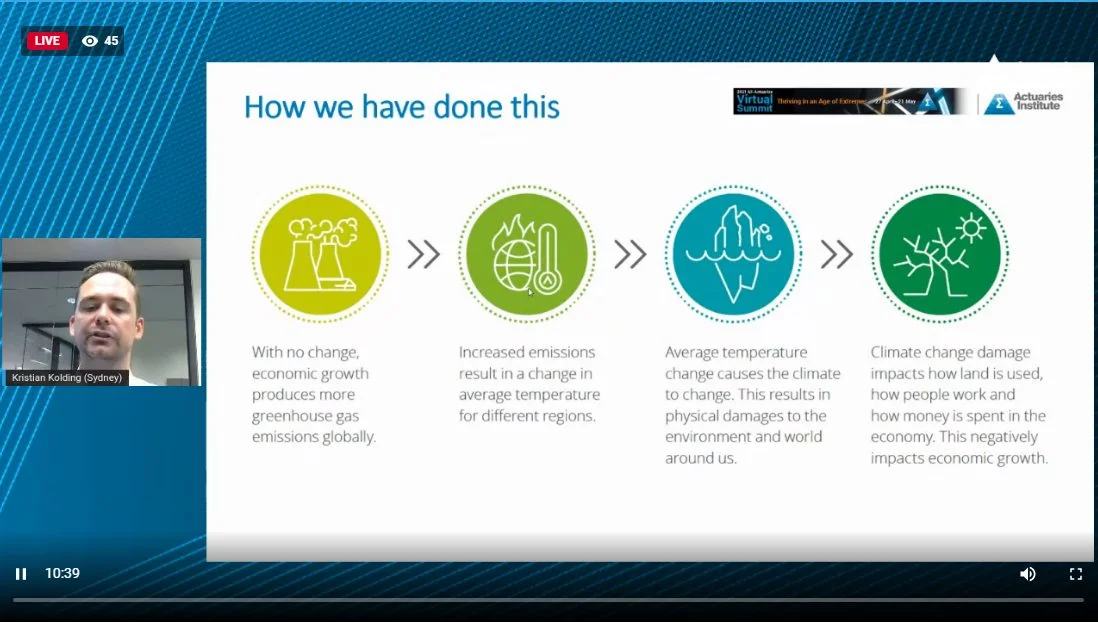
The contrast is material. Deloitte modelling indicates that a recovery that delivers on net zero by 2050 that is consistent with keeping global warming to 1.5°C, could add $680 billion (in present value terms) and grow the economy by 2.6% in 2070, adding more than 250,000 jobs.
Kristian urged us to apply his methodology, setting the base as “unconstrained emissions” rather than focusing on the precision of the numbers.
Geoff Summerhayes, formerly a Regulator at APRA and now Senior Advisor at Pollination, agreed with Kristian that the economic and social impacts of climate change are being felt.
“Climate change is not an economic scenario, it is the baseline. We need to build in resilience to live in a 2°C warmer world,” Geoff said.
APRA is now stress testing the banks based on a 3°C warming scenario.
Geoff believed we need to accept Net Zero greenhouse gas emissions as a premise, with the uncertainty lying in the speed and rate at which we get there. The race to a Net Zero greenhouse gas emissions starts with the transition of the energy sector then widens to the electrification of our entire economy with renewable power.
The growing climate change dialogue in the media is also related to the planned gathering of global climate leaders in Glasgow for the 2021 United Nations Climate Change Conference (COP26) in November. Geoff shared how the themes of COP26 are very relevant to Australia and our challenges of insurance affordability and resilience. He named three themes:
Geoff brought to life the challenges of transition to Net Zero, particularly the need to grow our renewable energy sector by up to 400% of our existing energy requirements. This highlights the additional renewable energy required to decarbonise manufacturing and embed green energy into our products. He believed Australia remains the land of opportunity in renewable energy with the space, wind, and sunshine to become a global leader in green energy and exporter of products with embedded green energy.
Nicolette also invited Jillian Broadbent AC, formerly of the Clean Energy Finance Corporation and Swiss Re, to respond to the discussion. Jillian pointed to several Australian business that are decarbonising now and “doing what they can within their control”. She noted that “decarbonsiation in the Australian economy has been accelerating over the last five years with many investors focused on Environmental, Social and Governance themes.”
Jillian described how companies like Swiss Re, Woolworths and Macquarie Group are leading, firstly taking control of their own emissions (scope 1) and emissions from their energy sources (scope 2) with clear targets for 2025 and 2030. Some even have ambitious targets, to reduce the emissions of their supply chain (scope 3), by 2050.
Nicolette invited Jillian to answer questions linking back to the Deloitte and Gratin Institute findings. Jillian agreed that the critical costs of climate change have been called out in studies like these and that we “don’t need to worry about whether the decimal points are right, we need policy action, the threat is very real”.
The Grattan Institute paper is described as recommending a target for 90% of Australia’s energy to come from renewable sources and 10% from gas to support the transition. Jillian believes “90% renewable energy is a reasonable aim, as the last mile is the most expensive. Let’s not be too purest”.
Rade Musulin, a Principal at Finity Consulting and the Convenor of the Actuaries Institute working group on Climate Change, brings to life the role actuaries play in the understanding and addressing climate risk.
The actuarial profession has an important global community and Rade shared how actuaries are already collaborating across the globe, “preparing actuaries for this historical transformation”.
In question time, Rade highlighted the risks and opportunities, reminding us that the time horizons for elements of climate risk are different. Physical risk plays out over decades, while transition can occur more quickly. We could see economic dislocation in the next two years, but benefits of managing climate risk well will not be apparent for at least two decades.
This highlights the political challenge of three-year Parliamentary terms. We need to find ways to do political science better so that progress can be sustained when there is a change in government and to give politicians a “dialogue to give people hope and clarity on how to innovate”.
In wrapping up the Plenary session, the panel was asked to consider advice to the actuarial profession. In summary, the key points from the panel include:
| References1 – Australia’s Clean Economy Future: Costs and Benefits – Melbourne Sustainable Society Institute |

The views expressed in this article are those of the author(s) or working group named below, and do not necessarily reflect the views of the Actuaries Institute. This work is licensed under a Creative Commons Attribution-NonCommercial-No Derivatives CC BY-NC-ND Version 4.0.