General Insurance
Valid values vanquish vulnerability to volatility



Claim your CPD points
No property owner is hoping to suffer significant losses as a result of a perilous event. But if you were to find yourself in that position, and you were prepared enough to have purchased property insurance, you may let yourself feel somewhat… Validated? Vindicated? Like a visionary, perhaps? But be warned - do not vault to visions of victory. You may be vulnerable yet. Underinsurance is a financial risk faced by property owners and that risk is heightened during economic volatility.
This article aims to address the risks faced by property owners in the current environment, where fluctuating supply costs and government restrictions may cause previously reasonable insured values to be insufficient, leaving policyholders out of pocket.
At its simplest, underinsurance occurs when the value that the property has been insured (sum insured) for less than the amount required to repair and/or replace the property in case of an insured event occurring. It can be driven by a number of factors, including:
The last of these is of particular interest, because it means that even the most organised and savvy policyholders may be caught out if they take a 'set and forget' approach to insurance, comfortable with their belief that they will be adequately insured against all risks.
The cost of property construction generally increases over time due to inflationary increases in goods and services required in a build. Although, only directly relevant for personal lines, we can use the price of new houses as a proxy for the change in price for properties in general. According to ABS data, the cost to build a new house in Australia increased by 74.8% between 2004 and 2018 [i] . This averages out to around 4% per annum, with variations expected between states and for houses of different styles and sizes. This level of growth should be enough to make policyholders wary, as it suggests that the insured values in contracts can quickly become inadequate, particularly if construction takes place over a number of years.
Beyond the general upward trend, events of the past few years have caused the price of construction to increase much more significantly than previously. One of the largest costs in construction is the lumber used for the framing of buildings, and the price has fluctuated hugely in the past year due to restrictions on supply. These supply issues were originally driven by the bushfires of early 2020, which, according to the NSW Forestry Corporation, reduced the amount of available quality timber by up to 30% in key areas [ii] . Flow on effects from COVID-19 have also exacerbated the shortages faced by Australians by reducing lumber imports from the US. This was driven by reduced production during the early months of COVID-19, an increase in US demand as a result of low interest rates, and an interruption of freight and shipping capacity [iii] . Historical US lumber futures prices to September 2021 can be seen in the graph below.
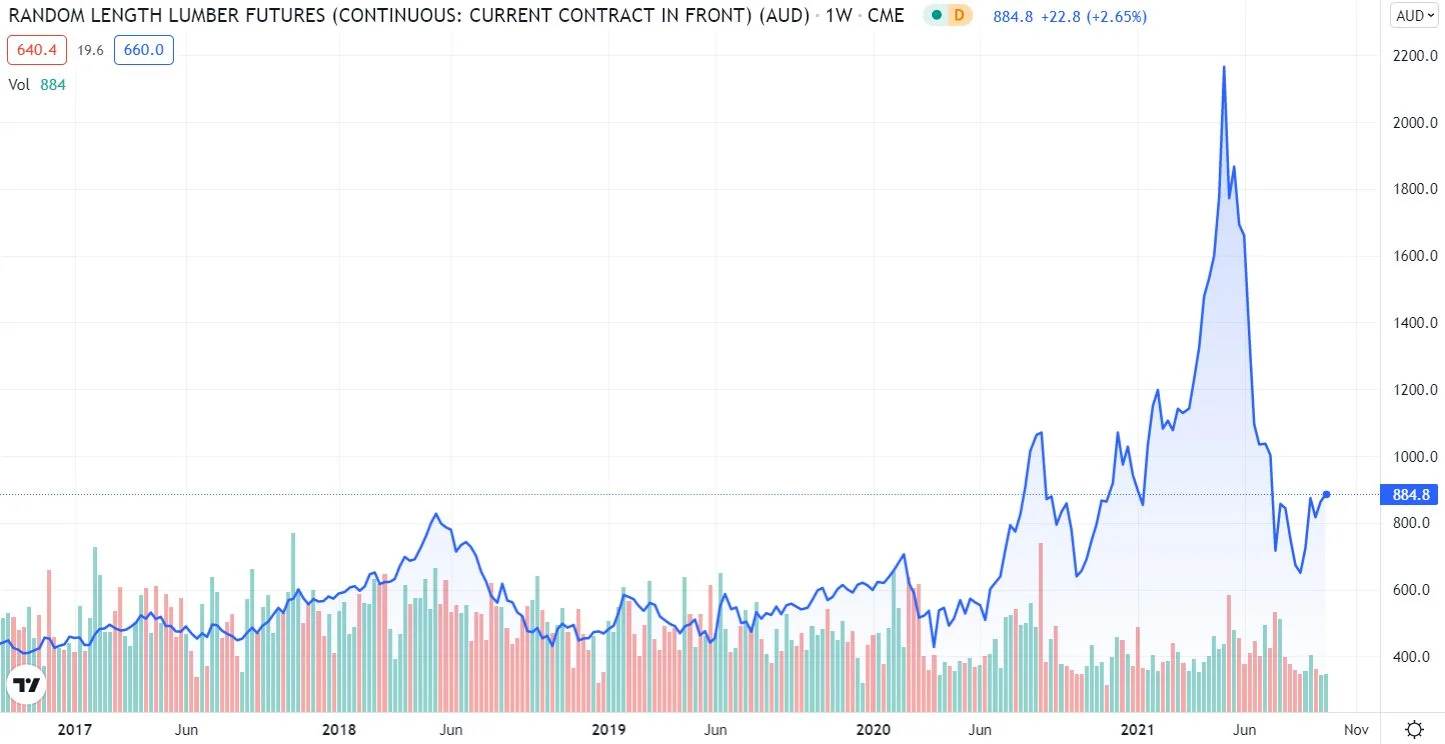
Source:
Reports in July suggested that the average price of a new home in US increased by around USD$30,000 (AUD$40,000) [iv] , compared to April 2020. Australian house prices have not risen to the same extent, but there are obvious pressures and concerns of which homeowners and policyholders should be aware.
The good news is that lumber prices have reduced from the peak observed in May 2021, and further decreases are expected by the end of the year. Lumber prices in the US have already fallen by 60% from the records reached in May, after they had risen more than 500% through the pandemic. Award-winning portfolio manager Michael Gayed has given a number of reasons why he thinks prices will continue to decrease [v] . These include:
This should allay concerns of builders and policyholders to some degree, but the fluctuation in costs should serve as a warning to both groups of the vulnerability of construction costs to external factors.
I think the most important thing to take away is to recognise the extent to which the value of an insured property can move over time, and to acknowledge that even well-prepared policyholders may find themselves underinsured if they are not adaptable to the changing conditions.
According to MCG Quantity Surveyors, the cost of building an average home in Australia's biggest capital cities has risen by more than 10% in the six months to August 2021, which has likely left many property investors underinsured [vi] . Even before the pandemic, they suggest that up to 80% of investors may have been underinsured, which should cause alarm bells to start ringing in the mind of any policyholder.
The key, then, is to stay ahead of the curve - if you wait until you need to claim to realise that you are underinsured, it is already too late. Instead, policyholders should consider the following options available to them:
By considering these items, policyholders will be able to gain some level of comfort and confidence that the values within their insurance contracts are valid and adequate. And it is only with these valid values that they can vanquish the risks arising from their own vulnerability to volatility within construction prices.
Footnotes:
[i] https://stockhead.com.au/news/timberrrr-astronomical-lumber-prices-adding-41k-to-the-price-of-a-new-home/
[ii] https://markets.businessinsider.com/news/commodities/lumber-price-outlook-3-reasons-decline-michael-gayed-housing-sawmill-2021-8
[iii] https://www.insurancenews.com.au/daily/building-costs-surge-boosts-underinsurance-risks
[iv] Approach with caution: Without an insurance broker, the onus is on you | CBNet
[v] https://www.budgetdirect.com.au/home-contents-insurance/guides/buying-house/cost-to-build-a-house.html
[vi] https://www.abc.net.au/news/rural/2021-07-30/timber-supply-shortage-drives-price-rise/100332880
[vii] https://stockhead.com.au/news/400pc-rise-are-aussie-timber-prices-about-to-go-through-the-roof/
The views expressed in this article are those of the author(s) or working group named below, and do not necessarily reflect the views of the Actuaries Institute. This work is licensed under a Creative Commons Attribution-NonCommercial-No Derivatives CC BY-NC-ND Version 4.0.