Health
Update on Mortality in Australia




Claim your CPD points
The Australian Bureau of Statistics (ABS) has released the Australian weekly mortality statistics up to 24 November 2020 (for doctor-certified deaths only, i.e., excluding coroner-referred deaths).
Unfortunately, we still do not have the full year's picture for 2020, however this data adds three more months since our last update (this is the fifth in a series of updates on Australian mortality in 2020; previous versions can be found here ). [1] We will be doing a full update on 2020 in a paper at the 2021 All-Actuaries Virtual Summit in May, when we have information for the full year.
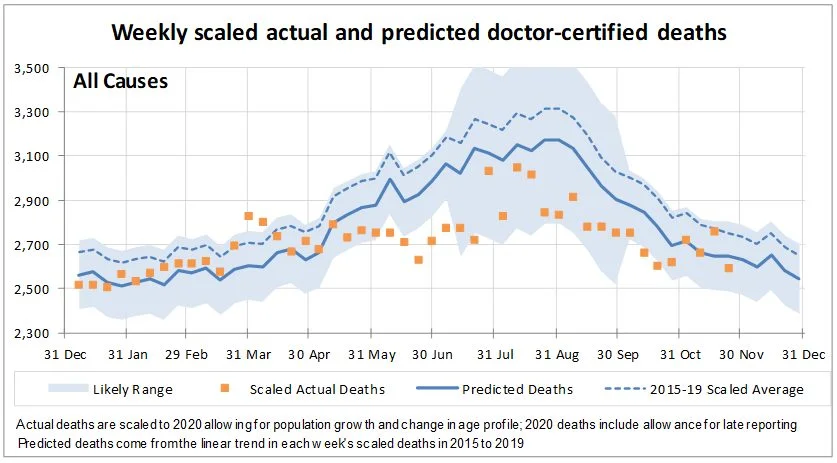
Across the year to 24 November, there have been almost 3,900 (2.9%) fewer doctor-certified deaths in Australia than predicted based on the previous five years' deaths.
In the months of September and October, weekly deaths were at or below the low end of the likely range. Deaths in November, however, have been close to expected. This is not because deaths in November have increased, but rather because we are through the winter hump, hence experiencing a lesser benefit from low levels of respiratory disease deaths.
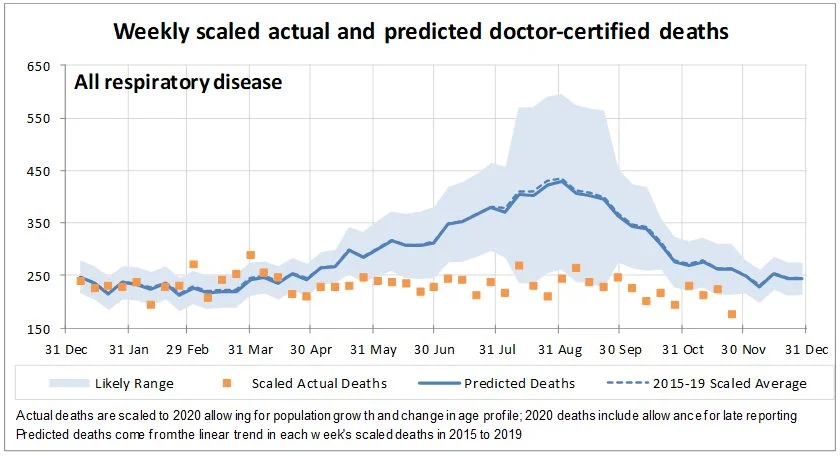
Deaths due to respiratory disease (comprising influenza, pneumonia, chronic lower respiratory disease, and other respiratory disease) continued to be much lower than predicted, due to continued lower levels of respiratory illness in the community. Up to 24 November, there were around 3,100 fewer deaths from respiratory disease than predicted based on previous years' deaths for the equivalent period. While much of the press has focussed on lower levels of influenza deaths, these account for only around 20% of the reduction in respiratory deaths.
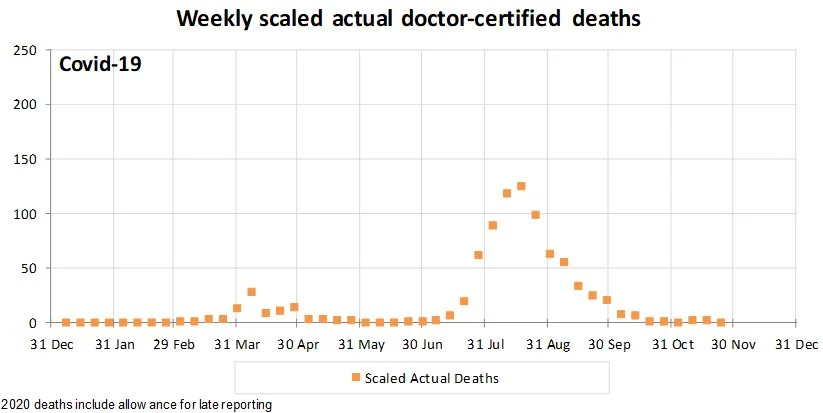
Doctor-certified COVID-19 deaths included in this data release account for 830 deaths in the year to 24 November 2020. This is lower than the 907 officially recorded COVID-19 deaths. The discrepancy arises as some COVID-19 deaths will have been reported to the coroner (notably some deaths associated with the Ruby Princess and some deaths in aged care homes in Victoria).
The following table summarises the deaths in the year to 24 November compared with our prediction (based on deaths in 2015 to 2019).
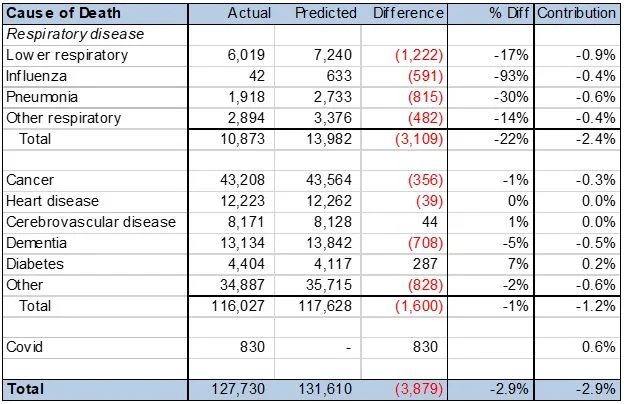
Overall, there were around 3,900 (2.9%) fewer deaths up to 24 November than predicted.
This is driven by lower numbers of deaths from respiratory illness. Higher than expected deaths from this cause at the end of March (likely undiagnosed COVID-19) have been more than offset by the much lower numbers of deaths since mid-April.
Deaths from non-respiratory causes are also lower than predicted by around 1,600 deaths:
[1] As with our previous analysis, we built a model predicting weekly deaths in 2020, based on the information provided by the ABS about weekly deaths during 2015-2019. For each cause of death:
The views expressed in this article are those of the author(s) or working group named below, and do not necessarily reflect the views of the Actuaries Institute. This work is licensed under a Creative Commons Attribution-NonCommercial-No Derivatives CC BY-NC-ND Version 4.0.