
Australian Actuaries Intergenerational Equity Index: Spotlight on the Australian Tax and Transfer System
A Report providing a detailed picture of how Australians contribute to, and benefit from, the tax and transfer system at different stages of life.

As Australia's population ages, questions of intergenerational equity and fiscal sustainability are becoming increasingly important. This new Report examines how Australia's $1 trillion tax and spending system is distributed across generations, how those patterns have changed over time, and what they may mean for the future.
Led by Actuaries Institute members Dr Hugh Miller, Dr Laura Dixie and Shams Mehry, the Report aims to inform the national conversation on whether the pattern of government expenditure (spending) and taxation by age is sustainable in a society that seeks intergenerational equity.
"The large differences in average tax and spending by age are striking. And demographic forces are significant, with an ageing population continuing to affect Australia's fiscal balance."
— Hugh Miller, co-lead author
The Report found government spending follows a U-shaped pattern across Australians’ lifetimes: Highest for children and older Australians, while taxation peaks during the working ages of 40-60.
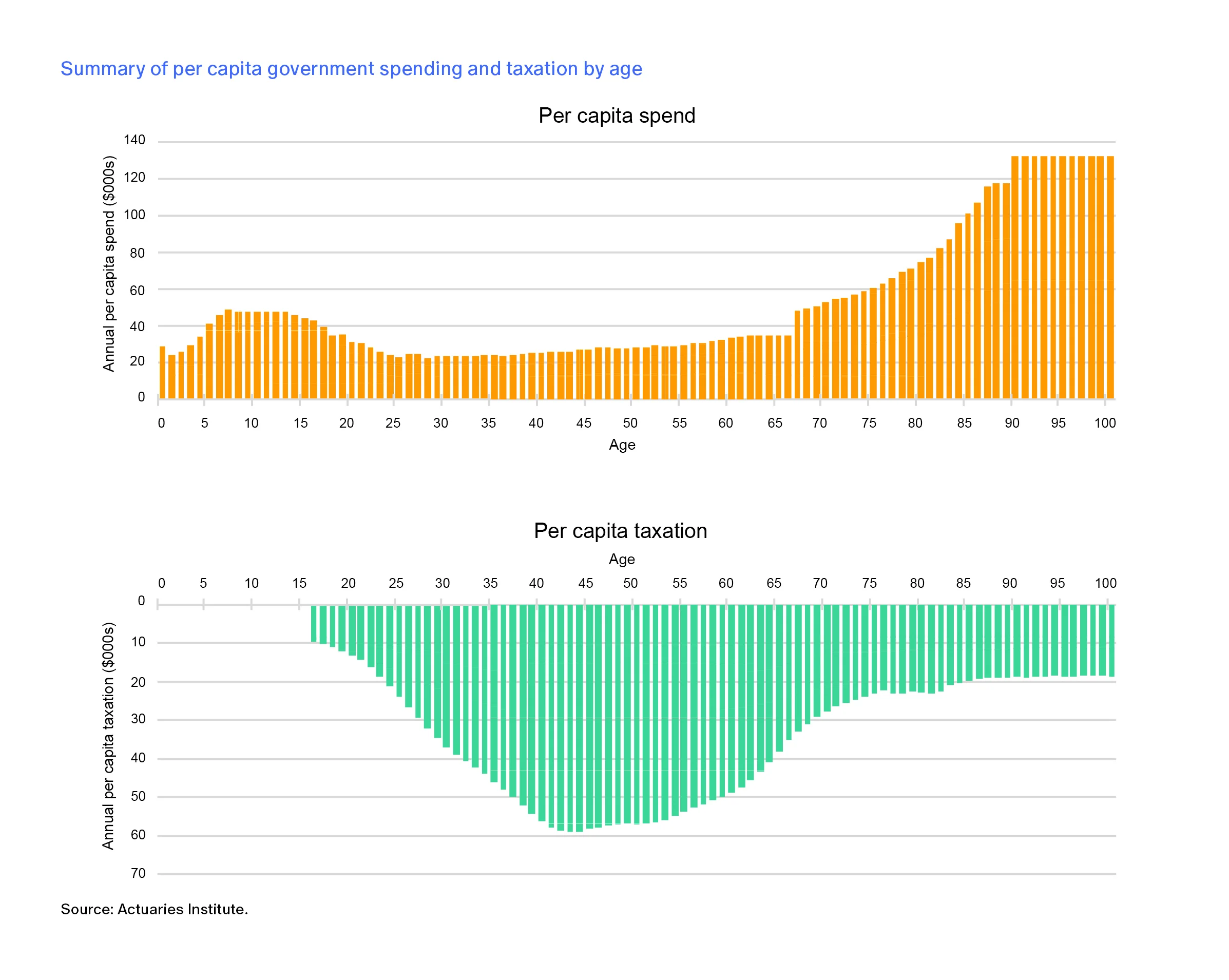
Two Australians with the same gross incomes of $100,000 – one aged 30, one aged 71 – end up with net incomes that differ by more than $42,000 once taxation, government spending and transfers are accounted for.
“Some of that $42,400 difference reflects genuine need, particularly higher healthcare spending for older Australians. But a significant part also reflects differences in eligibility for benefits and taxation settings,” Hugh said.
The Report also found that over the past two decades, government spending has risen faster than taxes and the impacts have been distributed differently across age groups.
"Australians aged 20 to 30 stand out as the only age group not to have seen a gain over the past two decades. That is a significant finding, and one that only becomes visible when you examine taxation and spending together and consider how outcomes vary across age groups."
— Dr Laura Dixie, co-lead author
Several policy considerations are identified in this Report, including age-based tax and spending settings that better consider means, broadening the tax base, overall fiscal discipline and supporting asset accumulation at younger ages.
Our analysis focuses on intergenerational equity, but it’s important to note that wealth and income vary significantly within generations across all ages. We specifically recognise the high rates of poverty and significant health challenges experienced by many older Australians.
For policymakers, regulators and industry, the findings provide an important evidence base for national discussions about Australia’s future.
Spotlight on the Australian Tax and Transfer System, is the first of two deep-dive papers expanding on the Australian Actuaries Intergenerational Equity Index and contributes to the broader discussion ahead of the Government’s Intergenerational Report due later this year.
A further Actuaries Institute spotlight paper is planned for later in 2026 examining housing.

About the authors
Hugh Miller, Laura Dixie and Shams Mehry
Hugh Miller is a principal at Taylor Fry. For the past 15 years he has been applying actuarial techniques to social sector problems spanning welfare, employment, housing, disability and health. He, along with Laura and Ramona Meyricke, codesigned the Australian Actuaries Intergenerational Equity Index, exploring how wealth and wellbeing differs across time and generations. Hugh was 2021 Actuary of the Year.
Laura Dixie is an experienced actuary and a director at Taylor Fry. She works in Taylor Fry’s Government practice using quantitative analysis applied to a range of datasets to understand how people interact with services in the health, education and social sectors.
Shams Mehry is a consultant at Taylor Fry. He works across government sectors applying his statistical modelling and quantitative analysis skills in a range of health, education and transport contexts.
Related reports
Be informed. Stay ahead. Subscribe.
Receive industry-leading perspectives, straight to your inbox.