The world needs to wake up to long-term risks



Claim your CPD points
The 16th edition of the World Economic Forum’s Global Risks Report was published in January 2021, alongside a call for the world to ‘wake up to long-term risks’. Gaurav Agrawal highlights the key conclusions from the report.
In 2020, the world saw the catastrophic effects of ignoring long-term risks – something the Global Risks Report has been ‘sounding the alarm on’ for the past 15 years. While the COVID-19 pandemic has shown the reality of such risks materialising, the emergence of vaccines provides a potential exit for this threat. However, other long-term risks, such as climate change and environmental concerns, do not have an immediate response to diminish risk. Instead, understanding and acting on the threat in advance provides the only chance to manage the risk and reduce its impacts.
| “In 2020, the risk of a global pandemic became reality, something this report has been highlighting since 2006. We know how difficult it is for governments, business, and other stakeholders to address such long-term risks, but the lesson here is for all of us to recognise that ignoring them doesn’t make them less likely to happen. As governments, businesses and societies begin to emerge from the pandemic, they must now urgently shape new economic and social systems that improve our collective resilience and capacity to respond to shocks while reducing inequality, improving health and protecting the planet”– Saadia Zahidi, Managing Director at the World Economic Forum. |
The latest report analyses the risks from societal fractures—manifested through persistent and emerging risks to human health, rising unemployment, widening digital divides, youth disillusionment, and geopolitical fragmentation. Businesses risk a disorderly shakeout which can exclude large cohorts of workers and companies from the markets of the future. Environmental degradation—still an existential threat to humanity—risks intersecting with societal fractures to bring about severe consequences. With the world more attuned to risk, lessons can be drawn to strengthen response and resilience.
The report draws conclusions from analysis of over 800 responses to the latest GRPS, with risks categorised across five areas – economic, environmental, geopolitical, societal, and technological.
For the first time, the report rates risks according to when respondents perceive they will pose a critical threat to the world:
Over the next ten years, respondents perceive:
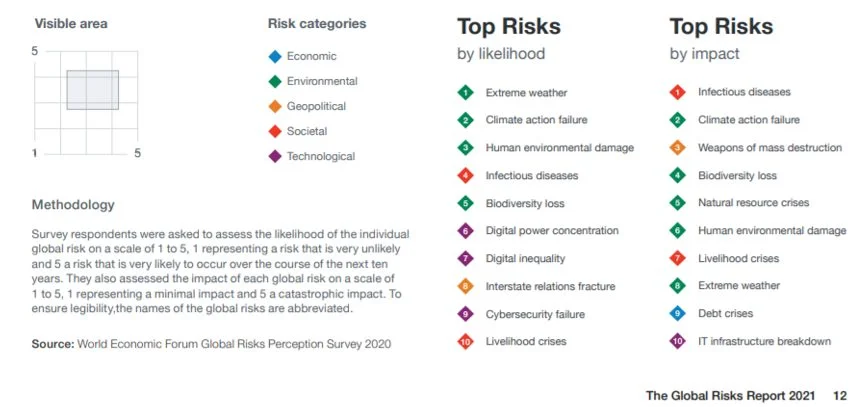
Climate change continues to be perceived as a catastrophic risk. Pandemic lockdowns worldwide, through a reduction in human activity, have driven a reduction in global emissions in the first half of 2020. However, similar emissions reductions experienced during the market downturns of the 2008–2009 Global Financial Crisis were fleeting, and if this is any indication of the post-lockdown world, emissions are likely to bounce back when activity resumes. A shift towards greener economies cannot be delayed until the shocks of the pandemic subside. Climate action failure is the most impactful and second most likely long-term identified risk.
The top ten risks by likelihood and impact across the five categories are summarised in the report extract below.
The report considers global responses to COVID-19, detailing lessons across five domains to bolster global resilience – government decision-making, public communication, health system capabilities, lockdown management, and financial assistance to the vulnerable.
However, if lessons from this crisis only inform decision-makers how to prepare for the next pandemic—rather than enhancing risk processes, capabilities, and culture—the world will again be managing through another crisis.
The responses to COVID-19 offer four key governance opportunities to strengthen the overall resilience of countries, businesses, and the international community, to act rather than react, in the face of cross-cutting risks:
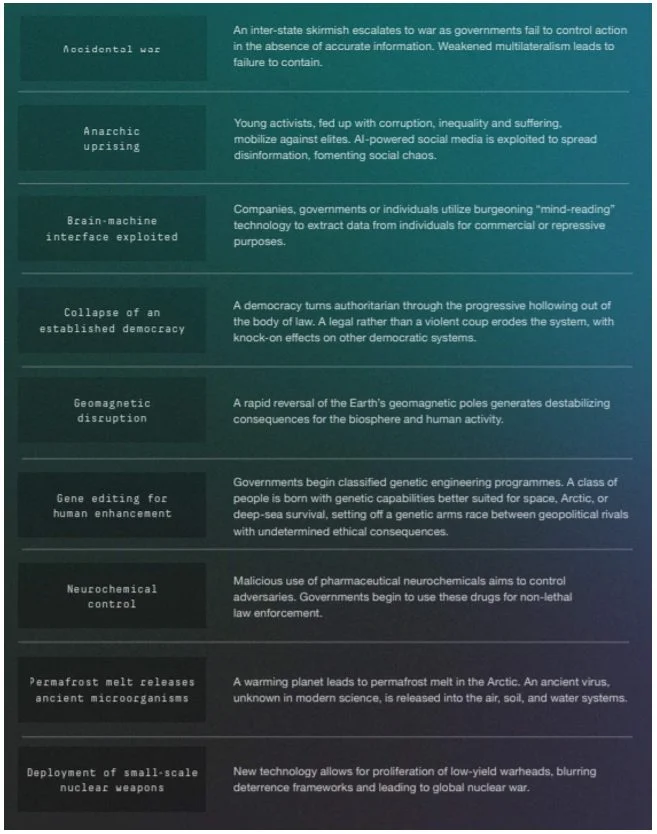
The report closes with an overview of ‘frontier risks’ – nine high-impact, low-probability events drawn from experts’ insights to encourage more expansive thinking about the universe of risk possibilities in the next decade and enable preparation and resilience in the face of crisis. These are summarised in the report extract below and include geomagnetic disruption, accidental wars, and exploitation of brain-machine interfaces.
The full report is available here .
The views expressed in this article are those of the author(s) or working group named below, and do not necessarily reflect the views of the Actuaries Institute. This work is licensed under a Creative Commons Attribution-NonCommercial-No Derivatives CC BY-NC-ND Version 4.0.