Feature
Risk Management
Career and Leadership
Risk management education update



Claim your CPD points
In order for the education curriculum to stay relevant in this fast-paced century where risk and disasters are becoming more frequent and extreme, quietly hidden away in the background are a group of actuarial volunteers that worked endlessly to design, review, and implement our own in-house Enterprise Risk Management fellowship course.
And this meant that 2022 was a highly anticipated year for the education team to trial the success of the course but more importantly obtain key learnings to enhance it further. We saw an overwhelming number of applicants, with more than 50 students enrolled in the first semester that included a diverse mix of backgrounds across different industries and levels of experience. Their key objective was to embark on a journey with more principle-based learning that focuses not only on global but also local hot topics and key issues. They then hope to leverage this learning and experience as risk actuaries that are transferrable across different industries and geographies over the course of their professional career.
So, what are the key takeaways from the new course? And what did it achieve? Whilst the team ensures the course contents and supporting materials are relevant to today's issues, inclusive of hot topics and emerging risks, this doesn't mean each one of us will require expert knowledge across the entire universe of emerging risks such as cryptocurrencies, cyber, or ESG. Rather the course tests students' abilities to apply risk management techniques that add value to the business. So, finding upside opportunities to enhance business growth and resilience is just as important as minimising downside risks.
These topics assessed the relationships between emerging and historical markets, the impact of climate change on the sustainability of businesses and lastly understanding people's risks within our institutions. All of these are what risk actuaries do day in and day out to manage the operations of their businesses.
The biggest thing when it comes to Actuarial examinations are the results. Many of us went through the painful journey of sub-20% pass rates. Therefore, you might ask, what have we done to help students succeed? The introduction of weekly tutorials and access to combined study forums improved the engagement and subsequently the pass rate of the course. It is pleasing to see over 50% of the students passed the course on their very first attempt. This doesn't mean we've lowered the passing criteria to allow more students to pass, but rather that the quality of learning has improved with a renewed strategy. It is also pleasing to hear positive feedback from post-course surveys centred around frequent student engagement, the focus on the application of risk techniques, and open dialogues between industry SMEs and students.
The table below shows a simple breakdown of the pass rates. For those keen on more details, you can visit the BOE report for semester 1 2022 where you will find detailed comments and statistics on the assignment, examination, and some overall feedback.
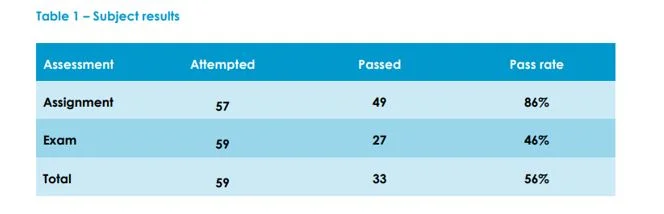
Table sourced from 2022 Semester 1 BOE report
Looking forward the team will be:
Stay tuned and if you would like to be involved, please reach out to any of us at the Education Faculty .
The views expressed in this article are those of the author(s) or working group named below, and do not necessarily reflect the views of the Actuaries Institute. This work is licensed under a Creative Commons Attribution-NonCommercial-No Derivatives CC BY-NC-ND Version 4.0.