Public Policy
Reflections on the Institute’s Public Policy Program in 2025




Claim your CPD points
The Institute’s Public Policy program can reflect on another year of significant impact across important issues facing Australia. As the three staff members behind this program, we take joy in sharing our observations and celebrating success.
Through the authentic professional association model, which draws on the expertise of many volunteer members and a network of esteemed other professionals who lean in, the program delivered:
All of this is only possible with the governance provided by the Public Policy Council Committee, chaired by Andrew Boal. Thank you to all involved!
If there’s a unifying theme, it’s sustainability ─ whether climate change related, other broad societal sustainability challenges, and/or critical financial sustainability pressure points.
This is not surprising given the concept of ensuring sustainability is deeply embedded in the profession’s DNA.
In the area of climate change, a new major report explored Mobilising Investment for Climate Adaptation through better valuing and coordinating investment and growing and diversifying the revenue streams available to fund it.
We also revamped the Australian Actuaries Climate Index so it now provides sharper insights for new region definitions that better align with how we live, build, work and govern. Both contributions are very timely against the backdrop of Australia’s first National Climate Risk Assessment (NCRA) and National Adaptation Plan published this year. We have also welcomed the constructive dialogue with those who are part of our new Climate & Sustainability External Expert Reference Group.
The Mental Health Financial Safety Net Report discussed how 22 funding supports across public and private systems could be better integrated and the overall safety net strengthened to deliver more cohesive, equitable and timely care. Of note, nearly $4 billion of the $18.5 billion in funding comes from insurance.
The Housing in Australia Report drew together earlier strands of Institute research to spotlight an emerging dual crisis of growing housing inequity. Rising prices relative to wages in some areas is creating intergenerational inequity that extends into retirement, while the risk of climate-driven price declines in high-risk regions could drive geographic inequity.
The emerging technologies of AI and quantum computing were explored in three papers:
The Reinsurance Explained Dialogue Paper unpicked how this bedrock in general insurance is changing and the potential role of innovative alternative capital instruments as we seek to adapt.
In life insurance, a significant update to the Life Insurance Sustainability Guide offered actuaries, other insurance professionals and interested parties a framework for managing life insurance for the long-term alignment of all participants.
Also of interest, across multiple practice areas, Mortality in Australia and the Rest of the World in 2024 shared the latest analysis, including how different causes of death have trended.
There were also several new publications on reforms that could help improve individual financial wellbeing across superannuation, retirement and financial advice:
All are especially important given the Superannuation Guarantee has reached maturity, our population is ageing and government budgetary pressures continue.
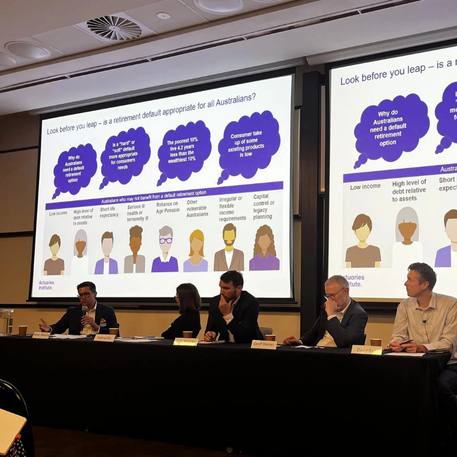
Actuary and Institute representative Nathan Bonarius (pictured far left) at 33rd Colloquium on Pensions and Retirement Research, CEPAR
Critical consultations which the Institute contributed to included the Economic Reform Roundtable, the review of the Terrorism and Cyclone reinsurance pools, Private Health Insurance product cycling, use of genetic testing in life insurance underwriting, retirement best practice principles, and proposed prudential reforms in governance, longevity product capital settings and reinsurance for general insurance.
The program also delivered a highly engaging member briefing from the Australian Climate Service and Australian Bureau of Statistics about the suite of resources in the NCRA and the National Insurance Dataset that is being developed.
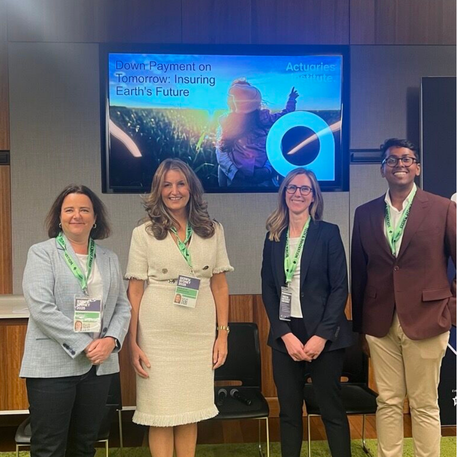
Actuaries and Institute representatives Elayne Grace, Nicolette Rubinsztein, Ramona Meyricke and Saroop Philip (pictured left to right) at 2025 SXSW panel session ‘Down Payment on Tomorrow: Insuring Earth's Future’
Institute spokespeople brought the insights from these and the ever-growing back catalogue to life at major external events hosted by parliamentarians, agencies and regulators, the Committee for Economic Development of Australia (CEDA), the Centre of Excellence for Population Ageing Research, the Chief Data and Analytics Officer network and SXSW. It is always exciting to engage in these discussions; they are essential to ensure the actuarial insights are practical and actionable.
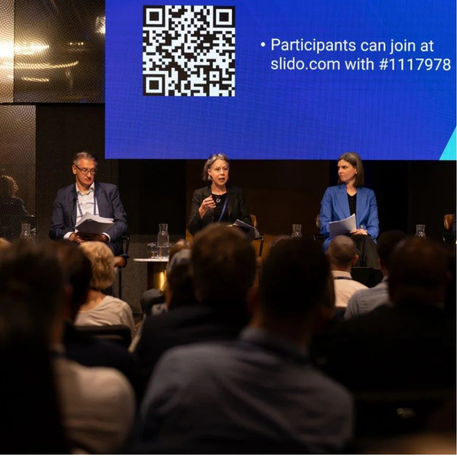
Head of Public Policy and Professionalism Vanessa Beenders (pictured middle) at ACCC and AER Regulatory Conference 2025
While impact is difficult to measure, and usually results from many experts bringing together their perspectives and accumulating over many years, we are proud to reflect that at the end of this year, the Policy Program has contributed to:
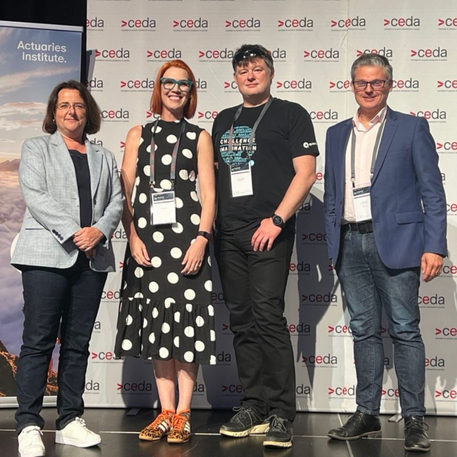
Actuaries Elayne Grace, Victor Bajanov and Craig Price (pictured left to right and with Kellie Nuttall) at CEDA AI Leadership Summit 2025
We know there is a long way to go on these, and many more, issues. But progress and impact are important to celebrate and to sustain the energy and commitment from everyone behind the program, including those who take the time to engage with our content and help make change happen.
A sneak peek into 2026: we will publish practical guidance on AI risk assessments in financial services, which is being jointly developed with the UTS Human Technology Institute, and an update to the Australian Actuaries Intergenerational Equity Index with spotlights on the topics of housing and distributional outcomes of the tax and transfer system.
As always, get in touch with us at [email protected] if you have ideas, want to volunteer or want to join the conversations.
The views expressed in this article are those of the author(s) or working group named below, and do not necessarily reflect the views of the Actuaries Institute. This work is licensed under a Creative Commons Attribution-NonCommercial-No Derivatives CC BY-NC-ND Version 4.0.