Mental health – A natural experiment



Claim your CPD points
In his presentation Mental Health – A Natural Experiment at the 2022 All-Actuaries Summit, Jeff Humphreys explored the results of a ‘natural experiment’, where a company made multi-layered changes to address spiralling mental health issues.
My presentation originated from advice I have provided for many years for a large professional services company. This work involves, among other things, reviewing the insurance arrangement the company has set up for its staff and negotiating appropriate premium rates with the insurer.
The company has provided the same income protection benefits to staff and partners for a very long period. The company’s business and the nature of the workforce have remained the same over time, although there has been a small aging in the population recently.
Part way through this period the company changed its approach to the management of the mental health of its employees. Voilà, a natural experiment, with fascinating outcomes.
My view of mental health and its possible deterioration is that it is largely a random risk. It is a risk faced by all of us. It is a risk that can be managed if it occurs, managed well or managed poorly and in some cases managed very poorly.
A natural experiment can be defined as:
In 2013 the company changed the way it managed the mental health of its employees. This is the Intervention. This was a permanent change, not a pilot study.
The change required the acceptance of and support for a significant culture shift for staff and partners. Key features of the change included:
There are two controls used to understand the impact of the intervention.
Control #1 – Across time
Control #1 is the company experience before and after the change, summarised using the following metrics:
Control #2 – Populations
Control #2 is the IP claims experience of the professional services industry. I have represented this (thankyou to one of our leading group life insurers) with the experience of a group insurer:
The results of the natural experiment are summarised below.
Control #1 – Across time
Control #1 is the company experience before and after the change, summarised using the following metrics:
| Mental Health Sick Leave | 2013 | 2014 | 2015 |
| Number of cases | 8 | 13 | 18 |
| Average Leave (days per case) | 52 | 32 | 9 |
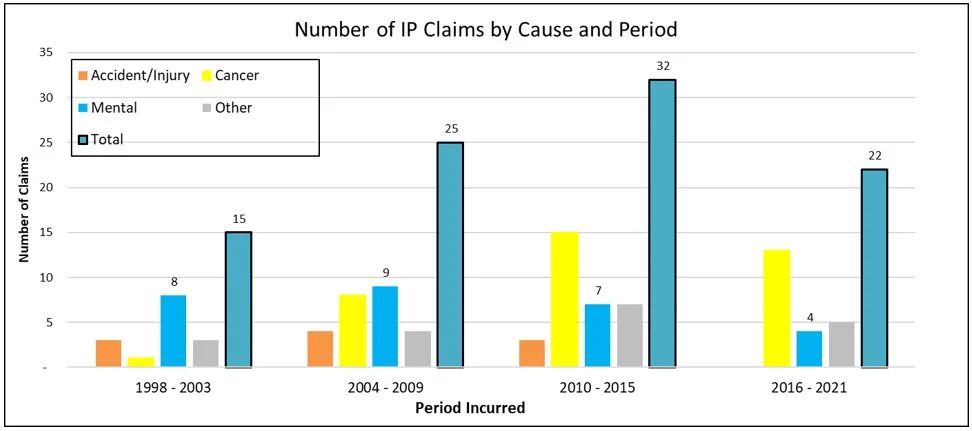
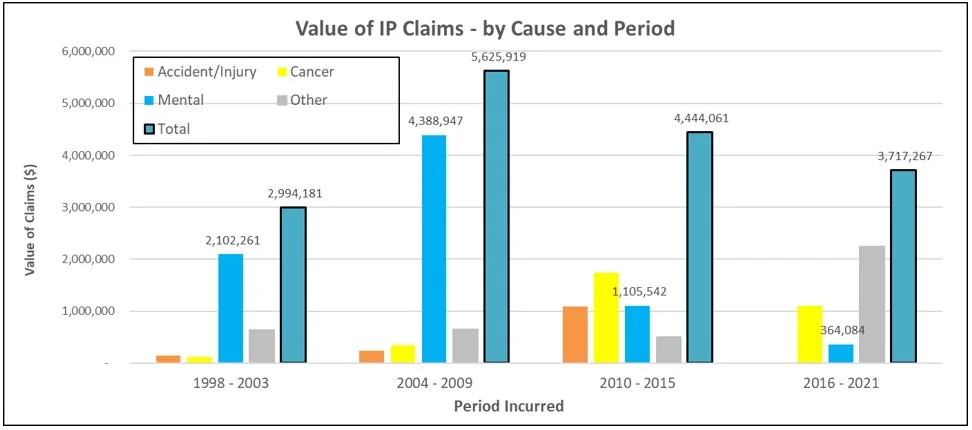
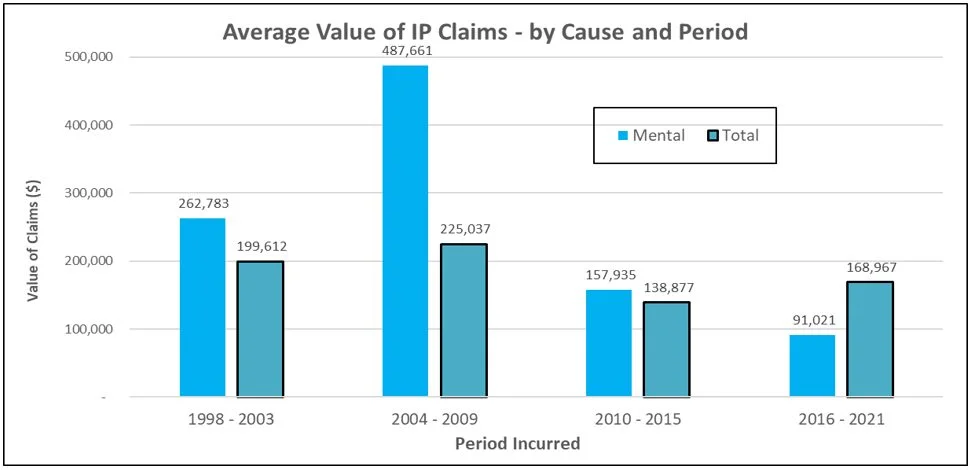
The conclusions are compelling. This is before any adjustment for:
The primary factor reducing claims cost for mental health claims is the reduction in claim duration, with average claim size reducing by around 80%. The number of claims has also reduced by around 50%.
Control #2 – Populations
The industry experience for the professional occupation category from 2008 to 2019 for mental health claims (represented here as Insurer A) is compared with the company’s experience (six year average). The experience is expressed as the proportion of IP claims that are mental health claims both by number and cost.
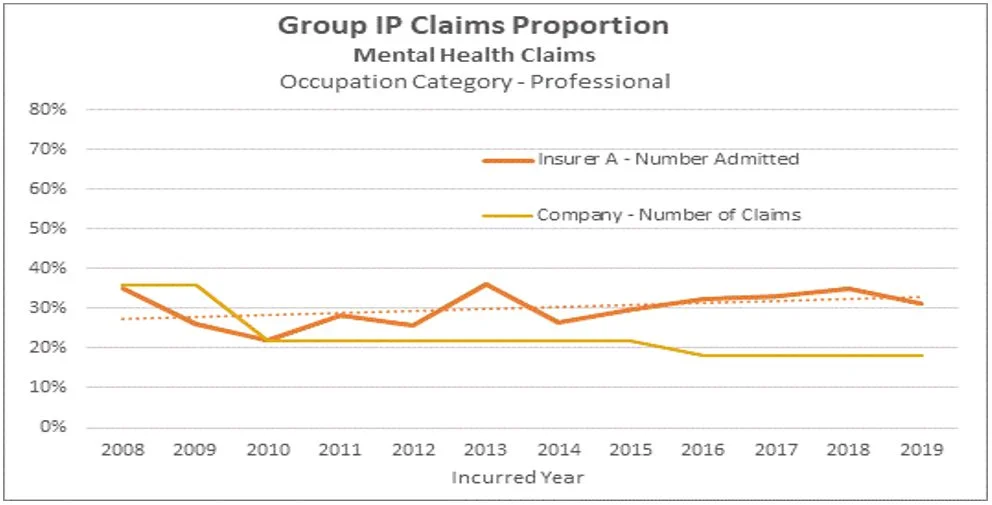
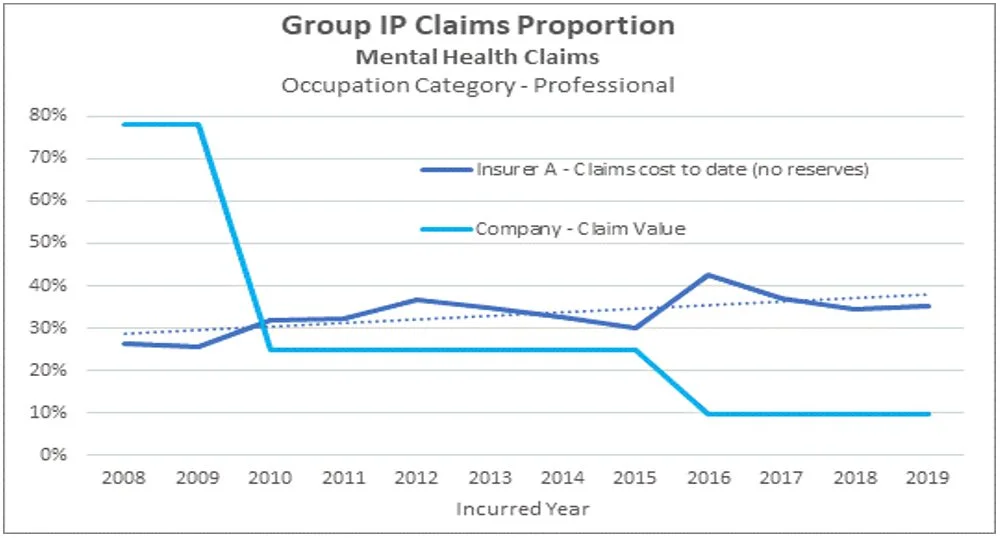
The impact of the intervention can be clearly seen. For both number and cost, the company had experience that was:
Again, the cost impact is the most dramatic reflecting the reduced claim duration for the Company experience as well as a reduction in incidence.
On the premium side, between 2013 and 2016, the Insurer’s base premium changed depending on age and sex from an 11% reduction to a 44% increase. The premium for Company A over the same period reduced by 22%.
For the company, there is a clear result with direct economic value through reduced sick leave, lower premiums (by 50% or $1 million p.a.). Add to this the indirect economic value with a happier, more productive workforce, higher staff retention rate, improved reputation and easier recruitment of staff.
The human condition is considerably improved, with reduced stress, anxiety and depression and the effect this has on staff, family, and friends.
This result is readily transferrable to other companies, providing a template from which to tailor and implement change. There is no copyright on the framework. It may also be transferrable to superannuation funds when providing cover to members of larger employers.
For most Australians their biggest asset is the present value of their future personal exertion income. Left to individuals, this is less likely to be fully insured than say the house, the car, or even the dog.
For companies seeking the peace of mind that all their employees are looked after financially if they suffer a long-term disablement, superannuation may no longer be the best place to obtain this cover:
Early intervention has to be early. The company considers that the early intervention window is within 15 days from the first signs that an issue is developing.
By the time an IP claim is reported to an insurer early intervention is far more expensive and far less likely to succeed. In any event the life industry has a poor record with early intervention, see for example Swiss Re Rehabilitation Watch 2016 where the average delay between date of disability and first touch by in-house rehabilitation consultant was reported to be 350 days.
Early intervention should ideally be at the employer level.
To be really effective the employer should have an appropriate framework in place for early identification of potential cases.
The natural experiment indicates that:
It provides assurance that it is worthwhile looking for alternative, broader solutions in this area.
It may be that we do not have to accept the textbook premise of mental health and ‘societal trend’.
If actuaries see the mental health issue as only about insurer profit then it is solved typically by hunting around for a ‘trend’, and then using a mix of the actuarial toolkit:
We have seen from past experience that this approach may provide only a short-term solution. The IDII debacle is a good example as was group risk pricing in 2013/14. The narrow solution does nothing to help solve the issue. Rather it entrenches the problem and makes it worse when it unravels.
The natural experiment suggests there is a broader role for actuaries in mental health than the narrow focus of the short-term profitability of a life office. The prior insurer learnt this the hard way being replaced by a more reasoned insurer. For the prior insurer, the long-term value of the client went from very large to zero.
So rather than defining mental health as a ‘societal trend’ that we do not control or influence but must load premiums for, actuaries may encourage companies or superannuation funds to consider strategies that address the underlying issues. These strategies may include:
1. Providing leadership on what a successful mental health framework looks like and the financial benefits that attach to this.
2. Provide price feedback:
3. Putting forward the value proposition for independent actuarial advice to assist companies ensure their disability design is sustainable and meets the desire to cover all employees for their death and disability risk, understand their claims experience and what is driving it, to establish what is a fair premium and to negotiate with the insurer and assist with any tender of the policies.
4. Assistance selecting an appropriate rehabilitation provider
Not all companies will be interested but many will.
Actuaries don’t seek to and are not asked to help solve the underlying issue of mental health in the workplace. Actuaries are not responsible (nor trained or experienced) for designing, implementing or promoting mental health programs or frameworks in the workplace. It’s not our job.
However, actuaries can influence the outcome of incidence and duration of mental health claims. So, while we don’t hold the hose, we can assist the people who do.
The views expressed in this article are those of the author(s) or working group named below, and do not necessarily reflect the views of the Actuaries Institute. This work is licensed under a Creative Commons Attribution-NonCommercial-No Derivatives CC BY-NC-ND Version 4.0.