Launch of new Green Paper: Mind the Gap – Australian Actuaries Intergenerational Equity Index



Claim your CPD points
Monday 17 August 2020 saw the launch of the Australian Actuaries Intergenerational Equity Index (AAIEI), commissioned by the Actuaries Institute and written by three Taylor Fry staff (Ramona Meyricke, Laura Dixie and me).
The Green Paper, Mind the Gap - The Australian Actuaries Intergenerational Equity Index , and the interactive index represent an important contribution to the debate about how to treat generations 'fairly' by examining structural factors that have been changing over time.
Listen to Launch of the Australian Actuaries Intergenerational Equity Index on Spreaker.
The index itself tracks a wealth and wellbeing score of three distinct age groups over time, using over 20 indicators drawn from six domains (economic & fiscal, housing, health & disability, social, education and environment) with the overall absolute index results shown below.
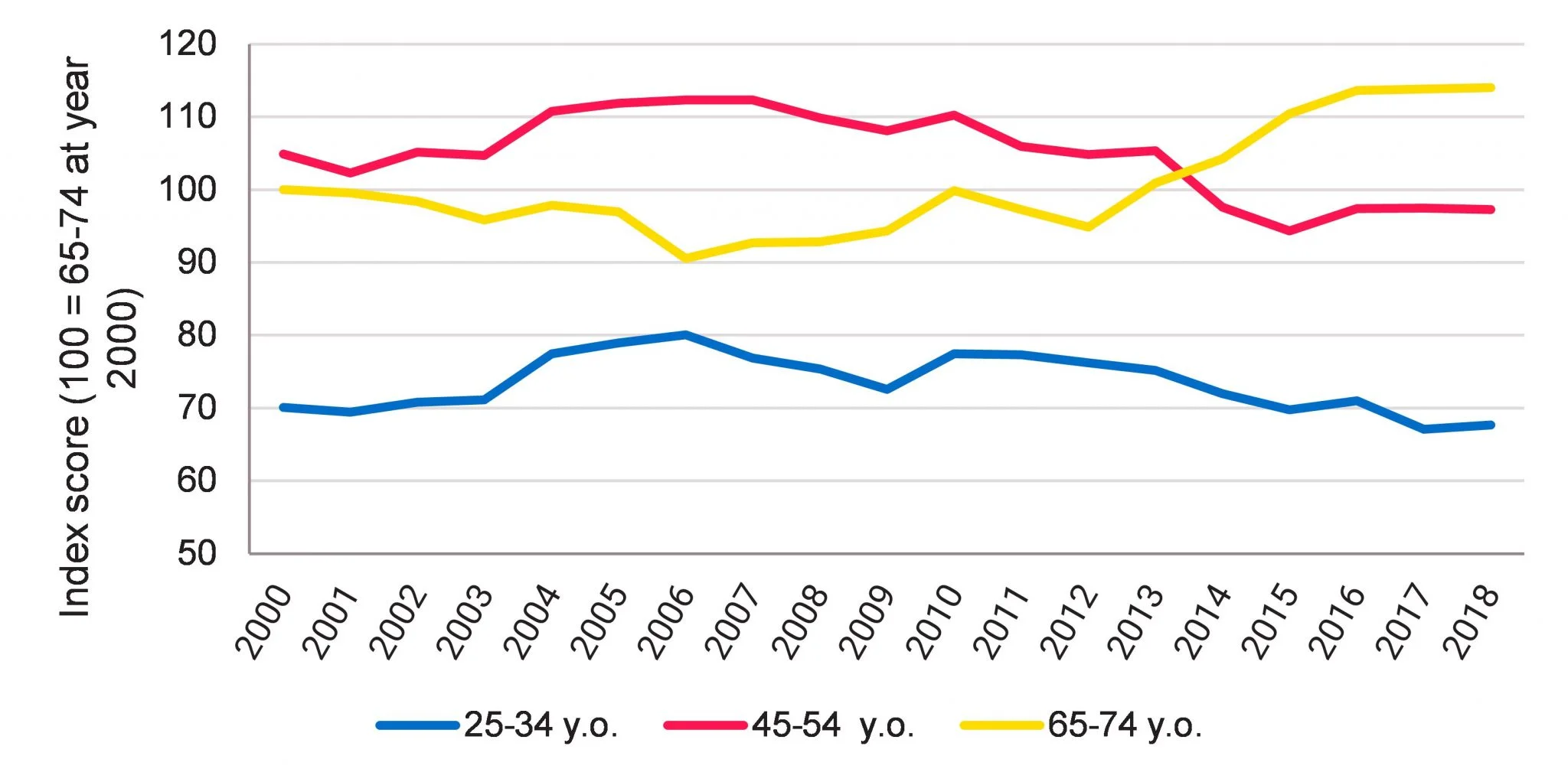
While some gaps between age groups should be considered normal considering natural life stages (for example, older people have had more time to accumulate wealth or buy a house), the striking result is that the gap between the youngest age group (25-34, currently Millennials) and the oldest (65-74, currently Baby Boomers) has never been larger. This suggests we're experiencing growing intergenerational tensions, as exemplified by the 'OK Boomer' meme seen in 2019.
The paper itself is well worth a read for full details of how the index is constructed and what drives it, but we highlight a few items.
The COVID-19 pandemic also brought some intergenerational issues into sharp relief. Rates of unemployment, and underemployment, are almost always higher for younger people but the spike seen has disproportionately affected younger people. Increased government debt will take many years of fiscal restraint to manage down as a proportion of GDP. And many people, particularly younger people, have drawn down on their superannuation early, which will have longer-term consequences for wealth accumulation and standards of living in retirement.
Intergenerational issues are not solely about problems facing younger Australians. The aged care royal commission has highlighted the failure of society to allow the elderly to live with dignity in their final years. And poverty rates are high for subgroups across different ages, including pensioners who do not own their own home.
Government policy can have implications for intergenerational issues. The paper points to several policy proposals that have already been developed across each of the domains.
This article is also published on the Taylor Fry website .
The views expressed in this article are those of the author(s) or working group named below, and do not necessarily reflect the views of the Actuaries Institute. This work is licensed under a Creative Commons Attribution-NonCommercial-No Derivatives CC BY-NC-ND Version 4.0.