Career and Leadership
Jobs for actuaries – past, present and future



Claim your CPD points
A recent survey by the Actuaries Institute asked members about their education, employers and job functions (past and present), and where they expect and hope to be in 10 years' time. Deputy CEO of the Institute Elayne Grace reports on the findings.
This employment survey was an initiative set in motion by the Institute's Council this year. It aims to gather insights into the actuarial job function, job market and views of qualified actuaries on their own career paths and job prospects. I would like to thank those who took the time to complete the survey - your responses have provided useful insights into the current and future direction of the profession.
The survey was undertaken by 777 respondents; 501 males, 276 females. Fellows made up 58.6% of respondents, Students made up 24%, and the rest were Accredited (2%), Associate (14%) and Retired (1.5%) members.
Encouragingly, 80% of Students and Associates indicated that they planned to complete the Fellowship program. However, of those who did not plan to, their reasons included being time poor, being more interested in data analytics and machine learning courses, not seeing Fellowship as necessary or relevant to their current role and career path, and/or their employer not sponsoring them to do so
The survey asked participants who they worked for, and in what practice area and function, both now, and 10 years ago.
The comparative findings were most stark in the actuarial function question. Those normally working in valuation/reserving saw a drop from 32% 10 years ago, to only 24% now. The pricing function saw a rise from 18% to 22% and data analytics rose from 6% to 9%.
Actuaries are still mostly working in corporate and consultancy roles. Corporate roles saw a slight jump in numbers while consultancy roles dropped 9% from 10 years ago to 24%.
The number of actuaries working in superannuation fell from 12% 10 years ago, to 9% now. The general insurance function rose from 33% to 36% while life insurers stayed the same (29%). Government, self-employed, not-for-profit, paid directorships have all increased by 1% with Fintech popping up from zero 10 years ago, to 1% of members working in this area now.
The majority of members surveyed (71%) said that less than 50% of their role involved APRA regulatory consideration with a quarter of members saying their roles involved no considerations at all.
4% of respondents said their job involved 100% APRA regulatory considerations and an additional a quarter of members surveyed said their job involved more than 50% of APRA regulatory considerations.
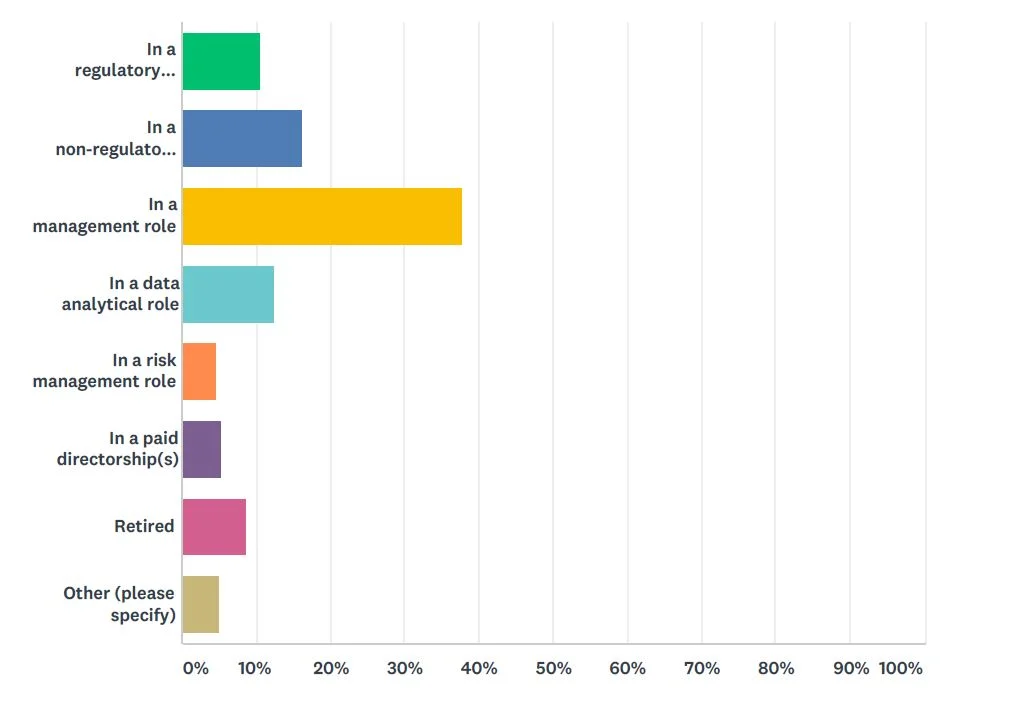
In the next 10 years, only 10.5% expect to be in a regulatory actuarial role and 16% in a non- regulatory actuarial role. 38% respondents expect to be in a management role and 12% in a data analytical role.
In the next 10 years, other respondents said they expected to be:
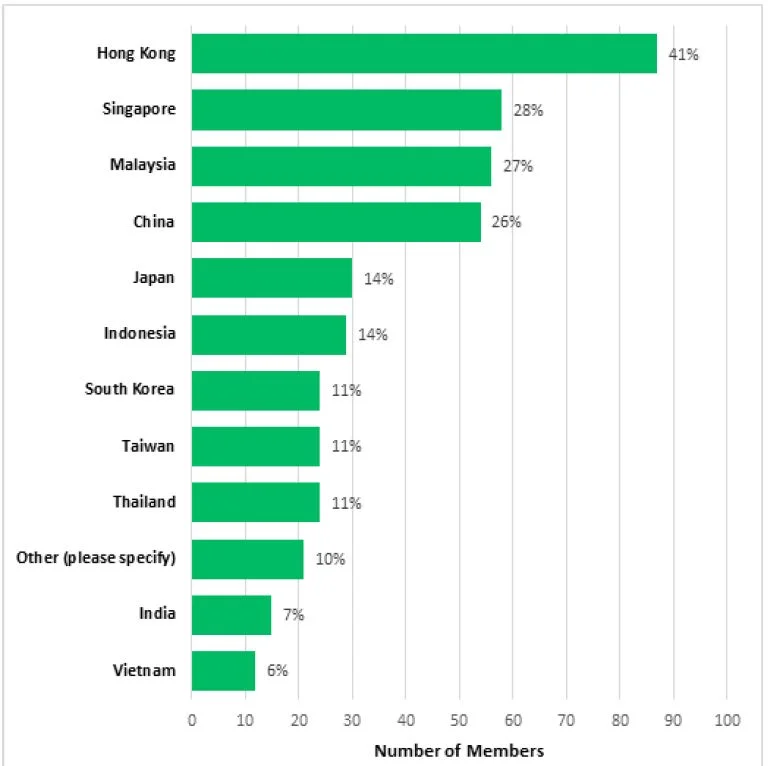
Members who have worked outside Australia mostly worked in Asia (27%) and Europe (24%). Hong Kong was the most common Asia base (41%), followed by Singapore, Malaysia, China, Japan and Indonesia.
When asked where they would like to work, members said Europe (55%), Asia (47%) and the Americas (40%). Within Asia, members were by far most interested in working in Hong Kong, followed closely by China, Japan, then Singapore, South Korea, Taiwan and Malaysia.
An overwhelming majority of respondents (65%) said they would still choose an actuarial career if they were a new, young graduate today, or recommend it to their kids or young people. Although 16% said they would not, 18% had mixed comments
And yet with 68% having completed a university actuarial degree and 18% a maths degree, it was interesting to see that although 21% said that "with the benefit of hindsight" they wished they'd studied a maths degree, only 47% of respondents said the same for an actuarial degree. 5% said they would have preferred to study computer science.
Only 39% of respondents said they had additional qualifications - 88 respondents held a CERA qualification, 29 held an Australian Institute of Company Directors (AICD) qualification, 21 held a CFA, 16 had completed a PHD, nine held an MBA, and four held a Data Analytics qualification.
Only 35% of respondents said they had found it hard to get a job in their preferred field and judging by their comments, this was largely in the graduate market. A lack of experience when starting out, competition and a lack of positions in the graduate market were all cited as reasons why.
When asked whether they see their current area of work growing or contracting over the next five years, 45% saw growth and 15% saw contractions, while 35% said they expected their area of work to stay the same. Interestingly 57% of people said they had or would like to work part time in the next ten years.
Data Analytics was overwhelmingly the largest expected growth area (70%) followed by Risk Management (14%), Health (5%) and Banking (4%).
These results are consistent with the Institute's modelling of future scenarios for the profession. Data Analytics is a major focus in the Institute's Strategic Plan and the Data Analytics Working Group has worked hard to establish the popular Data Analytics Seminar (coming up again this year on 11 October) and resources like regular data columns on Actuaries Digital as well as the LinkedIn community .

Guy Thorburn with his prize - an iPad
Guy Thorburn, the Australian Government Actuary, won the employment survey competition to receive an iPad - congratulations Guy!
"Having just changed roles, I'm seeing lots of areas in which actuaries are able to make a unique contribution," said Guy.
"I hardly needed any incentive to complete the survey, but to win such a great prize is icing on the cake. I'm looking forward to putting it to good use.
"The world of work is changing and new opportunities are emerging for actuaries to apply our skills. It great to see that the Institute is keeping one step ahead in this changing environment."
The views expressed in this article are those of the author(s) or working group named below, and do not necessarily reflect the views of the Actuaries Institute. This work is licensed under a Creative Commons Attribution-NonCommercial-No Derivatives CC BY-NC-ND Version 4.0.

From model governance to machine learning, explore actuarial perspectives on data science and artificial intelligence
Subscribe to Actuaries Digital for free and receive the latest actuarial analysis, research, and commentary direct to your inbox