Banking
Is It Time for a New Monetary Regime?



Claim your CPD points
Michio Suginoo explores whether the recent low in bond yields have broader implications for monetary policy across the world.
There is much hype around cryptocurrencies, such as Bitcoin, which have received significant media attention as well as increasing regulator scrutiny. One possibility is that this popularity reflects growing frustrations against fiat money - the existing monetary system controlled by central banks. The rise of cryptocurrencies has also emerged at the same time as a deflationary environment among some advanced economies. Is this all a coincidence-or are there some bigger underlying forces in the world's monetary environment? Taking history as a guide, there are some past trend that offer striking parallels to our time. It suggests a new paradigm shift in monetary regime.
This article, outlining historical features of the monetary regime cycle [i] (MRC) and paradigm shifts in monetary system, attempts to place modern events in this broader context.
Since the 19th century, the coherent underlying evolution in the monetary system was the gradual shift from metallic standards to fiat money in multiple steps. In its passage, a series of significant paradigm transformations in monetary regime took place around reversals of the bond yield cycle in the core global power states (call it the bond wave [ii] ) namely the UK until the early 20th Century and US thereafter. ( Suginoo, 2017 )
Also, historical reversals of the bond wave tend to correlate with extreme monetary conditions, possibly with some time lags. A top range of the bond wave is highly associated with an extreme inflationary environment; its bottom range, with an extreme deflationary environment, except for war interruption periods. [iii] ( Suginoo, 2017 )
These two empirical relations together suggest that extreme monetary conditions might have something to do with paradigm shifts in monetary regime. The chart below captures these historical facts [iv] . And the details can be found in this hyperlink . ( Suginoo, 2018 )
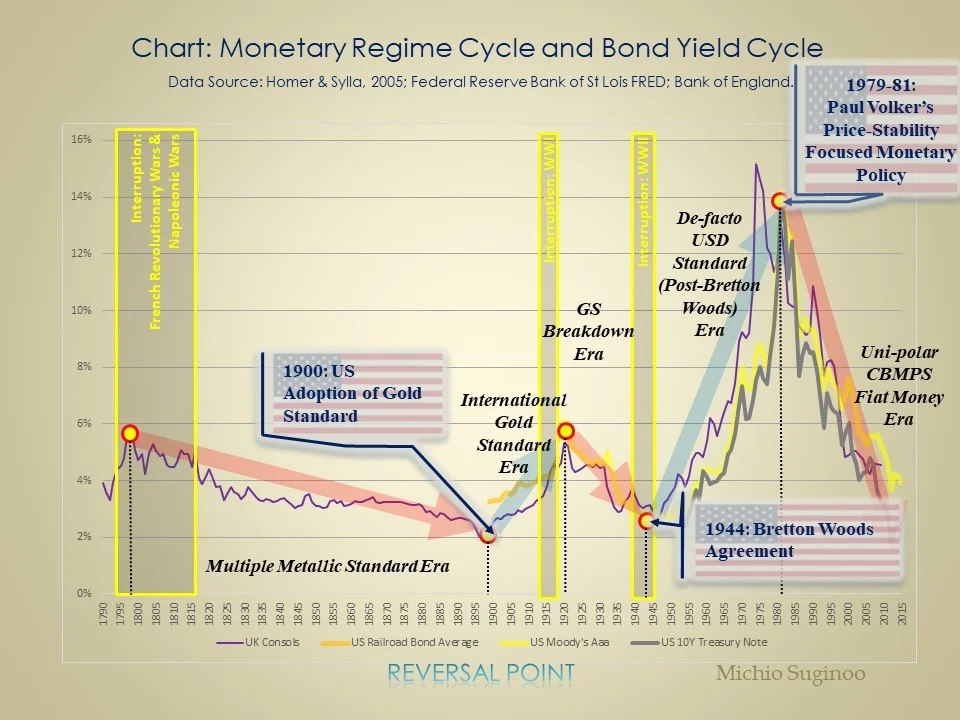
MRC in the chart, providing only four historical reversals of the bond wave, presents three types of monetary transitions: two 'orderly transitions,' a 'chaotic transition,' and a 'total vacuum.'
Two 'orderly transitions' evolved along new consolidation stages in the global geopolitical order:
Then, there were one 'chaotic transition' and one 'total vacuum.'
The last two transitions (the chaotic transition and the total vacuum) demonstrate that authorities' pursuit in preserving the status quo could create broader economic imbalance and paradoxically impair their existing monetary paradigm. Both transitions were also by-products of arbitragers' victory against monetary authorities' inertia. Here is another episode, the birth of UK gold standard , to emphasise this tendency. (Suginoo, 2018)
It might well appear that we are at another turning point in the bond wave, with bond yields as low as they are likely to go and an eventual reversal inevitable (however, this might be proven wrong, if a persistent deflation were to re-emerge going forward). With history as a guide, under the current extreme monetary condition with an extended period of low interest rates, we are likely to experience some sort of paradigm transformation in the monetary regime-maybe with some time lag.
Contemplating potential alternatives for the next monetary regime , we need to monitor several points:
In our contemporary context, one relevant parallel to historical paradigm shifts is Shirakawa's monetary policy paradox : monetary policy's success in restoring price and economic stability can feed the very causes of financial crisis-an extension of leverage and its consequence, asset bubble. Such bubbles in turn lead to economic instability. Once its consequential financial crisis unfolds, monetary policy loses its effectiveness. It creates a self-defeating cycle. In the long-run, monetary policy could end up transferring economic imbalance from one area to another in the economy [vi] . ( Suginoo, 2017 )
After all, we still need to be aware of our limitation in contemplating the future. If our future is shaped by three dynamics-cyclical dynamics, evolutionary dynamics, and by-product of accidents-the last two factors are tautologically beyond our ability to anticipate. Here is a list of some possible alternatives for the forthcoming monetary reality. Please visit my existing work to explore them further .
[i] In this reading, 'cycle' refers to general pendulum-like oscillation dynamics with irregular interval and irregular vertical scale. It is an open system that is susceptible to cyclicality, evolutions, and uncertainties. Therefore, it does not convey any notion of a regular periodic constant cycle.
[ii] The bond wave concerns the core power states of a given time, referring to either of the followings: the cycle of its long-term bond yields in a general context, and a rising cycle of its long-term bond yields or a declining cycle of its long-term bond yields in a trend context. I use these words interchangeably.
[iii] A war interruption can cause inflationary force even at the bottom of the bond yield cycle. (Goldstein, 1988, pp. 252-253) As an example, the post-Great-Depression deflationary environment was transformed to be inflationary by WWII even at the bottom of the bond yield cycle at that time. In addition, during the war the bond yield was managed by the government for the purpose of smooth war-financing. In a way, for this particular case, the lag was the symptom of the war-financing management.
[iv] Refraining from analysing the causal relationship between these factors-monetary conditions, the bond wave, and the monetary regime cycle-this reading invites readers to focus on observing historical facts as a guide to formulate relevant and legitimate questions about the present and the future of our monetary paradigm. In this attempt, it sees that our reality is driven by at least three dynamics: cyclical dynamics, evolutionary dynamics, and by-product of accidents. In a way, it promotes an agnostic approach in economic thinking, without heavily relying on any particular school of economic thought.
[v] Henry Kissinger (2014) wrote "Disraeli called the unification of Germany in 1981 "a greater political event than the French Revolution" and concluded that "the balance of power has been entirely destroyed." The Westphalian and the Vienna European orders had been based on a divided Central Europe whose competing pressures-between the plethora of German states in the Westphalian settlement, and Austria and Prussia in the Vienna outcome-would balance each other out. What emerged after the unification was a dominant country, strong enough to defeat each neighbour individually and perhaps all the continental countries together. The bond of legitimacy had disappeared. Everything now depended on calculations of power. (…) Europe's new order was reduced to five major powers, two of which (France and Germany) were irrevocably estranged from each other." (Kissinger, 2014)
[vi] Shirakawa's paradox reminds us of Hyman Minsky's emblematic phrase "Stability is Destabilising" that encapsulates his Financial Instability Hypothesis. Both Minsky's Financial Instability Hypothesis and Shirakawa's Monetary Paradox share the same topic-causes and consequences of finance-fed financial crises. While Minsky's Financial Instability Hypothesis has intense focus on the private sector's money creation mechanism, Shirakawa's Monetary Policy Paradox has a wider framework to examine and question the effectiveness of central banks' monetary policy actions. And both articulate that policy incentives and behaviours and psychologies of economic agents play significant roles in altering economic reality. ( Suginoo, 2017 )
The views expressed in this article are those of the author(s) or working group named below, and do not necessarily reflect the views of the Actuaries Institute. This work is licensed under a Creative Commons Attribution-NonCommercial-No Derivatives CC BY-NC-ND Version 4.0.