How can model governance capture value from AI in insurance?



Claim your CPD points
Simon Lim reflects on the use of AI in insurance and suggests a practical framework for assessing AI models and managing risks.
Major Australian general insurers are investing heavily in deploying artificial intelligence (AI) and machine learning (ML) models. This trend is likely to accelerate as the tremendous value of AI becomes widely known.
The term artificial intelligence (AI) commonly refers to specialised predictive machines, i.e. software/algorithms that take data as input, and output predictions. Although AI also includes other areas such as unsupervised learning, predictive algorithms are the focus of this article. In insurance pricing, predictions are focused on the expected claims cost of a policy. There are many different types of AI models, with machine learning being one of them and the focus of this article.
Traditional insurance models, such as generalised linear models (GLMs), also predict the claims cost. The key benefits of more advanced AI (or machine learning) models are:
Machine learning (ML) models are harder to evaluate and explain because they are more complex and automated. Specifically:
Explaining AI is like interviewing a candidate for a job.
An interesting point to note is that explaining an AI model is generally done top-down, such as running the model under different conditions and seeing how it changes or building a simpler model that emulates the AI model.
In contrast, explaining a GLM can be done bottom-up where its underlying mechanics are interpreted directly. AI explainability is like interviewing a candidate for a job. The candidate is assessed via a discussion which involves asking hypothetical questions, but the interviewer is not able to observe on-the-job performance firsthand.
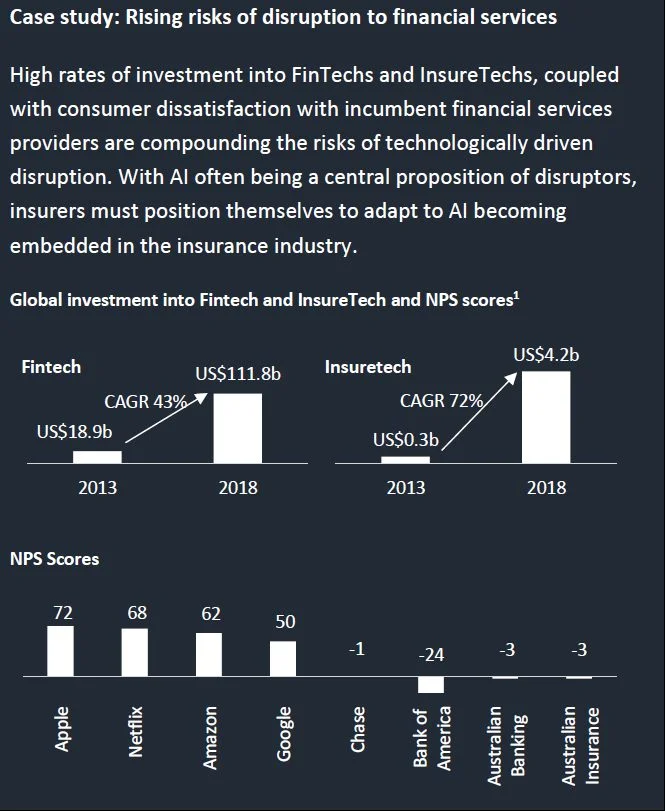
Despite this complexity, insurance leaders are still accountable for the accuracy and risks arising out of AI usage. Competition will likely force businesses to implement AI. However, AI introduces new risks, such as whether the promised benefits are realised within budget and reputational risks associated with misuse or perceived misuse of data and AI.
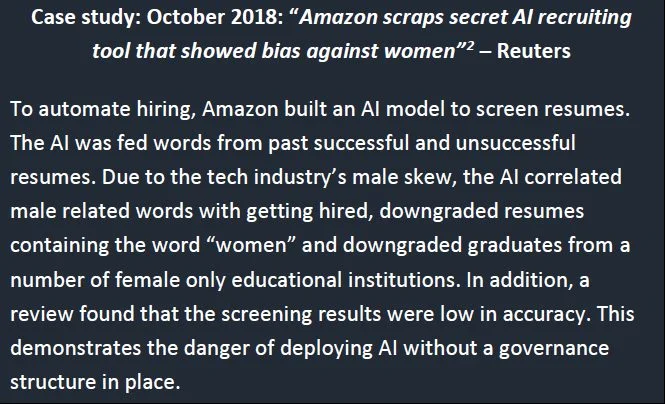
As leaders are accountable for these outcomes, an understanding of how to evaluate AI models and how to ensure they meet business needs is therefore essential.
AI model development follows a process like manufacturing. Code is written to build a “machine” and data is passed through this “machine” to produce predictions. Checks should be performed throughout this process and development iterated to minimise re-work.
We propose an efficient model governance framework which sequences activities in increasing order of required supervision and cost, as shown in the figure below.
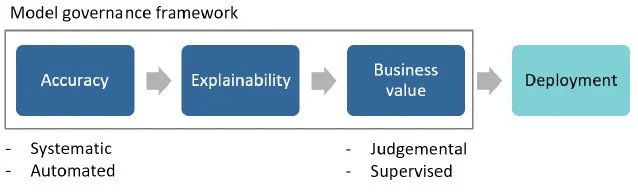
Checks that are systematised and low cost, such as statistical tests, should be applied first prior to more complex assessments. This sequence increases the rate of development and model effectiveness because:
The three stages of the model governance framework are as follows.
The key goal at this stage is to apply quantitative metrics which may indicate problems with the model such as over-fitting or poor accuracy.
These statistical tests and interpretations can be typically systematised and are therefore low cost to run once established.
Typical tools to use include: GINI coefficient, Goodness of fit metrics, cross-validation, one-way charts and actual versus expected heatmaps.
Lack of explainability, consistency or intuitiveness may indicate (although not guarantee) that the model has fitted to noise and may perform poorly in a live environment.
Although metrics used in these tests can also be systematically run, interpretations require judgement and an understanding of context and therefore full automation is generally not possible.
Common queries made in this stage include:
Typical tools to use include: Partial Dependence Plots (PDP), Feature Importance, Shapley plots and dependence plots, one-way plots.
Once a model has passed stages 1 and 2, it is technically sound and the business has confidence that it will perform in a live environment. However, the value of the AI model should be quantified in order to justify the model’s deployment cost.
It is vitally important that business objectives are clear. According to McKinsey [1] , “unclear objectives” and “lack of business focus” are the top issues driving IT cost overruns and failures.
The two use cases for increased modelling accuracy are in being able to more effectively:
The true value of the model lies in the increased profits or superior business outcomes arising out of these strategies. This can be quantified via scenario and price elasticity analysis.
For example, for the risk avoidance case, we could quantify the loss ratio improvement if the 2% worst risks identified in a backtest were avoided or re-priced. For the growth scenario, we could quantify the increased profits if the business were to growth in a selected highly profitable segment.
There are some practical considerations when quantifying such scenarios. Firstly, any price increase scenarios should adjust for loss ratio improvements purely from higher prices. Secondly, the relationship between price and volume, i.e. price elasticity, should be incorporated and such assumptions agreed with stakeholders.
Like any investment decision, this test is judgemental due to the large number of possible scenarios. Nevertheless, it is important to ensure the business derives value from AI.
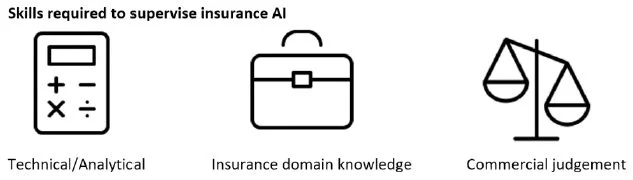
Model governance is not a mechanical process. It requires supervision by people with technical expertise and commercial judgement in addition to insurance domain knowledge.
Model governance is also labour intensive. We suggest some strategies to ensure governance does not become too burdensome:
Until a new generation of AI emerges that can self-review effectively, AI governance will continue to be essential in order for businesses to manage risks and derive value from AI.
[1] Source: KPMG, Credit Suisse, Allianz, NfX, Customer Monitor[2] https://www.reuters.com/article/us-amazon-com-jobs-automation-insight/amazon-scraps-secret-ai-recruiting-tool-that-showed-bias-against-women-idUSKCN1MK08G [3] https://www.mckinsey.com/business-functions/digital-mckinsey/our-insights/delivering-large-scale-it-projects-on-time-on-budget-and-on-value
The views expressed in this article are those of the author(s) or working group named below, and do not necessarily reflect the views of the Actuaries Institute. This work is licensed under a Creative Commons Attribution-NonCommercial-No Derivatives CC BY-NC-ND Version 4.0.