COVID-19 Mortality Working Group: Another month of high excess mortality in July 2022



Claim your CPD points
| In summary:• Total excess mortality for the month of July 2022 is estimated at 16% (+2,600 deaths), relative to expected mortality at pre-pandemic levels. |

The COVID-19 Mortality Working Group has examined the latest Provisional Mortality Statistics, covering deaths occurring prior to 31 July 2022 and registered by 30 September 2022, released by the ABS on 27 October. This release also includes the article COVID-19 Mortality in Australia, with details on all COVID-19 deaths occurring and registered by 30 September 2022.
We compared observed deaths to our “baseline” predicted number of deaths for doctor-certified deaths (by cause) and coroner-referred deaths (for all causes combined). We also provide an indicative estimate of excess mortality due to COVID-19 only, for the three months subsequent to the ABS data (August to October 2022).
We will shortly be publishing two accompanying pieces to this article; the first covering analysis of excess mortality by gender and age band, and the second focusing on the 2022 influenza season.
Our previous Actuaries Digital article discussed in some detail how we arrived at our baseline predicted deaths. In short, our baselines are set by extrapolating linear regression models fitted to standardised death rates (SDRs), which are then re-expressed as numbers of deaths. For the pandemic years, we have included different years to train the regression models:
The baseline for our estimates of excess deaths remains “in the absence of the pandemic” for each of the three years 2020 to 2022. We have not included any COVID-19 deaths in the baseline, as these would not exist in the absence of the pandemic.
As always, it is important to note that predicted death numbers are increasing faster from demographic changes (ageing and population size) than they are reducing due to mortality improvement. Therefore, our model predicts higher baseline numbers of deaths in each successive year.
The results we present here differ from those quoted by the ABS in its commentary surrounding the release of the Provisional Mortality Statistics. For 2022, the most significant difference is in the determination of the baseline, where the ABS uses a simple average of the number of deaths from 2017, 2018, 2019 and 2021, with no allowance for mortality trends or demographic changes. In our view, this understates the baseline and therefore overstates the measure of excess deaths.
For example, the ABS has reported that 16,375 (17.3%) excess deaths occurred by 31 July 2022, in comparison with our estimate of 13,700 (14%).
Figure 1 and Table 1 summarise the results of our analysis. This article concentrates on the experience in 2022, but we have also shown the 2020 and 2021 results for context.
As in previous work , we have assumed that coroner-referred COVID-19 deaths will be 5% of all COVID-19 deaths in 2022, based on the experience of late 2021. If our estimate of coroner-referred COVID-19 deaths is too high (or low), this will not affect the total level of excess deaths measured; it will just mean that our estimate of non-COVID-19 coroner-referred deaths will be too low (or high) by the same amount.
(Figure 1 – Weekly actual and predicted deaths in Australia – All Causes)
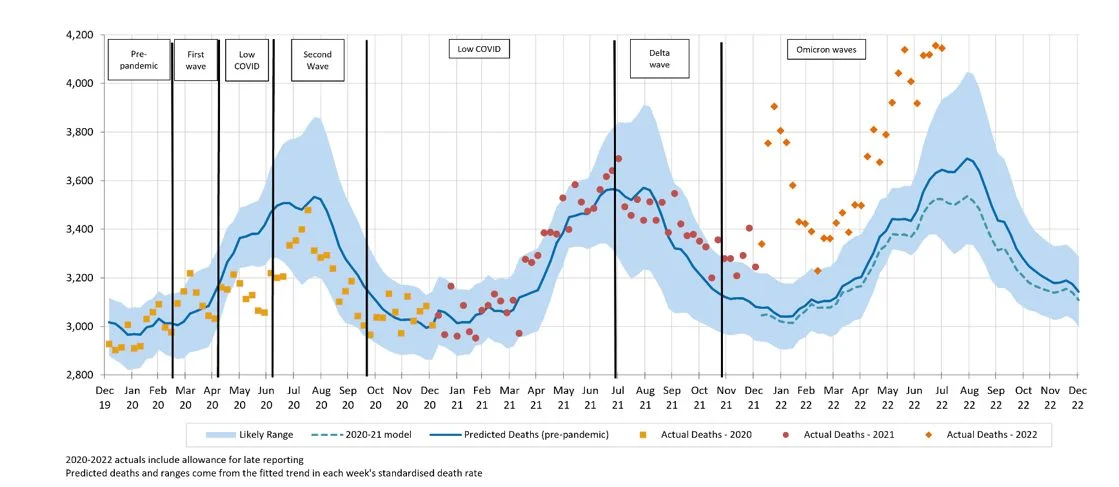
Deaths in the five new weeks of data (July 2022) were again well above the upper end of the prediction interval (i.e. above the 97.5th percentile). So far, all but one week of 2022 has been above the 97.5th percentile.
(Table 1 – Excess deaths in Australia)
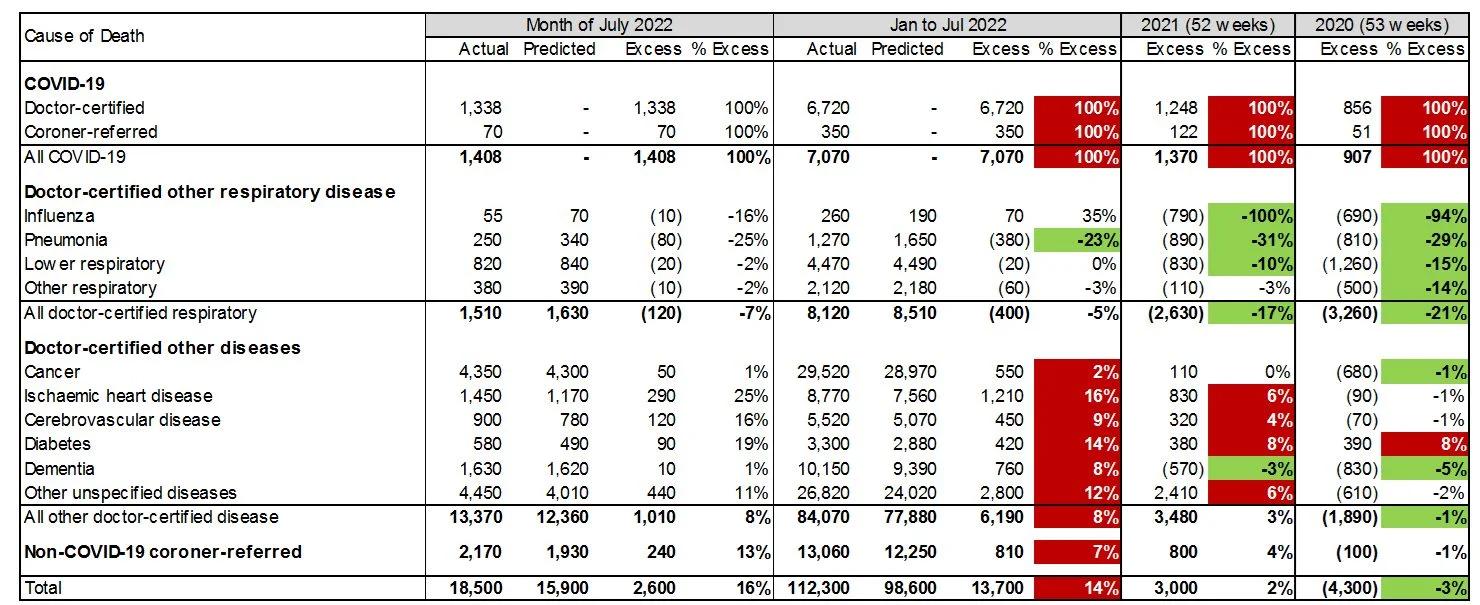
(Figures shaded green indicate that the observed values are below the 95% prediction interval while figures shaded red are above the 95% prediction interval.)
For the month of July 2022:
For the first seven months of 2022:
The ABS’s COVID-19 Mortality in Australia article shows that, in the first seven months of 2022, there were 1,696 deaths in people who were COVID-19 positive at death but where COVID-19 was not the primary cause of death. It is unclear how many people who died with COVID-19 would have died during this seven-month period anyway, and how many may have had their death hastened by COVID-19. However, COVID-19 may have been a contributory factor in around one quarter of the excess mortality from non-COVID-19 causes.
Figure 2 shows the breakdown of excess deaths in the first six months of 2022 into those due to COVID-19, those with COVID-19, and those where COVID-19 does not appear on the death certificate. We have shown both the numbers of excess deaths and the percentage excess.
(Figure 2 – Excess Deaths by Involvement of COVID-19)
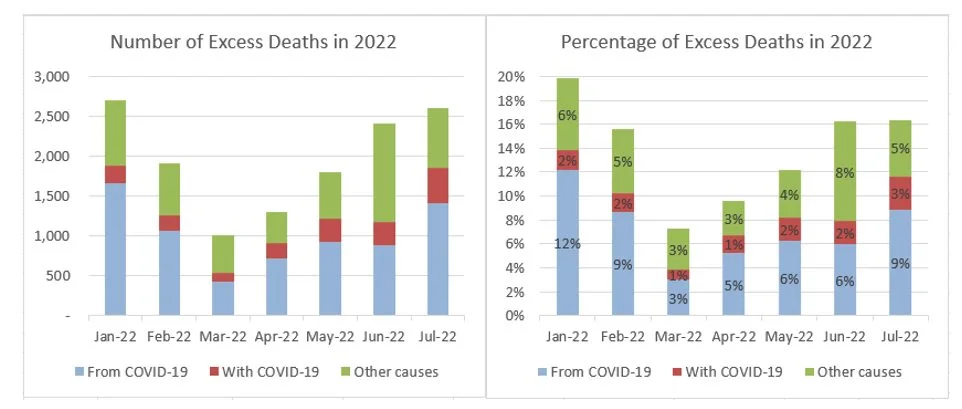
The excess death percentage in July 2022 is the same as for June (16%). However, the mix of COVID-19 versus non-COVID-19 deaths has changed; following a very high proportion of excess deaths not involving COVID-19 in June 2022 (8%), the excess has come down in July (5%).
The measurement of higher numbers of deaths than predicted does not tell us why this is occurring. There are a number of reasons hypothesised around the world (where this effect is occurring to a greater or lesser extent). It isn’t possible to identify from death counts alone what is causing the non-COVID-19 excess deaths, but we have listed below the most likely explanations.
We note that multiple factors are likely in play, and different factors may be more or less pronounced at various times. The following indicates which factors, in our view, are likely to be having a greater or lesser impact on Australian excess mortality in 2022.
While the ABS Provisional Mortality Statistics data is only available up to the end of July 2022, surveillance COVID-19 deaths are available up to the end of October 2022. Figure 3 shows the number of such deaths in each month since January 2020.
Note that, with the change to weekly reporting of COVID-19 surveillance statistics, it is no longer possible to report full calendar months. The month of September 2022 shown runs from 1 September to 29 September (27 September for Queensland), while the month of October 2022 is from 30 September to 27 October (28 September to 25 October for Queensland).
(Figure 3 – COVID-19 deaths in Australia, reported from surveillance systems -adjusted, where known and material, to reflect the actual month of death for late-reported deaths)
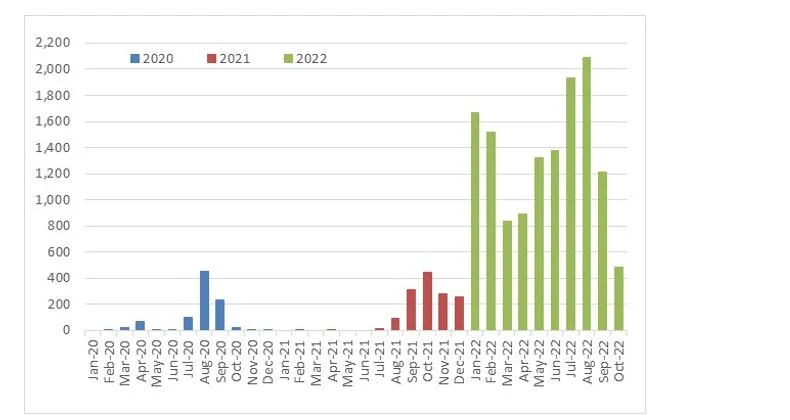
In the ten months to end October 2022, there have been approximately 13,350 COVID-19 deaths. Of these, around 3,800 occurred in the three months to end October 2022 (where we have no provisional mortality statistics). Reported deaths in the month of October were the lowest so far of 2022.
The COVID-19 Mortality in Australia article shows the proportion of those death certificates mentioning COVID-19 where COVID-19 was the underlying cause. Figure 4 shows a comparison of deaths “from” COVID-19 versus those “with” COVID-19. For the most recent months, a large proportion of deaths have not yet been registered, so we have also shown our estimate of the numbers of as-yet unregistered deaths.
Figure 4 also contains a line showing the proportion of registered COVID-19-related deaths that were “from” rather than “with” COVID-19. Many deaths are still to be registered in the last month shown, so this percentage could change – hence, this point is shown as a preliminary estimate.
(Figure 4 – A comparison of deaths “from” COVID-19 to those “with” COVID-19 (source: ABS))
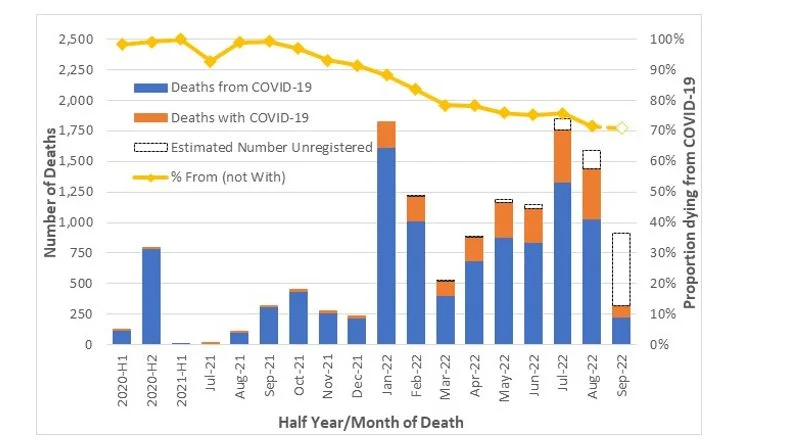
The proportion of registered COVID-19 deaths from COVID-19 has reduced in 2022, from 88% in January, to 75% in May to July, and then a substantial drop to 71% in August and September.
We consider it reasonable to assume that, of the 3,800 “COVID-19” deaths reported in August to October 2022, 71% may have been from COVID-19 rather than with COVID-19. Therefore, we estimate that around 2,700 deaths in this period may have been due to COVID-19.
Our prediction model suggests that, without a pandemic, there would have been a total of around 46,300 deaths in the three months August to October 2022.
Thus, COVID-19 deaths represent around 6% extra mortality over August to October 2022 (9% in August, 6% in September and 2% in October). There have probably been fewer deaths from respiratory diseases in this period than our pre-pandemic predictions. However, we consider it likely that mortality from non-COVID-19, non-respiratory causes will be higher than our pre-pandemic predictions, given the higher-than expected mortality in 2021 and the first seven months of 2022, and that this will outweigh the benefit from respiratory disease. Therefore, we expect that total excess mortality in August to October 2022 will have been higher than the 6% explained by COVID-19.
Figure 5 combines our preliminary estimate of excess deaths due to COVID-19 only for August to October 2022 with our detailed excess death estimates shown earlier, to reveal cumulative excess mortality since the start of 2020.
(Figure 5 – Estimated cumulative excess deaths in Australia since 1 January 2020)
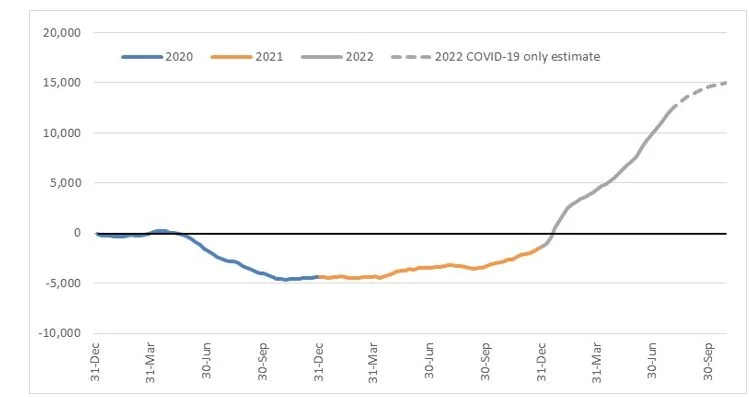
Deaths from the Delta wave in the latter part of 2021 and the Omicron wave in early 2022 had fully eroded the negative excess deaths experienced earlier in the pandemic by early January 2022. After very sharp increases in excess deaths over the first seven months of 2022, we estimate the excess will slow down with the lower level of COVID-19 deaths in September and October.
Cumulatively across the pandemic, our conservative estimate is that Australia had experienced just over 15,000 excess deaths by the end of October 2022. This represents an average excess mortality rate of about 3% across the pandemic.
These impacts by year can be seen separated into excess deaths from COVID-19 and other causes in the table below.
(Table 2 – Excess deaths separated into COVID-19 and other causes)
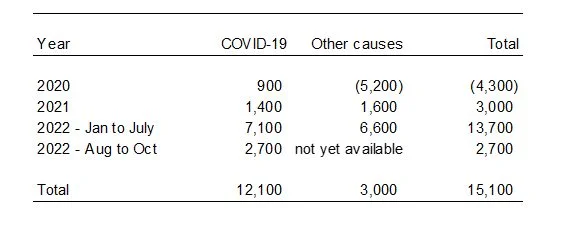
We estimate that there have been 12,100 deaths from COVID-19 in Australia to the end of October 2022.
For non-COVID-19 causes, the lower than predicted deaths in 2020 have now been more than offset by higher than predicted deaths in 2021 and the first seven months of 2022.
Figure 6 shows the cumulative standardised mortality rates (SDRs) for 2015 to 2022, expressed relative to the rate for 2019. The SDRs are from the Provisional Mortality Statistics, plus allowance for late-reported deaths.
(Figure 6 – Cumulative standardised mortality rate relative to 2019)
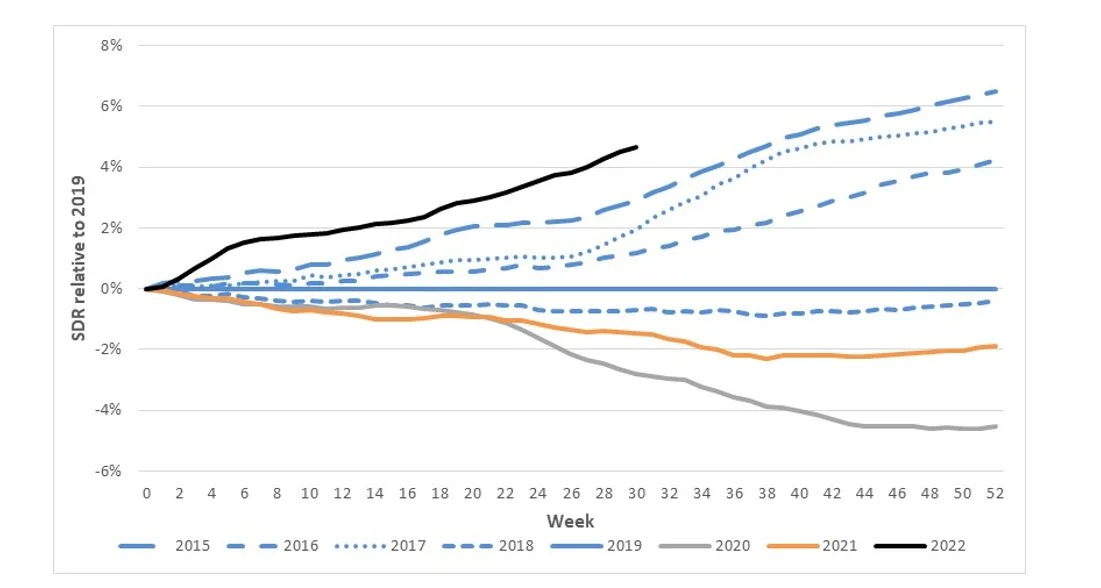
The graph shows that:
In this section, we assess where COVID-19 sits in terms of leading causes of death in Australia.
The ABS reports on the top 20 leading causes of death by grouping deaths based on their International Classification of Diseases, version 10 (ICD-10) code. Cancers are grouped based on the region of the body rather than included as a whole. In this analysis, we have followed the ABS classification system.
We have estimated deaths for the leading causes for the first ten months of 2022. To do this, we have:
We have also estimated leading causes for the whole of 2022, noting that we have not made any estimate of COVID-19 deaths in the remaining two months of 2022.
(Table 3 – Excess deaths separated into COVID-19 and other causes)
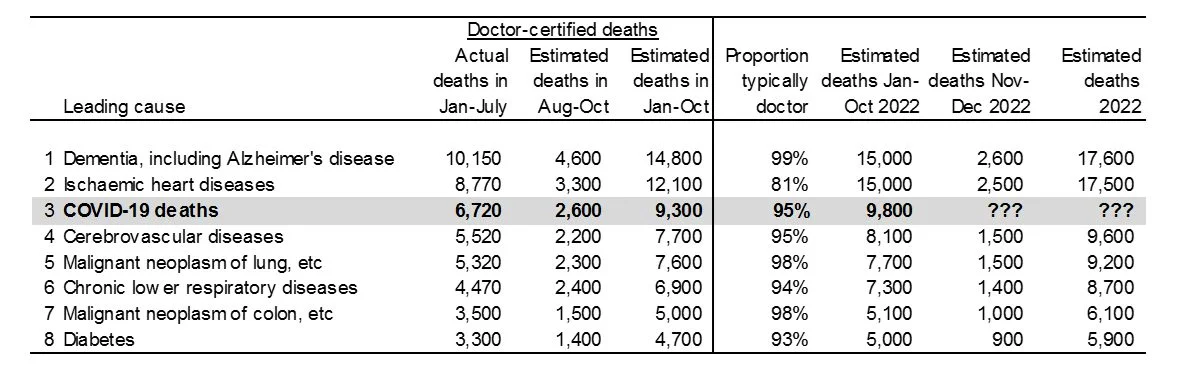
Ischaemic heart disease has been the leading cause of death in Australia for many years. However, the mortality rate for this cause has been declining. At the same time, the population has been aging, resulting in an increasing number of dementia deaths. We estimate that dementia will overtake ischaemic heart disease to be the leading cause of death in 2022 by a small margin (17,600 versus 17,500).
We expect there will be around 9,500 deaths from each of cerebrovascular diseases (largely stroke) and cancers of the lung in 2022.
Turning to COVID-19 deaths, we estimate deaths from COVID-19 in the first ten months of 2022 at about 9,800:
This puts COVID-19 as the third leading cause of death for the first ten months of 2022, and we expect that COVID-19 will also be the third leading cause of death over the whole of 2022.
The remainder of this article shows actual versus predicted deaths to 31 July 2022. Analysis and discussion of individual causes of death refer to doctor-certified deaths, while coroner-referred deaths are shown for all causes combined (including COVID-19).
(Figure 7 – Weekly actual and predicted doctor-certified deaths in Australia)
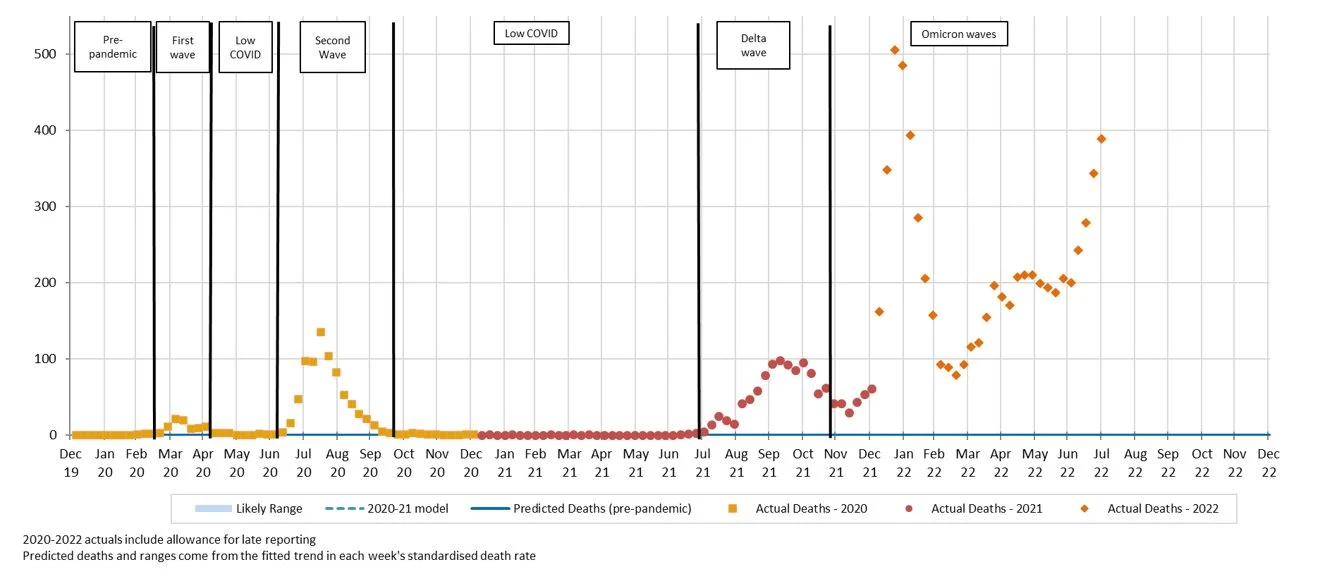
There were 1,338 doctor-certified deaths from COVID-19 in July 2022, compared with 1,934 surveillance deaths (596 fewer). We would not expect the numbers to be identical, because:
COVID-19 deaths in 2022 have far exceeded deaths from this cause earlier in the pandemic. COVID-19 deaths in July 2022 averaged around 300 per week, higher than the level in June 2022.
(Figure 8 – Weekly actual and predicted doctor-certified deaths in Australia – All respiratory diseases)
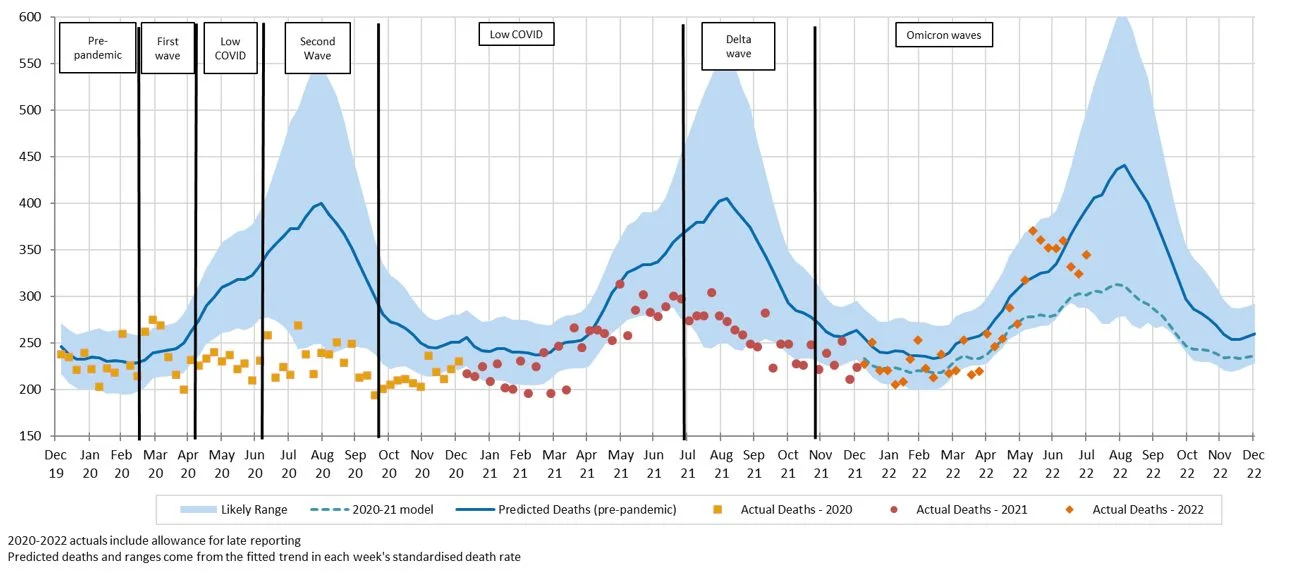
Deaths from respiratory disease at the end of June and early July were higher than predicted, different from the trend throughout most of the pandemic. However, they remained below the 97.5th percentile, and then fell below the expected level again in the last three weeks of July. This experience is largely driven by influenza deaths.
The following figures present a breakdown of deaths from respiratory disease into influenza, pneumonia, lower respiratory disease, and other respiratory disease.
(Figure 9 – Weekly actual and predicted doctor-certified deaths in Australia – Influenza)
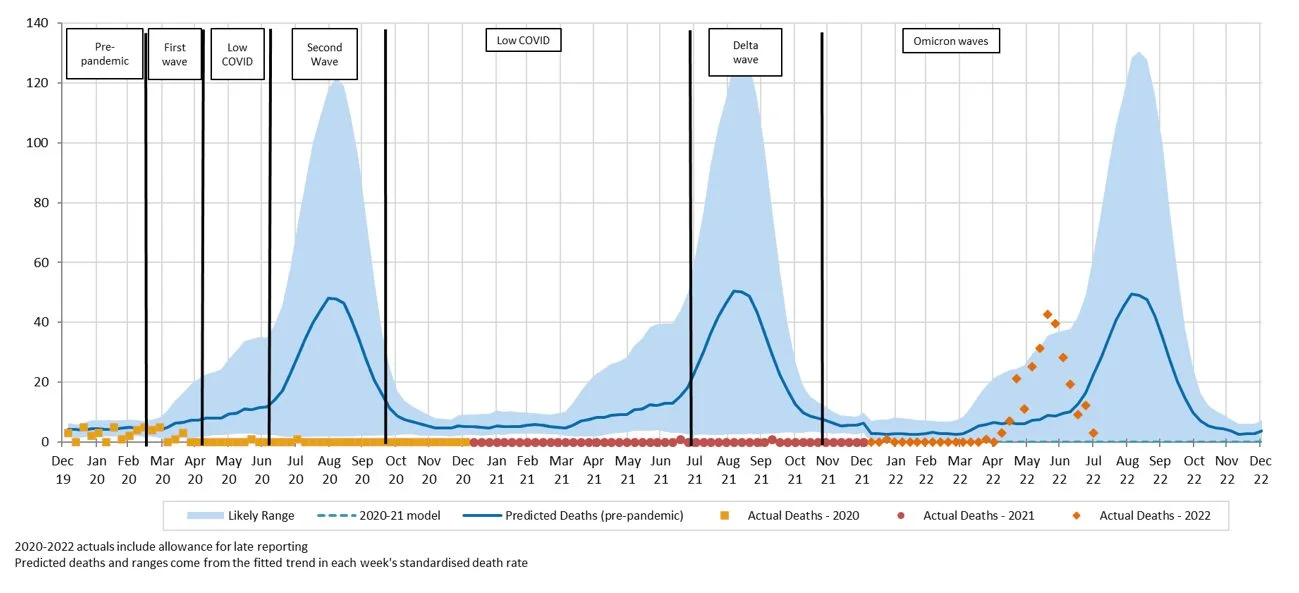
There were 55 influenza deaths in the month of July. We note that influenza surveillance reporting indicates that the flu season in Australia was earlier in the year than usual, and this is borne out by these death statistics.
(Figure 10 – Weekly actual and predicted doctor-certified deaths in Australia – Pneumonia)
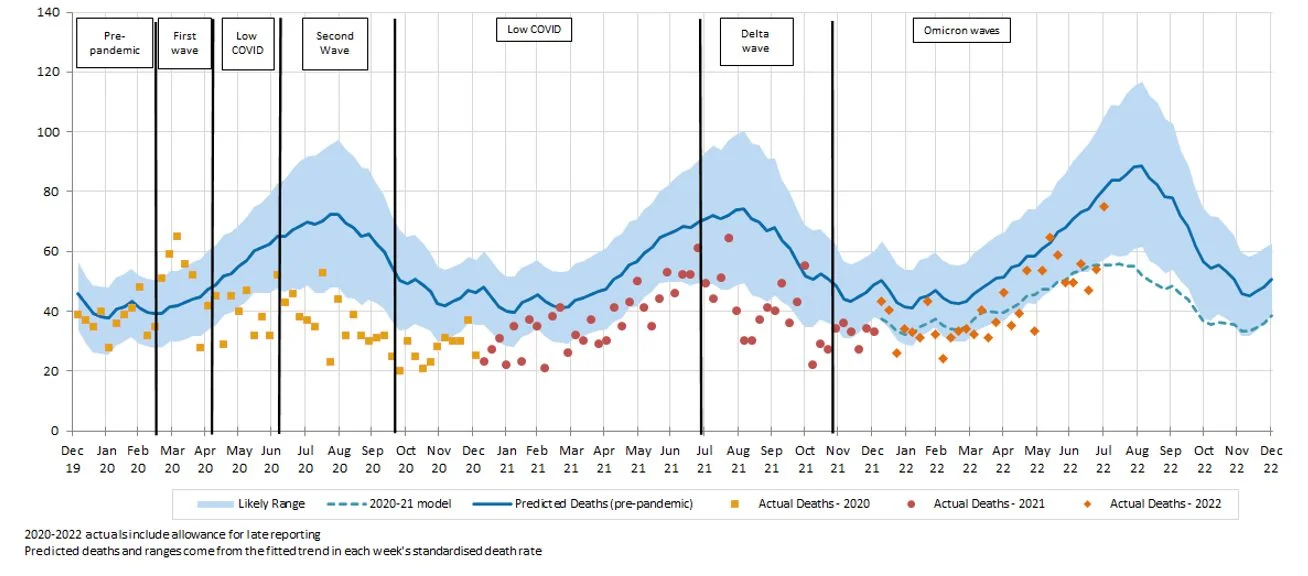
There were fewer deaths from pneumonia in July 2022 than predicted, with four of the five weeks at or below the bottom end of the 95% prediction interval. Deaths so far in 2022 are similar to the levels seen in 2020 and 2021.
(Figure 11 – Weekly actual and predicted doctor-certified deaths in Australia – Lower respiratory diseases)
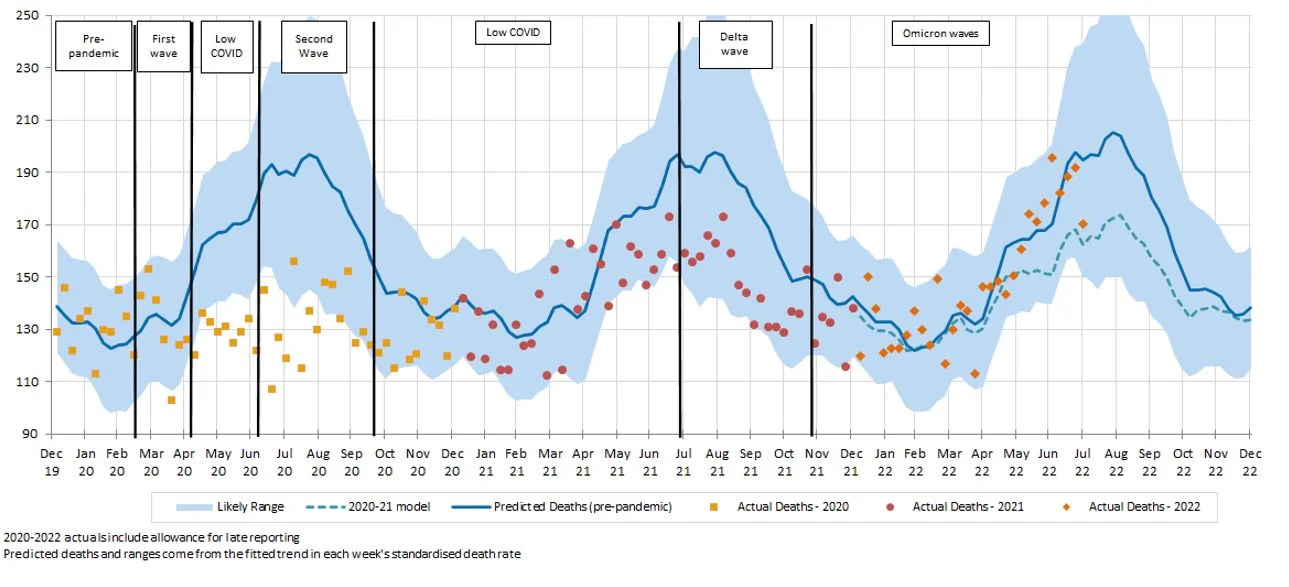
Deaths from lower respiratory disease were close to predicted for most weeks in July 2022 and all within the 95% prediction interval.
(Figure 12 – Weekly actual and predicted doctor-certified deaths in Australia – Other respiratory disease)
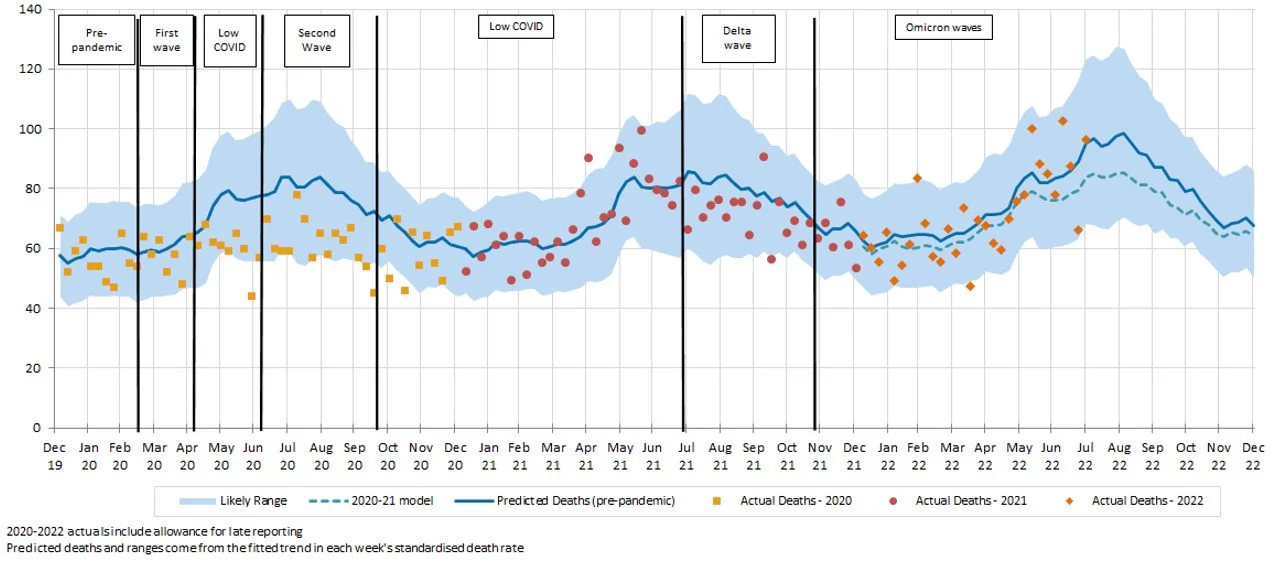
Deaths from other respiratory diseases were also similar to predicted in July 2022.
(Figure 13 – Weekly actual and predicted doctor-certified deaths in Australia – All causes other than respiratory diseases and COVID-19)
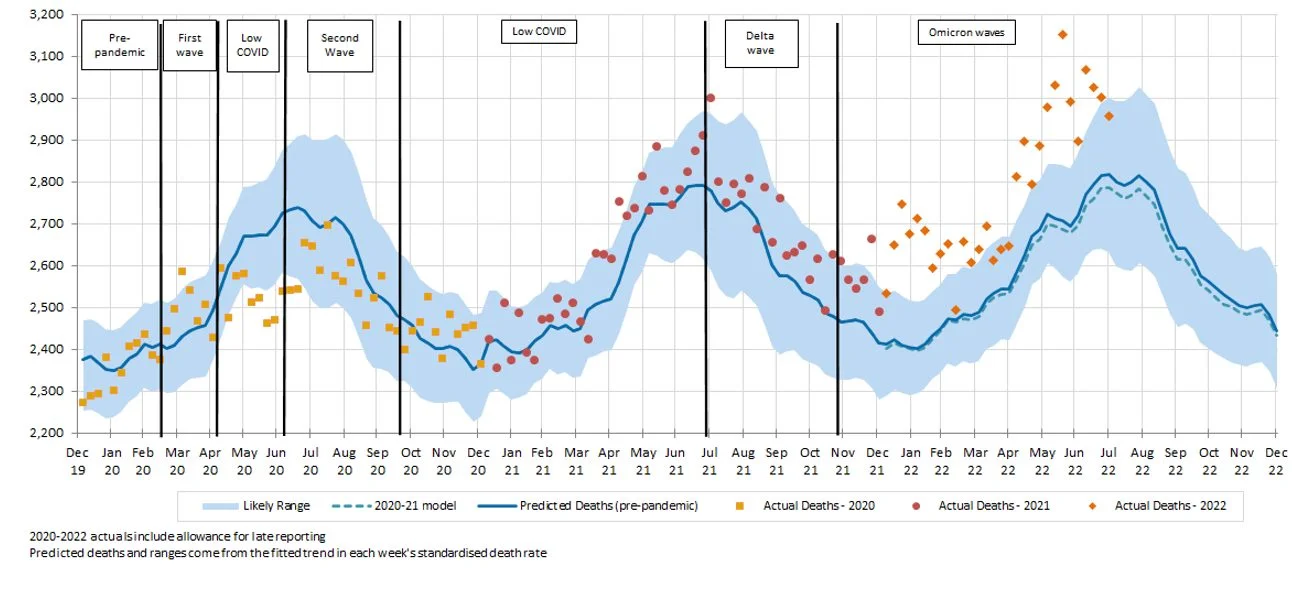
Excluding deaths from COVID-19 and respiratory diseases, deaths were well above the prediction interval in four weeks out of the five weeks of July 2022. This is mainly driven by deaths from ischaemic heart disease, cerebrovascular disease and “other” causes.
The following figures show a breakdown of non-respiratory/non-COVID-19 deaths into cancer, heart disease, cerebrovascular disease, diabetes, dementia, and all other causes.
(Figure 14 – Weekly actual and predicted doctor-certified deaths in Australia – Cancer)
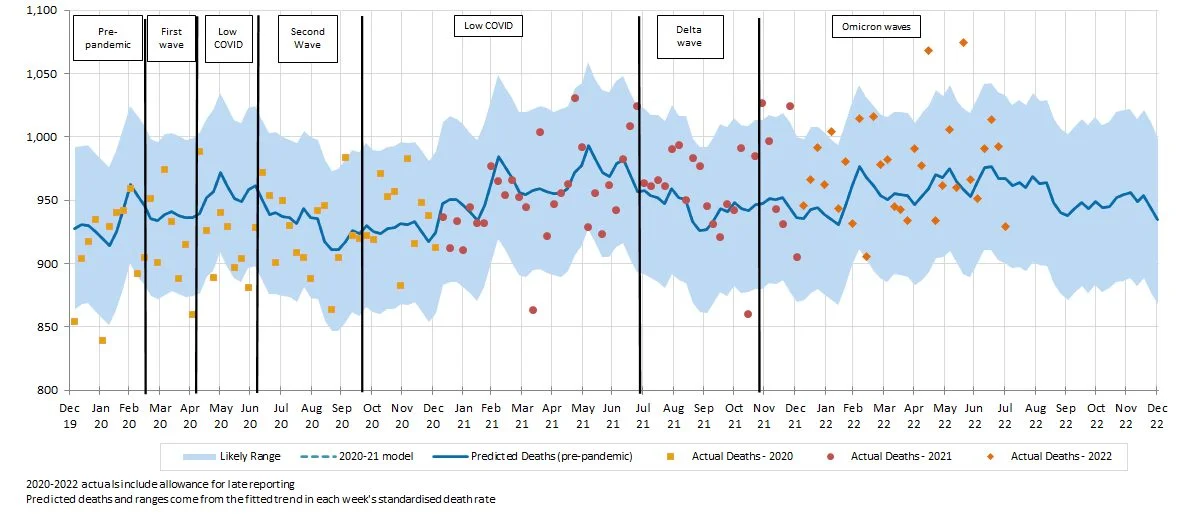
Cancer deaths continue to be close to predicted numbers for most weeks, except two high outlier weeks – one in May and one in June. With diagnostic testing down in 2020, there were concerns that there would be a spike in cancer deaths in 2021 and beyond. We are not yet seeing any clear evidence of this effect.
(Figure 15 – Weekly actual and predicted doctor-certified deaths in Australia – Ischaemic heart disease)
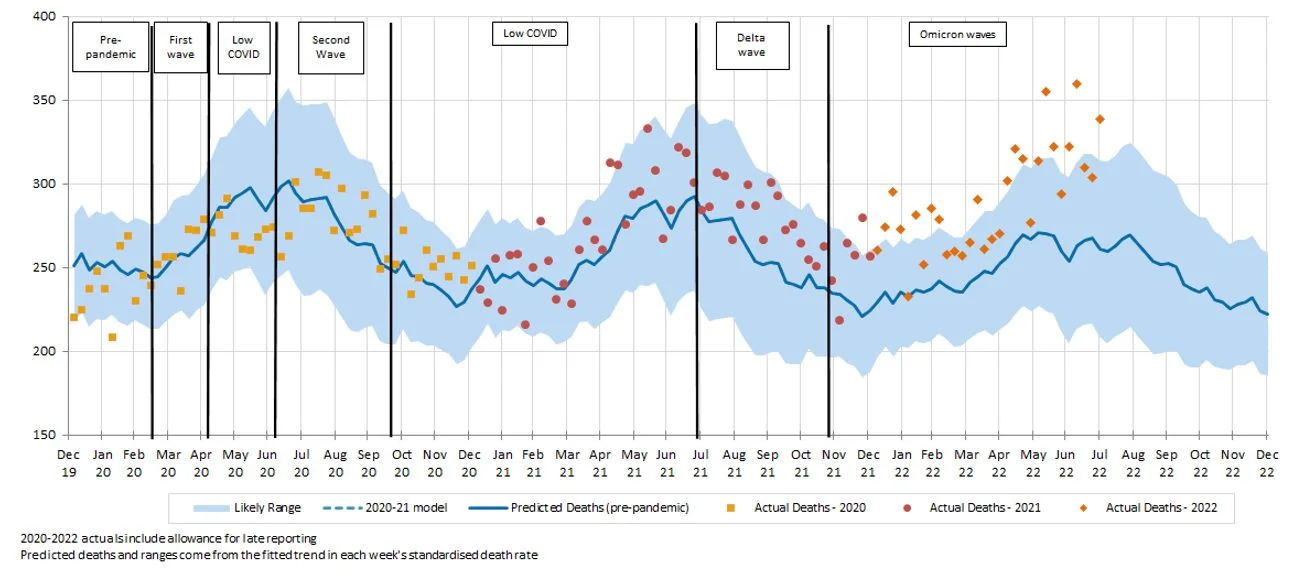
Deaths from ischaemic heart disease were again significantly higher than predicted in July, and outside the prediction interval for three of the five weeks. Very few weeks have been below the predicted line since March 2021. Although it is possible that our methodology results in over-aggressive expectations of mortality improvement from this cause, this could only explain up to around 4% of the 16% measured excess mortality.
(Figure 16 – Weekly actual and predicted doctor-certified deaths in Australia – Cerebrovascular disease)
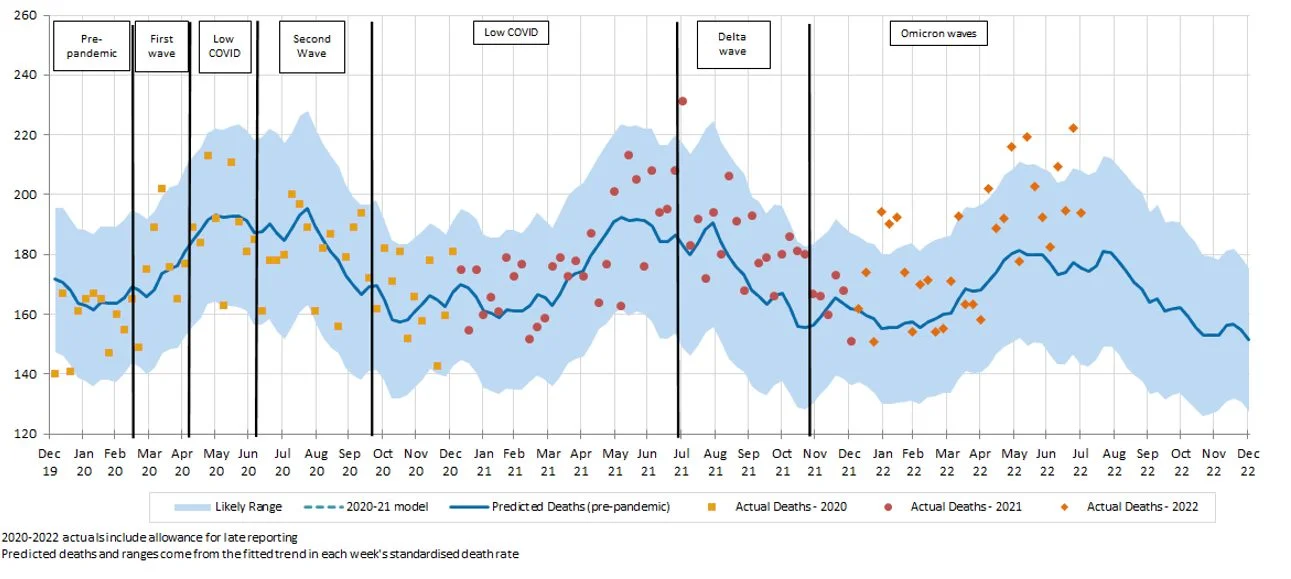
For cerebrovascular disease, deaths were higher than predicted for all five weeks of July 2022, and above the prediction interval for two of those weeks.
(Figure 17 – Weekly actual and predicted doctor-certified deaths in Australia – Diabetes)
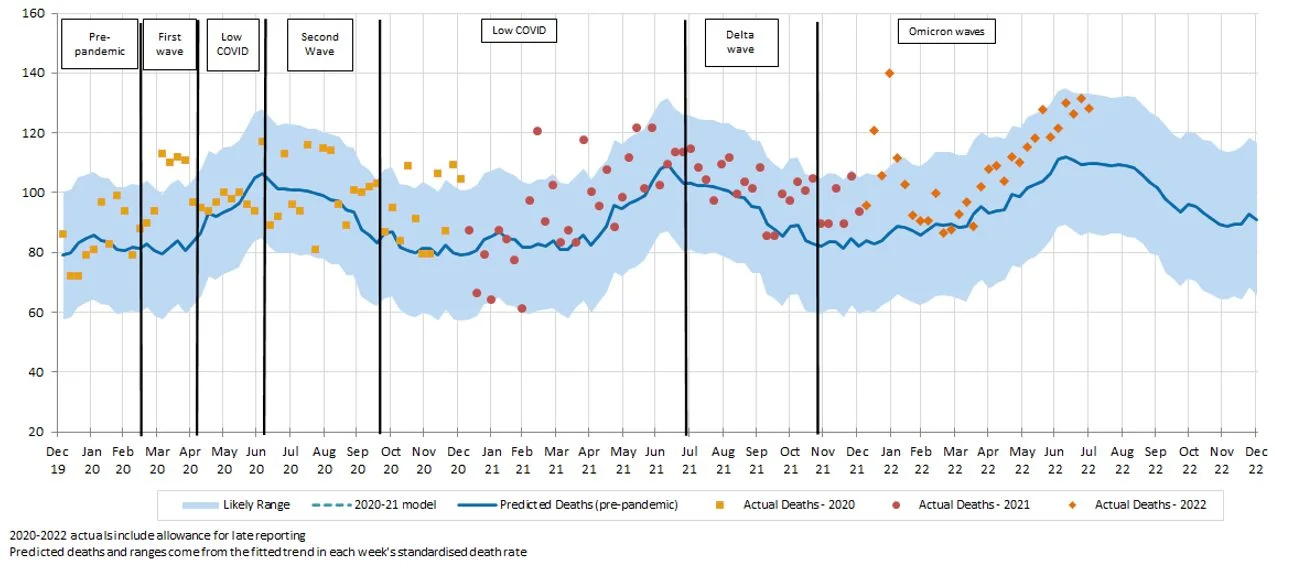
Deaths from diabetes were also higher than predicted in July 2022, although within the prediction interval. Few weeks have been below predicted since early 2021.
(Figure 18 – Weekly actual and predicted doctor-certified deaths in Australia – Dementia)
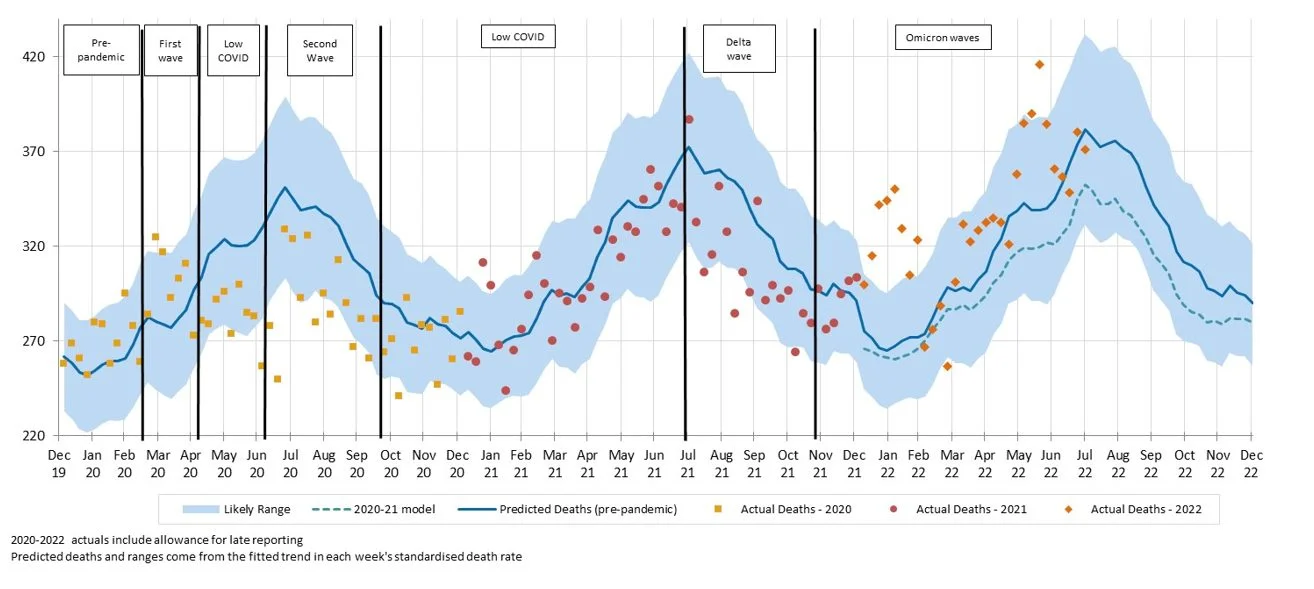
Deaths from dementia were close to predicted in July 2022.
(Figure 19 – Weekly actual and predicted doctor-certified deaths in Australia – Other unspecified diseases)
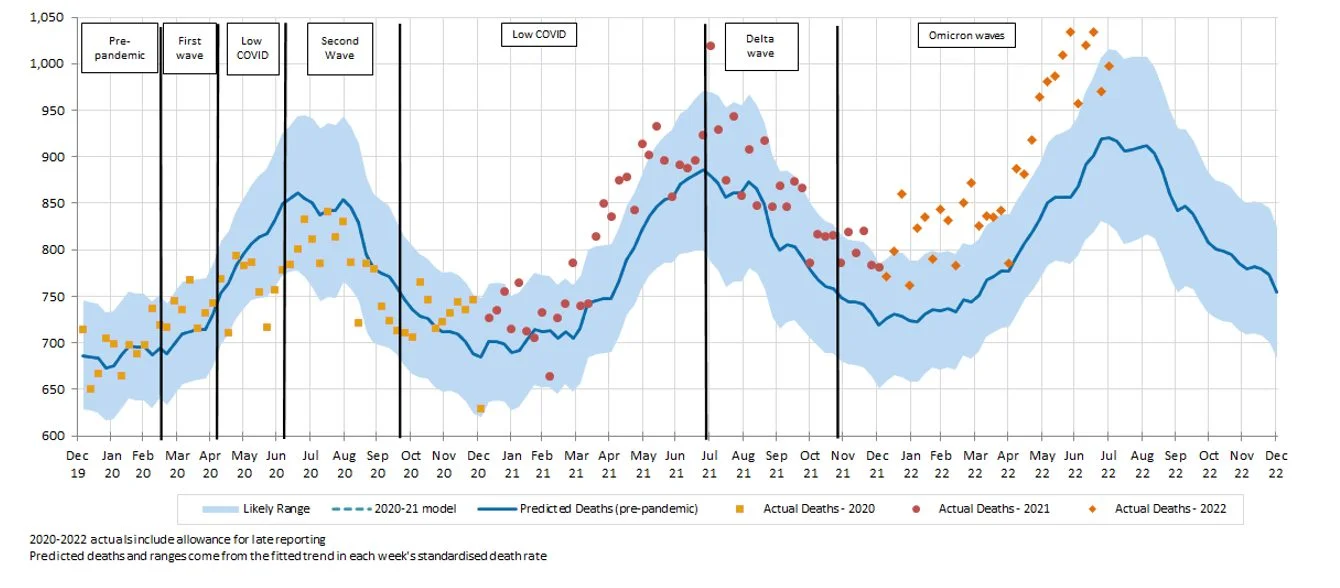
Deaths from other causes, i.e. those not explicitly reported on by the ABS, were again much higher than predicted in July 2022. Three of the five weeks were above the upper limit of the prediction interval.
(Figure 20 – Weekly actual and predicted coroner-referred deaths in Australia – All causes)
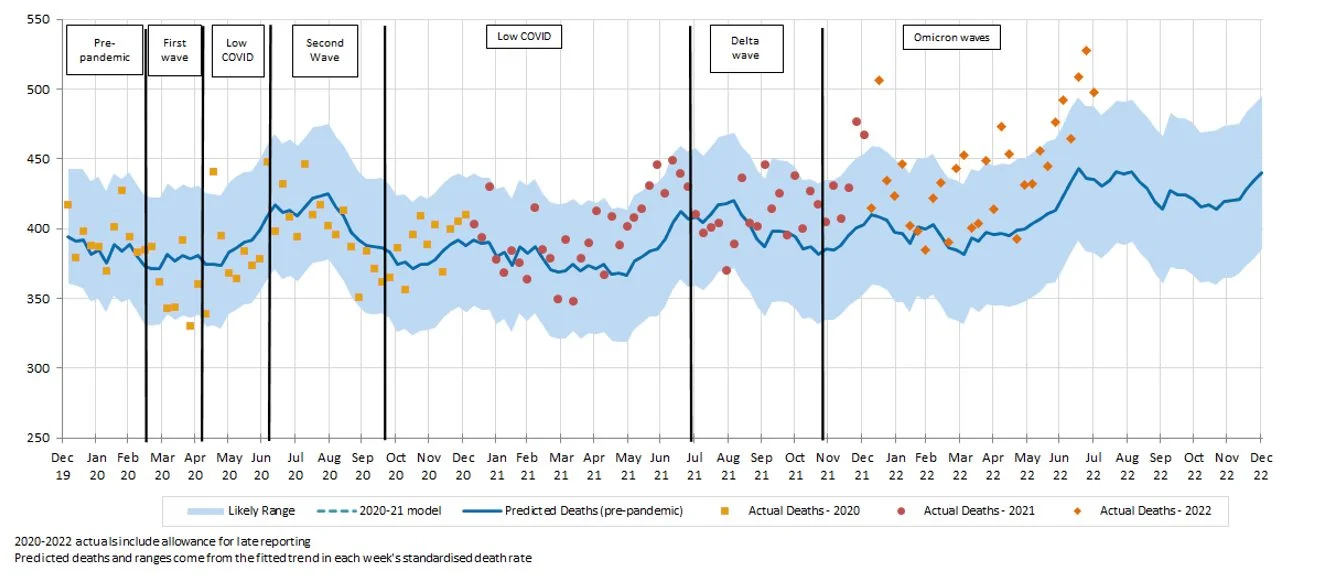
Coroner referred deaths continued to be higher than predicted every week in July 2022 and were above the prediction interval for four of the five weeks of the month. Note that actual deaths data included in the graph includes coroner-referred deaths from COVID-19.
| Members of the COVID-19 Mortality Working Group: |
| • Mengyi Xu |
The views expressed in this article are those of the author(s) or working group named below, and do not necessarily reflect the views of the Actuaries Institute. This work is licensed under a Creative Commons Attribution-NonCommercial-No Derivatives CC BY-NC-ND Version 4.0.