Coming of age: internet strategies for financial services companies



Claim your CPD points
21 years on from presenting his paper on Internet Strategies for Financial Services Companies to the Actuaries Institute Biennial Convention in June 1999, Sean McGing reflects on what we’ve learned from the journey.
“Plus ça change, plus c’est la même chose” – Jean-Baptiste Alphonse Karr (1848)(“The more things change, the more they stay the same!”)
Working from home has led to some unexpected enlightenment for me. A few weeks ago, I was clearing shelf space in my study when I came across a hard copy of my 1999 Internet Strategies paper. It evoked a number of sweet memories for me – the entrepreneurial excitement from having just set up my first Actuarial consultancy company, Askit Consulting, and the passion of my belief that actuaries are great to bridge business and systems. Askit stood for actuarial and strategic knowledge in information technology. Ever curious, I picked up the paper and started to read…
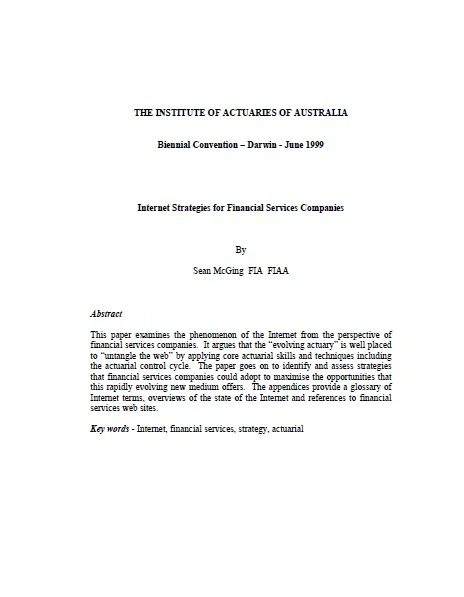
The Abstract, set out on the cover page, read:
This paper examines the phenomenon of the Internet from the perspective of financial services companies. It argues that the “evolving actuary” is well placed to “untangle the web” by applying core actuarial skills and techniques, including the actuarial control cycle. The paper goes on to identify and assess strategies that financial services companies could adopt to maximise the opportunities that this rapidly evolving new medium offers. The appendices provide a glossary of Internet terms, overviews of the state of the Internet and references to financial services web sites.
I leafed through until I came to the conclusions, curious to see how they compared to the current world. I was fascinated to read how relevant my conclusions were 21 years later. The summary was based on how technology has changed how we live our daily personal and work lives, and the perception that change has accelerated in an ever more complex world. My conclusions in 1999 are essentially all equally relevant today!
My conclusions were verbatim:
8.1 Conclusions
The internet has driven enormous industry and social change and will continue to do so as human ingenuity continues to tackle challenges. Table 8.1 illustrates some of the depth of 21 years of change.
Table 8.1: Profound changes driven by the internet in Financial Services
| Conclusion | Change examples |
| 1. Pace, reach and capabilities | Ubiquitous. Internet of things (IOT). Use of the cloud for storage of data and software as a service. |
| 2. Here to stay, integrated into daily life | Smart phones – running our daily lives. An app for everything. Messanger and video conference services for work and social. |
| 3. Changed how companies interact with customers | Chat bots; artificial intelligence based help. Complain / get company attention via social media. Online banking and payment systems. Creating accounts on company websites. Insurance premium calculators. Online tax returns. Advertising. |
| 4. Increased competition | Comparison sites. Digital marketplaces. More avenues to enter markets and reach customers. |
| 5. Reduce costs | Investment transaction costs and fees. EFTPOS. Administration and customer service automation. Document transportation and archiving. |
| 6. Improved customer service | On line and Apps capability eg personal banking, superannuation investment monitoring, switching, contributions. Lodgement and management of insurance claims online. |
| 7. Cultivation of personal relationships | Company Apps with messaging capabilities. Social media. Targeted marketing eg financial services linked to frequent buyer and flyer programs. |
| 8. Speed up interaction with suppliers and customers | Extensive use of APIs (Application Programming Interface), open banking. Increased payment options. |
| 9. New opportunities | Ill health prevention – wellbeing – fitness trackers. Robo advice. Education and training. |
| 10. Actuaries internet aware for greater effectiveness and efficiency. | Actuaries’ data analytics journies – eg Quantium, Taylor Fry. Better use of technology. Big data capabilities. Better tools incl – coding, data visualisation. . |
On reflection, conclusion 10 – today’s strategic conclusions on use of the Internet may be different to those a few months later – implied a much faster rate of change than actually occurred. Companies did have the legitimate option of watching trends but not over-investing early to see how technologies played out. Interestingly, the conclusion feels much more relevant to the immediate period after COVID-19 stuck.
There was a rapid transition to new digital tools for work and personal use. Changes to goods and services transformed how we live, work and play during a global pandemic. Many people for the first time worked remotely, shopped virtually and even held a doctor’s appointment all courtesy of the Internet. What was unthinkable for many prior to a global pandemic became a new normal!
With 2020 vision(!), what else can we learn?
At the end of the 1999 paper, I acknowledged three actuaries that peer-reviewed my paper – Hugh McMullan, Hugh Sarjeant and Jules Gribble. I had, or have since, worked closely with all three. Each of them, in different ways, reflects the actuary merging with an entrepreneurial spirit and clever ways of using technology to build a business and provide solutions.
Hugh McMullan’s development of software is also seen in other actuaries of my generation I’ve known well who have made their mark in this space then and since including David Orford and Martin Spry. In more recent times another past co-worker Adam Driussi has combined these skills in the newer frontier of data analytics. Other actuaries continue to blaze the trail.
Reflecting on 21 years plus embracing actuarial and use of IT, and looking to the future, I am confident that as a profession we are well skilled in this blend and have the drive to build further – it’s in our DNA.
Download Internet Strategies for Financial Services Companies .
The views expressed in this article are those of the author(s) or working group named below, and do not necessarily reflect the views of the Actuaries Institute. This work is licensed under a Creative Commons Attribution-NonCommercial-No Derivatives CC BY-NC-ND Version 4.0.