Climate risk disclosures: The scientists are talking. Are we listening and how should we respond?



Claim your CPD points
Recently, a number of scientists have drawn attention to the challenges faced by businesses in undertaking climate risk assessments. This article sets out a potential five-phase approach to help increase our understanding of the physical impacts of climate change, which could form the basis of disclosures in the interim.
Central to the scientists’ viewpoint is the difficulty in predicting how the frequency and severity of the more extreme weather events will change at local situations where individual business assets are held.
| “I think there is at least a decade between what you (APRA) are suggesting businesses do, and what climate science can usefully inform them about.” Professor Andrew Pitman, Director of the Australian Research Council’s Centre of Excellence for Climate Extremes, in a letter to APRA in April 2021. |
In undertaking climate risk disclosures and assessments of physical risk, we need to be mindful of creating a false sense of accuracy by using complex tools with uncertain underlying science. There is a risk that in some cases, complete physical risk assessments in the short term will lead to spurious and arguably meaningless disclosures. The analysis remains a necessary and important task, but we need to avoid getting ahead of ourselves by understanding this uncertainty and factoring it into our approach and our advice. So, what might that look like? The remainder of this article sets out one possible approach.
In the Fiedler et al (2020) paper, the authors propose scientists working with business to develop climate projections that are fit for purpose. This is important work and needs investment from business. But it is not a quick fix and according to the authors might take at least 10 years.
Even before fit for purpose climate projections are available, there is additional work that can be done and needs to be done to increase our understanding of the physical impacts of climate change, and that could form the basis of disclosures in the interim.
Central to the approach is that the path to full quantification of the risk does not need to be rushed. There is plenty to be learned at each stage.
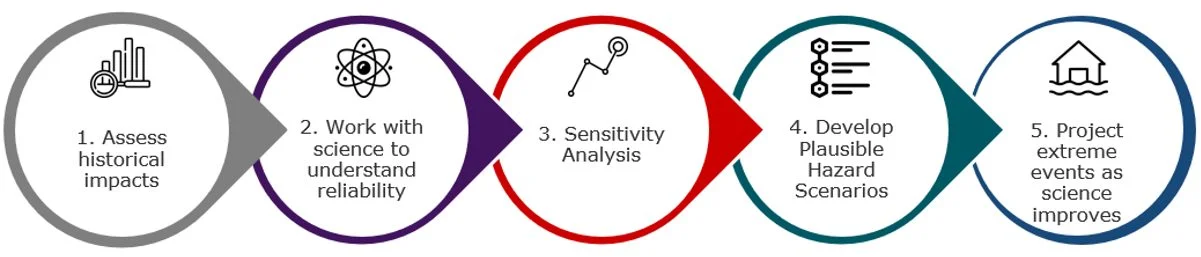
The following steps are proposed for those hazards where prediction is problematic:
There would be no assignment of such a scenario to a timeframe or specific warming scenario, recognising this is not possible to do at this stage (if we listen to the scientists). We could however describe the scenarios in broader terms, for example ‘modest’ and ‘severe’ plausible scenarios. Some companies may want to loosely attach the scenario to a warming scenario for compliance purposes. The Climate Measurement Standards Initiative (CMSI) has undertaken some excellent work in this area to provide a starting point for the development of relevant scenarios, although there is more work to be done in considering the tail risk which is most important to many companies.
The proposed approach can be used to deliver meaningful disclosures in relation to the risk that keep pace with the ability of the science to forecast extreme events.
A key question is whether the users of disclosures will be satisfied with sensitivity and hazard-based scenarios analysis in the short to medium term for certain hazards, with the warming scenarios probably being more than five or ten years away.
The views expressed in this article are those of the author(s) or working group named below, and do not necessarily reflect the views of the Actuaries Institute. This work is licensed under a Creative Commons Attribution-NonCommercial-No Derivatives CC BY-NC-ND Version 4.0.