Climate and Sustainability
General Insurance
Climate Change Blog – May 2019


Claim your CPD points
Welcome to another instalment of the Climate Change Blog, an article series that aims to cover news and events related to climate change and relevant to actuaries and the industries they advise. This month's edition looks at two pieces of work from the International Actuarial Association (IAA) and the CRO Forum that discuss how the world's response to climate change can affect many aspects of actuarial work.
At the time of writing, the Prudential Regulation Authority (PRA) of the Bank of England released a supervisory statement for insurers and banks within the scope of Solvency II. This supervisory statement is an emphasis of how climate change and society's response to it presents financial risks and affects actuarial work.
The Resources and Environment Working Group (REWG) of the IAA developed a paper entitled Decarbonisation: A Briefing for Actuaries in September 2018, then also held a webinar in January 2019. The aim of the paper was to introduce the topic of decarbonisation for actuaries around the world.
The REWG is a working group devoted to environmental issues that can affect the work of actuaries in their various areas of practice.
Decarbonisation refers to policies or actions that result in a reduction of greenhouse gas emissions, for example by substituting coal-fired power with lower-carbon sources of energy. While the energy sector is always front of mind when emissions are discussed, the sources of greenhouse gas emissions are spread across all sectors of the economy: Electricity (25%), Agriculture (24%), Manufacturing (21%), Transportation (14%) and Building (6%) (sourced from Climate change and the 75% problem ). Effective decarbonisation, therefore, will require broad transformation across the economy, including how food, goods and services are produced, transported, stored and consumed. The scale of change implied is comparable to the industrial revolution or the rise of the internet.
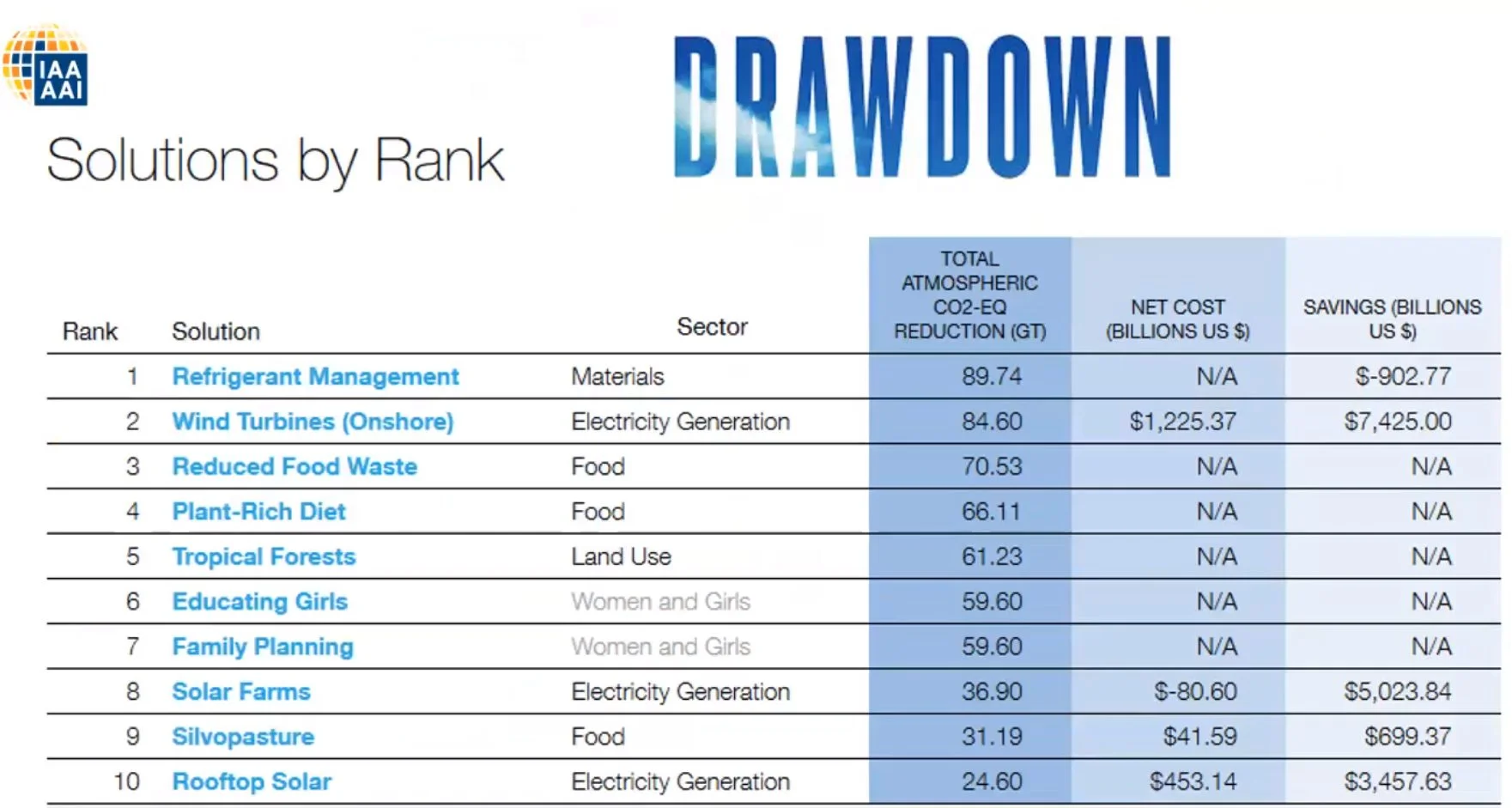
Drawdown , a global research and communication organisation, ranked 100 potential solutions to reduce greenhouse gas emissions by effectiveness, costs and benefits. The following figure summarises the top 10 solutions.
Source: https://www.drawdown.org/solutions-summary-by-rank
There are clear trends that the importance of sustainability and combating climate change is being recognised by businesses, for example:
Actuaries will need to assess the impact on their clients and identify opportunities to bring their professionalism and forward-looking financial skills. Actuaries need to:
The CRO Forum is a high-level discussion group formed by Chief Risk Officers of several major European insurance companies. In January 2019, as part of its third core aim, providing insights on emerging and long-term risks, the CRO Forum has produced a Position Paper, "The heat is on; Insurability and Resilience in a Changing Climate" . Their position seems clear, 'The time to act is upon us. The climate is changing and "the heat is on".'
The intent of the Position Paper is to provide the insurance sector and wider stakeholders with a clear, up to date view of the current challenges of climate change, centred around the insurance sector. It discusses implications for underwriting climate related risks, investment activities, and reporting and disclosure.
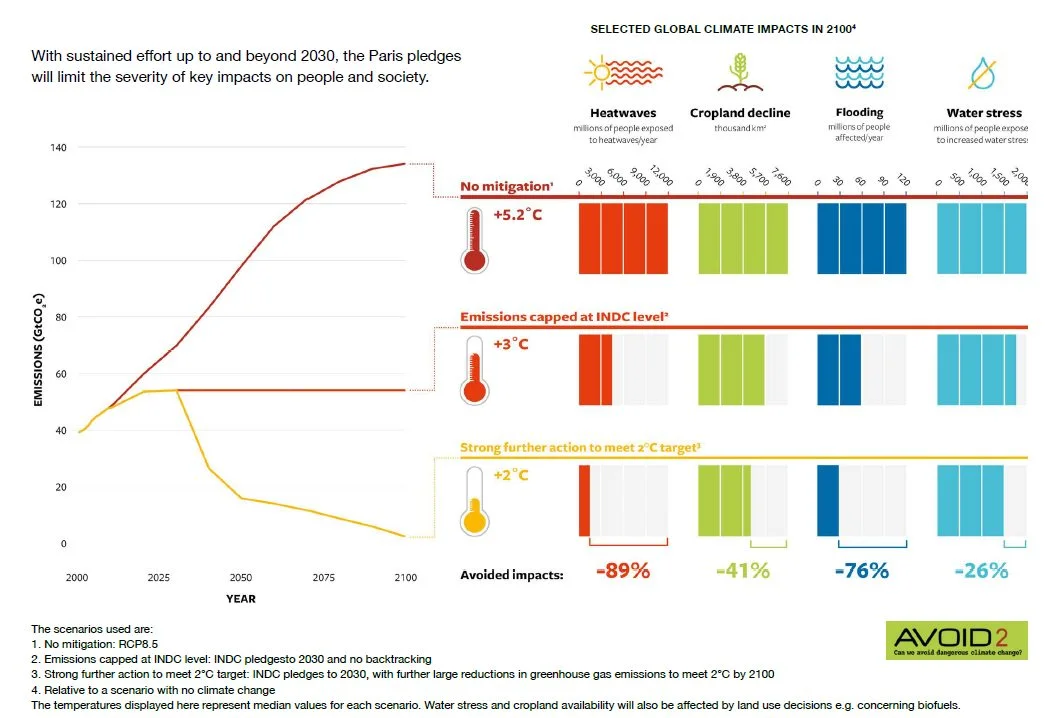
The Paper outlines climate change as both physical risk and transition risk, and narrows the focus down to three sample pathways, noted in the figure below:
https://www.thecroforum.org/2019/01/24/crof-eri-2019-the-heat-is-on-insurability-and-resilience-in-a-changing-climate/
There is a wide variation in the potential paths the world may take, which have different physical impacts. There is also commentary on the transition risk impact, ranging between the ambitious and no mitigation pathway:
The breakdown of these impacts in insurance from the different sectors are as follows:
This wide variety of risks and their impacts across the industry require a range of responses. The responses put forward by the CRO Forum for consideration include:
PRA expects firms to incorporate financial risks from climate change in their risk management framework and to use scenario analysis to inform strategy setting. The scenario analysis should include both short-term and long-term assessments of the firm's exposure to financial risks from climate change on their solvency, liquidity and, for insurers, their ability to pay policyholders.
The PRA has indicated that they intend to request this scenario analysis alongside market-wide stress tests for both Life and General insurance firms. This indicates a need to quantify the impact of climate risk scenarios on capital and reserving, although the PRA has also acknowledged some gaps remain to be filled, including for data and the development of reference scenarios for firms to use.
PRA expects the short-term scenario analysis to cover a period within the firm's business planning horizon. There should be quantification of these risks.
The long-term scenario analysis should cover a time horizon over decades long. Rather than a precise forecast, PRA expects this analysis to be a qualitative exercise to help inform strategic decisions. There should be a range of different climate-related scenarios, for example:
More detail in the supervisory statement .
Would you like to know more?
Other climate change articles published by members of the Climate Change Working Group:
The views expressed in this article are those of the author(s) or working group named below, and do not necessarily reflect the views of the Actuaries Institute. This work is licensed under a Creative Commons Attribution-NonCommercial-No Derivatives CC BY-NC-ND Version 4.0.