Feature
Big Data Adoption – A Question of Mind Set




Claim your CPD points
'Knowledge is power. Those who understand the performance and value drivers of their business outperform those who don't.'
(Extracted from Duncan West's presentation at the 2014 Financial Services Forum.)
This bright, new and shiny world has become the future hope of companies everywhere, offering the opportunity to use the wealth of data which they have collected to improve their efficiency and profitability. The rapid improvement in IT and telecommunications technology along with a new approach to data collection and analysis seems to offer a transformational shift in the way business is done.
History confirms that in the midst of evolutionary advancements such as this, the biggest risk which many businesses face is the risk of doing nothing. There has been a lot of mainstream adoption of big data techniques by online search engine firms like Google, online retailers, web marketing and lead generation firms and even banks and the general insurance industry to some extent. However in Australia there are still large areas of the financial services industry, in particular the life insurance, health insurance and superannuation sectors, which might have fallen behind other industries or even their global peers in this area.
While the industry has collected significant volumes of data over time, dated and legacy systems may make accessing and manipulating such data difficult. Competition from a new entrant who can rapidly collect meaningful data may be more likely than previously imagined. After all, nothing is potentially stopping organisations like Google from establishing superannuation funds, banks or insurance companies. With the enormous soft power and financial muscle these pioneering technology companies carry with them and their sophisticated approaches to data collection and data mining they can target the most profitable customers.
Using superannuation funds as an example, many potentially face hurdles when it comes to adopting Big Data such as:
However most medium and large funds which offer a range of member services on a commercial basis should be able to consider the potential benefits of an investment in the right infrastructure. Some of these potential benefits are mentioned below:
With regard to implementation the financial services industry must consider its strategic approach to the opportunities and risks that Big Data can offer. Just recruiting a large number of people with strong data analytics skills to interrogate your data is not going to be the solution. It will be important to have a clear strategy with the broader business goals forming a key platform on which to build the capability.
We are also interested in understanding what part actuaries can play in this emerging market. As actuaries we have been masters of data for a long time, particularly in insurance companies. However we need to remember that Data Scientists and Statisticians are specialist fields in their own right and they bring different knowledge and techniques. Technology and methods have progressed rapidly enabling data to be used in solving a wide variety of business decisions which actuaries to date have not been part of.
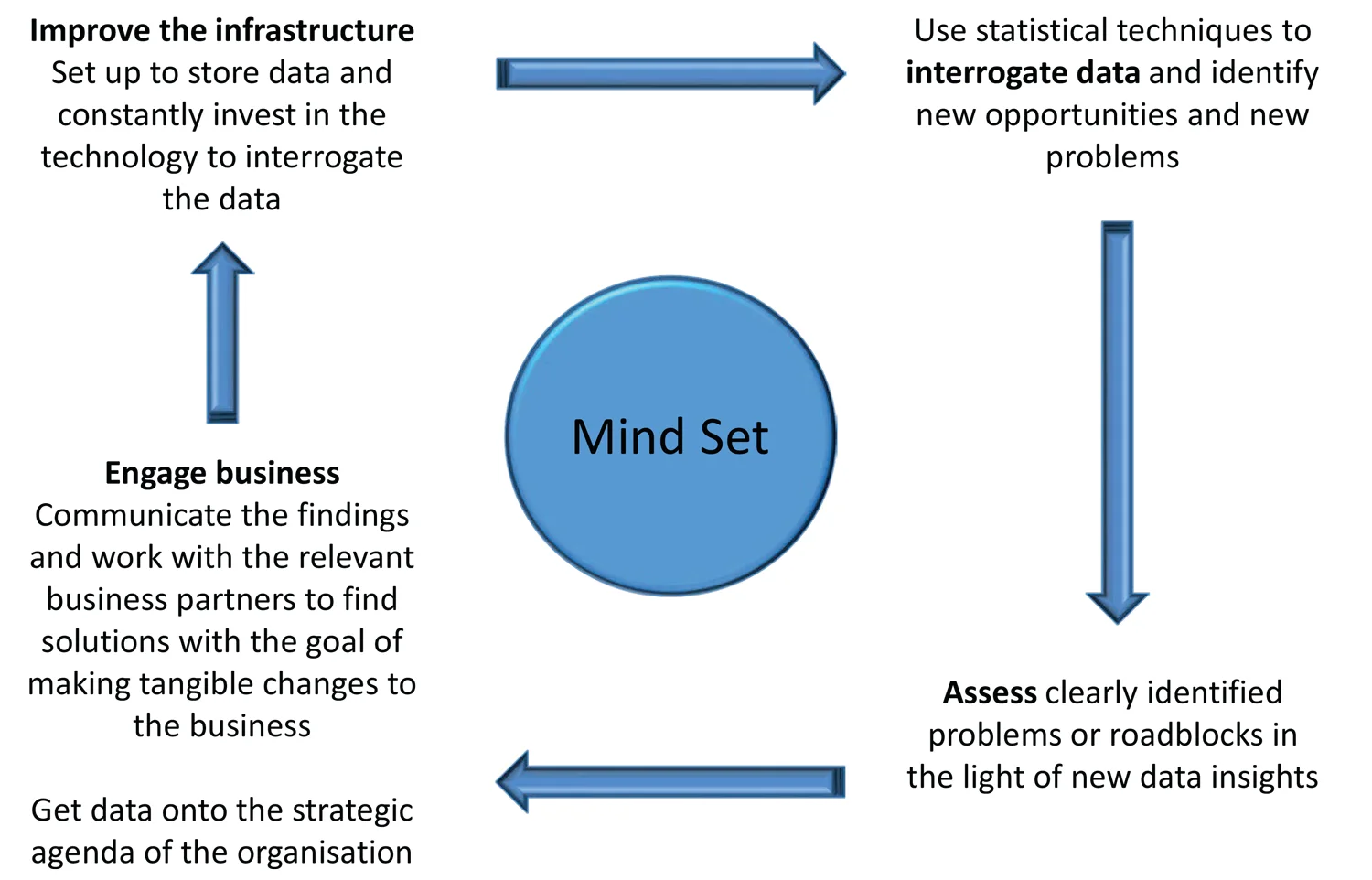
In thinking about where actuaries can fit in and add value we wondered what the Big Data control cycle would look like and have attempted to define a mini version of the control cycle as per the diagram below.
While actuaries can quite clearly play a key role in all aspects of this control cycle our key strengths lie in an ability to act as a bridge between business and IT and translating results into commercial information. We can influence getting data onto the strategic agenda but there is no need to wait until the perfect data storage infrastructure or data interrogation tools are built. The key thing is to identify the insights from the current data at hand and show intuition, commercial sense and a leap of faith to use the insights to solve current known business issues.
Whilst in theory actuaries equipped with an understanding of the actuarial science and practical experience in industries such as life insurance, health insurance and superannuation are in the box seat for the adoption of Big Data techniques in these sectors, in practice it might not be as easy. Key traits required by actuaries to make it happen in practice are:
We would be very interested to hear the thoughts of others about the future for actuaries in this field.
Acknowledgement: The author would like to thank the following people for their contributions:
The views expressed in this article are those of the author(s) or working group named below, and do not necessarily reflect the views of the Actuaries Institute. This work is licensed under a Creative Commons Attribution-NonCommercial-No Derivatives CC BY-NC-ND Version 4.0.