Feature
Career and Leadership
General Insurance
Health
Life Insurance
An update from the Premium Allocation Approach work stream



Claim your CPD points
Here, Brendan Counsell of the Institute of Actuaries' AASB 17 Implementation Taskforce provides an update on the 'premium allocation approach', or PAA to assist Australian actuaries involved in implementing the new accounting standard.
The PAA work stream is another of the technical groups of the Institute of Actuaries' AASB 17 Implementation Taskforce which overall is focused on producing guidance for Australian actuaries involved in implementing the new accounting standard.
Previous updates have covered measurement approaches available under AASB 17 - namely the general model ('building block approach' or 'BBA') and the variable fee approach ('VFA'). A third measurement approach available under AASB 17 is the 'premium allocation approach', or PAA. The PAA is a simplified model for short duration contracts and is expected to be available for many general insurance and health contracts as well as some life insurance contracts. This is the topic for this month's update.
The PAA work stream meets monthly and includes a wide range of participants from general insurance, health insurance and life insurance backgrounds.
The premium allocation approach measures the 'liability for remaining coverage' associated with a group of insurance contracts at the end of a reporting period as the sum of:
In summary, the PAA method is not dissimilar to measurement approaches applied under the current Australian accounting standard AASB 1023 for general insurance contracts and also simplifications applied for valuing certain types of life insurance contracts under AASB 1038.
The 'liability for incurred claims' is included within the scope of the PAA work stream due to its significance for many short duration contracts. It is important to note, however, that the liability for incurred claims is relevant for all insurance products regardless of the measurement approach used to calculate the liability for remaining coverage (i.e. PAA, BBA or VFA).
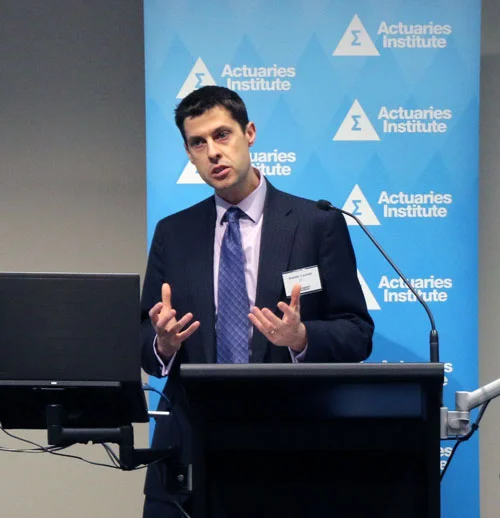
Brendan Counsell speaking at the September Insights session
PAA can be used as the measurement approach if, at inception of the group:
Defining the coverage period based on the 'contract boundary' can be subjective and is the focus of another work stream to be covered as part of a future update. Suffice to say that PAA is expected to be available for many general and health insurance contracts and some life insurance contracts.
A key focus for the PAA work stream is how PAA eligibility is assessed for contracts with a coverage period of more than one year, i.e. contracts for which PAA does not automatically apply. The PAA eligibility criteria are subjective with some key questions being:
Many other professional and industry working groups, such as the International Actuarial Association and accounting bodies are concurrently focussed on these interpretations. The Institute of Actuaries' AASB 17 taskforce is monitoring external developments and incorporating these into its deliberations.
Other key topics that our PAA technical workstream is expected to cover for include:
In summary, while the PAA is viewed as a 'simplified' method and certainly not as technically complex as BBA or VFA, there are plenty of subjective areas that can have significant implementation implications for insurers.
The views expressed in this article are those of the author(s) or working group named below, and do not necessarily reflect the views of the Actuaries Institute. This work is licensed under a Creative Commons Attribution-NonCommercial-No Derivatives CC BY-NC-ND Version 4.0.