Actuaries report from the 2021 Federal Budget



Claim your CPD points
The Australian economy has recovered stronger than expected, despite international borders remaining closed for at least another year. Significant spending measures to create jobs and secure economic recovery has been announced, along with significant funding for aged care, mental health and telehealth services, and higher forecasts for the National Disability Insurance Scheme. This update provides an overall summary of the economy and highlights key issues of interest to actuaries.
The Government has announced significant spending measures to create jobs and secure economic recovery as the impact of the COVID-19 pandemic reduces. The Government assumes Australian borders will remain closed until the latter part of 2022.
Significant funding has been added for the provision of aged care, in both home care and residential aged care, and additional health services, including the extension of telehealth and increased provision of mental health services, and to the National Disability and Insurance Scheme.
The Government announced some small changes to superannuation.
The 2020-21 low- and middle-income tax offset extension will be welcomed by average Australian income earners.
2021 Federal Budget papers can be found at www.budget.gov.au .
Total revenue for 2021‑22 is expected to be $496.6 billion. Total expenses are expected to be $589.3 billion.
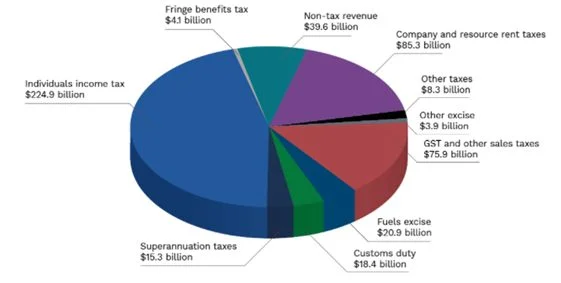
Source: https://budget.gov.au/2021-22/dist/img/overview_pie_charts_V2-0a.png
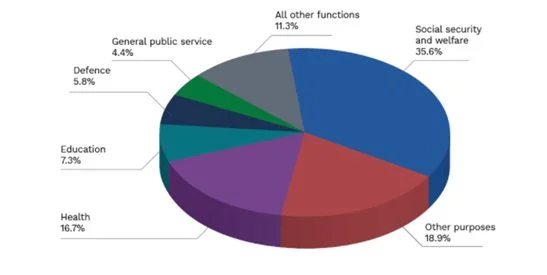
Source: https://budget.gov.au/2021-22/dist/img/overview_pie_charts_V3-0b.png
The main sources of stimulus include:
Similar to the 2020-21 Budget, several crucial assumptions underpin the Budget forecasts, namely:
The COVID recovery in financial markets and strong foreign exchange gains are projected to drive growth in tax receipts from superannuation funds in the 2020-21 Budget. Tax receipts are expected to rise by $3.5 billion (to $11.7 billion) in 2020-21 and $8.8 billion (up 30.8%) across the four years to 2023-24.
After an impactful 2020 Budget for superannuation funds with the Your Future, Your Super reforms, this year’s Budget breaks step by making only relatively minor changes to superannuation, with many measures having very little impact on the Budget revenue.
The key changes to superannuation in the 2021 Budget are focussed on increasing flexibility for older Australians to contribute to their superannuation or access housing wealth, use of superannuation as a vehicle to save for a home, and removal of the $450 rule to boost superannuation for low-income earners, particularly women.
The Government will remove the current $450 per month minimum income threshold under which employees do not have to be paid the superannuation guarantee by their employer. This measure is expected to have effect from 1 July 2022. The Retirement Income Review estimated this would impact 300,000 individuals, 63% of whom are women.
The measure is expected to decrease the underlying cash balance by $31.5 million over the forward estimates.
Downsizer contributions
The Government will reduce the eligibility age to make downsizer contributions into superannuation from 65 to 60 years of age from 1 July 2022. The current downsizer rules allow an individual to make a one-off, post-tax contribution to their superannuation of up to $300,000 per person from the proceeds of selling their home (without counting to non-concessional caps). Uptake of the current scheme is low, and the change is estimated by Treasury to have a negligible impact on receipts over the forward estimates.
Removal of the work test
The Government will allow individuals aged 67 to 74 years (inclusive) to make non-concessional or salary sacrifice contributions without meeting the work test (subject to existing caps). This measure is expected to take effect from 1 July 2022. This removes the requirement for individuals in this age group to work at least 40 hours over a 30-day period in the financial year to contribute to superannuation. The measure will result in a decrease in receipts of $30 million and increase in payments of $3.7 million over the forward estimates.
Pension Loans Scheme
The Government aims to improve uptake of the Pension Loans Scheme by:
Legacy product conversions
The Government will allow individuals to exit a specified range of legacy retirement products, together with reserves for a two-year period, including market-linked, life-expectancy and lifetime products, but not flexi-pension products or a lifetime product in a large APRA regulated or public sector defined benefit scheme. The measure will permit full access to the products underlying capital to allow individuals to potentially shift into more contemporary products. Social security and taxation treatment will not be grandfathered for new products commenced with commuted funds. The commuted reserves will be taxed as an assessable contribution.
The Government will increase the maximum releasable amount of voluntary contributions under the First Home Super Saver Scheme (FHSSS) from $30,000 to $50,000. The Government will also make a number of technical changes to the FHSSS to improve its operation where errors are made by applicants (e.g. allowing individuals to withdraw or amend applications or reapply).
These measures are estimated to decrease the underlying cash balance by $47.6 million over the forward estimates.
Not proceeding with early release for victims of family and domestic violence
The Government will not proceed with the 2018 policy to extend early release of superannuation to victims of family and domestic violence. This change to policy was largely expected following Government comments in March.
Funding measures
The Government will provide $9.6 million to APRA over four years to enforce measures as part of Your Future, Your Super.
Super Consumers Australia will receive $1.6 million over two years to support stronger consumer outcomes on behalf of superannuation fund members.
The ATO will receive $11 million over four years to administer the transfer of unclaimed superannuation money to KiwiSaver accounts.
Residency requirements – Self-managed super
The Government will relax residency requirements for self-managed super by extending the central control and management test safe harbour from two to five years for SMSFs and, removing the active member test for both fund types, taking effect from 1 July 2022.
As previously announced, the Budget contained a formal announcement that a Northern Australia Reinsurance Pool will be created to commence operations on 1 July 2022. It will be backed by a $10 billion guarantee and cover cyclone and cyclone related flood in Northern Australia. The pool will be administered by Australian Reinsurance Pool Corporation (ARPC). The pool is intended to be cost neutral over 10 years. The Budget provides $2.4 million for Treasury to establish a taskforce to consult industry and experts on the design and implementation of the pool. This had been previously announced and little new details were contained in the Budget.
The Budget announced a new National Recovery and Resilience Agency to lead our response to natural disasters. The Budget provided $600 million for community and household projects to mitigate the impact of natural disasters.
The Budget announced a $20 billion investment by 2030 in new technologies, which included initiatives for $1.2 billion for a variety of initiatives, including international partnerships on low emission projects, hydrogen hubs, Carbon Capture and Storage, and investment in lowering agricultural emissions. The Treasurer said Australia is “on the pathway to net zero and our goal is to get there as soon as we possibly can, preferably by 2050”.
There have been over 57 million telehealth MBS services since their introduction in 2020 in response to COVID-19 restrictions. Funding for these services has been extended through to the end of 2021 in a measure costing $204.6 million. Funding arrangements are slated to be revised on 1 July 2021.
A number of initiatives were announced, which the Government states are intended to support the sustainability of the private health insurance sector and improve affordability for patients. These include $23.1 million over four years from 2021-22 (and $2.1 million per year ongoing) to modernise and improve the administration of the Prostheses List, various spending initiatives to support the introduction of an improved certification process when admitting patients to hospital and a review of private hospital default benefit arrangements.
A number of measures were announced that target improved access to health services for Australians in rural areas. This includes $80.9 million being set aside to provide incentives and opportunities to work and train in primary health care in rural and regional Australia.
Specifically, part of the investment is intended to boost bulk billing rebates and provide more affordable healthcare for patients in regional, rural, and remote areas. A new, progressive incentive schedule will be applied, that increases the value of the Rural Bulk Billing Incentive (RBBI) based on remoteness. The Government is anticipating that this will enhance the financial viability of practices in rural and remote areas as well as reducing the gap paid by patients. There is also funding allocated to provides greater access to diagnostic imaging by creating an $20.7 million funding pool for the purchase of modern diagnostic imaging machines in rural and remote areas.
There are specific measures for women’s health including additional spending of $353.9 million to combat cervical and breast cancer, support for mental health and wellbeing of new and expectant parents, and new genetic testing of embryos prior to implementation. Nearly $27 million will go towards support for people with eating disorders and their families (with women accounting for almost two-thirds of eating disorder diagnoses).
Although no funding was published (due to commercial in confidence), the Budget papers show that the Government will be providing funding to the Department of Industry, Science, Energy and Resources to work with the Department of Health to develop an onshore mRNA vaccine manufacturing capability in Australia.
The papers describe its approach towards achieving this including:
The Government has committed an additional $13.2 billion over four years to 2023-24 to ensure the NDIS continues to provide support to people with significant and permanent disability. The Government along with the States and Territories is investing $122 billion in the NDIS over the next four years.
The Government will provide $17.7 billion over five years from 2020-21 to “fund aged care reforms and ensure older Australians are treated with respect, care and dignity”. Annual Commonwealth Government expenditure is projected to increase by 38% over the next four years, from $22.5 billion in 2020-21 to $31.1 billion in 2024-25.
The bulk of the $17.7 billion of new funding is dedicated to increasing the quantity and quality of care provided in residential aged care and home care:
There are a number of other reforms focused on quality of care, information for consumers and structural reforms:
New governance initiatives include:
To grow the pool of women in STEM, the Government is investing $42.4 million over seven years to support more than 230 women to pursue Higher Level STEM Qualifications. These scholarships will be provided in partnership with industry. This program complements the Women in STEM Cadetship and Advanced Apprenticeships Program announced in the 2020-21 Budget, which targets women to enter industry-relevant, pre-bachelor study.
A further investment of $4 million in the Literacy and Numeracy Test for Initial Teacher Education Students will assist in improving teacher workforce planning and outcomes and help teachers make informed decisions about becoming a teacher.
This general summary has been prepared for information only. Please refer to the Budget Papers for details in relation to specific issues.
The views expressed in this article are those of the author(s) or working group named below, and do not necessarily reflect the views of the Actuaries Institute. This work is licensed under a Creative Commons Attribution-NonCommercial-No Derivatives CC BY-NC-ND Version 4.0.