Feature
Career and Leadership
General Insurance
Life Insurance
A walk through Hong Kong riding the Omicron wave


Claim your CPD points
Last month, the Actuaries Institute published the Thought Leadership paper Big data and the digital economy: Benefits and pitfalls in the insurance industry . The paper examines how the actuarial profession can seize the vast digital opportunities in the age of data. In this article, Institute Board Member Iris Lun draws upon the paper's key points in investigating how the Hong Kong life insurance market has evolved amid the ongoing COVID-19 outbreak in the region.
COVID-19 has no doubt transformed the global insurance industry over the past two years, from product offerings and risk management to acceleration of digitalisation. Hong Kong, being a key global insurance hub, has also experienced some changes as a result. However, the impact on the local consumers and insurers had been relatively small, until Omicron hit.
Hong Kong has the highest life insurance penetration rates in the world, mainly due to the large proportion of savings and investment-oriented policies (e.g. savings with guaranteed returns and participating and investment-linked whole life). Most of these policies have very little protection element, hence there is still a huge mortality and morbidity protection gap in society. While the public awareness and interest in life and health insurance coverage have increased since the start of COVID-19, the urgency was not there as the pandemic was well controlled in Hong Kong relative to other parts of the world.
That all changed when the Omicron BA.2 variant first hit Hong Kong in December 2021. Being highly infectious and relatively difficult to detect, Omicron began to spread widely in the local communities. By February 2022 both the incidence rates and death rates were rising exponentially to become one of the highest in the world.
The relatively large number of fatal and critical cases among the unvaccinated/under-vaccinated elderly and infant populations have caused panic across families and carers. The local healthcare system was showing signs of collapse due to the overwhelming number of patients and lack of available staff as the infection rates continued to rise.
At the same time, individual insurance intermediaries started to spread fear on social media that once you have caught COVID-19 you would be uninsurable, in an attempt to get more new business in a short period of time. Insurers then came out to clarify their underwriting measures. Most insurers would allow normal underwriting and policy acceptance for asymptomatic or light COVID-19 patients after a period post full recovery (e.g. one month). However, for severe cases (e.g. with hospitalisation and/or complications) most insurers would impose underwriting restrictions.
Ultimately for protection products, pre-existing conditions are not covered and there is a waiting period for some medical and critical illness insurance. The awareness and fear of infection (including complications and long COVID conditions) have triggered people to apply for medical, critical illness and life insurance, hopefully to get coverage before they get infected or even before going for any COVID testing. The limitation of the public health system shown during this wave of the pandemic has also triggered people to get private health coverage.
Back in 2020 when COVID-19 first hit Hong Kong, many insurers came out with COVID-specific insurance including diagnosis benefits, hospital cash, quarantine cash, and later vaccine side effect benefit. While some insurers offered standalone products and/or riders, most insurers offered free coverage for new/existing customers for marketing reasons. However, due to the low incidence rates in Hong Kong, the response was lukewarm.
As Omicron hit Hong Kong with the exponential rise in cases, mandatory testing and quarantine, these COVID insurance benefits suddenly became very attractive. While many insurers already closed or drastically reduced their coverage offers due to the change in risks, a few remained open. One bancassurer was offering HKD180,000 as free diagnosis benefit, while one general Insurer was offering a low-cost COVID policy with daily HKD5,000 quarantine cash benefit. Applications for these policies went viral. Although both insurers eventually pulled their offers off the market, the impact and losses would yet to be known.
At the time of writing there were already many customer complaints about these policies including delays in policy issuance and claim rejections. This incident has highlighted the importance of timely and effective internal risk controls among the different departments of an insurer, particularly on new and changing risks such as pandemics.
Online sales of life and health insurance only started to expand around 2019 when the Insurance Authority granted virtual insurer licenses and digital insurers came into the market. The expansion continued through the COVID-19 pandemic, with the direct channel taking up to 3.8% market share in 2021. However, traditional channels including tied agency, bancassurance and brokers still dominate.
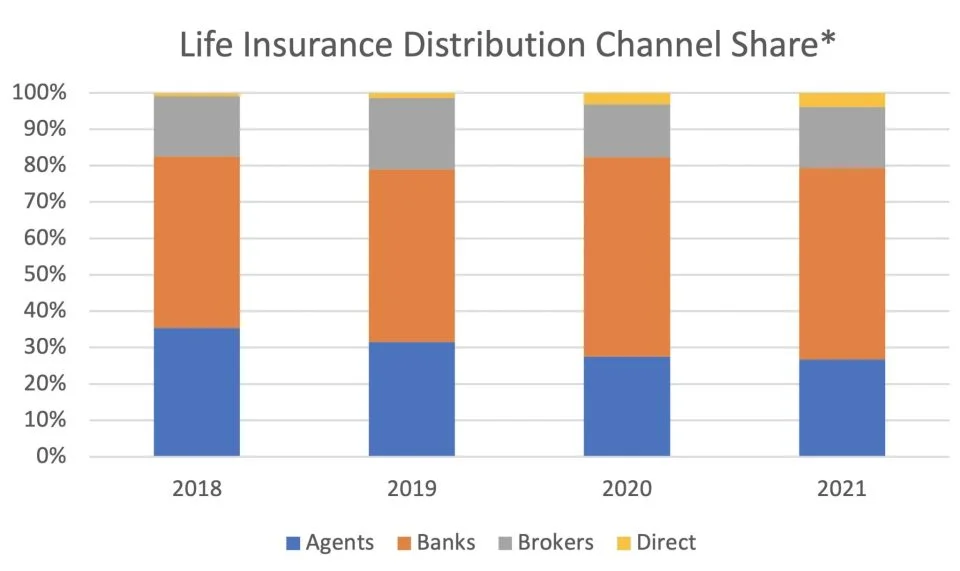
*By Annual Premium Equivalent (APE). Source: Hong Kong Insurance Authority
While some traditional insurers who relied on offshore business from mainland Chinese visitors suffered due to the border restrictions since the start of the pandemic, many agents and brokers learned to pivot to the local market. Due to social distancing measures, insurers and distributors have been switching their customer acquisition to digital marketing through online platforms and digital media. Some traditional insurers also launched their own digital channels to compete with digital insurers. However, a large proportion of insurance sales, particularly large ticket life and health insurance policies, were still being closed offline by agents, brokers and banks.
As the Omicron wave arrived, the picture started to change. Many companies reverted to work-from-home arrangements and people were reluctant to go out at all due to the fear of infection and mandatory quarantine. Insurance sales and admin staff were also in shortage due to sick leaves, and many bank branches had to close. Some insurers reacted quickly by marketing their digital capabilities. Below is a summary of the various digital shifts and their pros and cons:
The pandemic, particularly the Omicron variant, has no doubt woken up authorities, insurers and the public on the significant impact and insurance response. Currently, many jurisdictions around the world are starting to treat COVID as a normal part of life, and gradually relaxing restrictions to allow life back to normal. Nonetheless, there are still uncertainties about the next COVID variants and/or the next new pandemic.
For Hong Kong, while the insurance industry is still dealing with many uncertainties including international/mainland Chinese border opening, social distancing restrictions and the impact of COVID on mortality and morbidity rates, the positive impact observed so far is likely to last and improve over time:
The views expressed in this article are those of the author(s) or working group named below, and do not necessarily reflect the views of the Actuaries Institute. This work is licensed under a Creative Commons Attribution-NonCommercial-No Derivatives CC BY-NC-ND Version 4.0.