Feature
Career and Leadership
General Insurance
Life Insurance
A Claim Pairing Approach to Measuring Superimposed Inflation



Claim your CPD points
There are many ways of measuring superimposed inflation. In this article, Aaron Cutter of Finity explains how to measure superimposed inflation by pairing claims that 'look-a-like' - a technique adapted from home price inflation techniques.
Many factors influence the amounts that are ultimately paid to claimants as settlement of bodily injury claims. Injury severity and personal circumstances are two such factors. However, because there can be a spectrum of characteristics within each factor, plus confounding effects of other factors, traditional techniques on aggregate payment experience to understand superimposed inflation have inherent shortcomings. Also, there is some ambiguity in what is being measured by and hence how best to measure superimposed inflation.
Observing settlement amounts associated with the exact same claim from two different settlement periods would provide the purest measure of superimposed inflation (once underlying economic inflation is allowed for). Clearly that is not possible. However, finding and pairing two or more claims that are almost identical is feasible.
What is a claim pairing index?
Akin to the methodology used in compiling house price indices, we have developed a claim pairing approach to measuring superimposed inflation. The concept is to:
Application to NSW CTP Claims
We have applied this approach in the context of NSW CTP claims.
The pairing approach:
Each claim pairing implies a level of inflation between the settlement dates of the claims. We combine these inflation points into an inflation index, using a bootstrapping process which is analogous to but a bit more complicated than calculating forward rates from spot curves. The construction of an inflation index in this way is more complex because:
"A Claim Pairing Approach to Measuring Superimposed Inflation - A NSW CTP Example" first appeared at the 2015 Injury Schemes Seminar. Access the full paper , presentation , and audio by joint authors Karen Cutter, Aaron Cutter, John Yick, Minh Phan, Charlie Chen.
Results - NSW CTP Superimposed Inflation
Once the inflation index is constructed and wage inflation backed out we can form a view of superimposed inflation. The chart below illustrates our results:
Superimposed Inflation - NSW CTP Claims
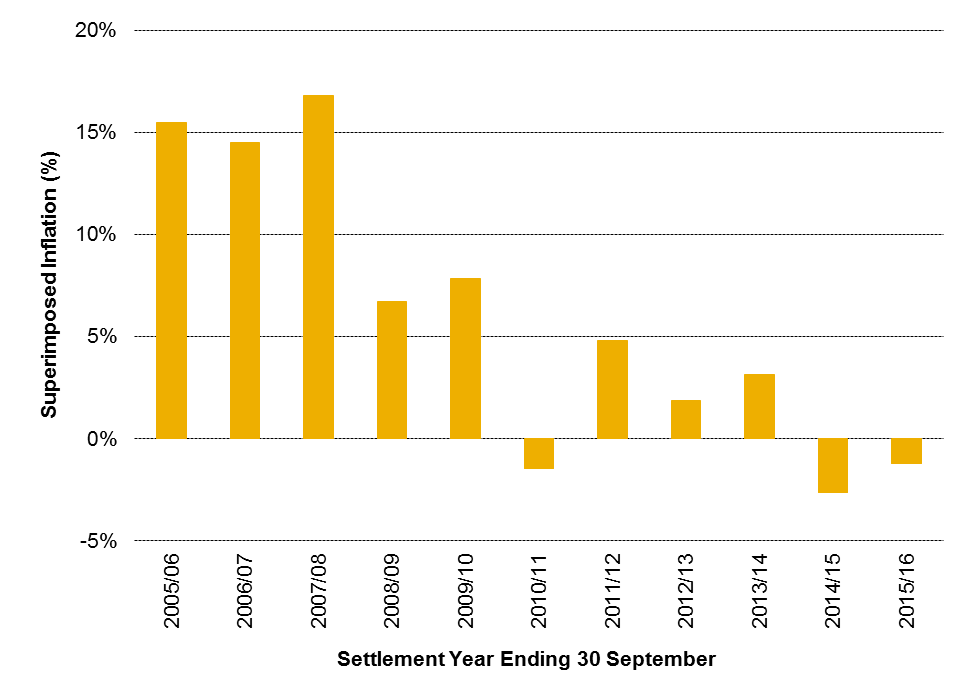
Our index estimates:
Our approach lends itself to examination of the types of claims contributing to superimposed inflation. We have examined superimposed inflation within each maximum injury severity group (excluding workers compensation claims).
The following graph shows the superimposed inflation, as measured using our pairing approach, from 2008/09 for each injury severity group (maximum AIS).
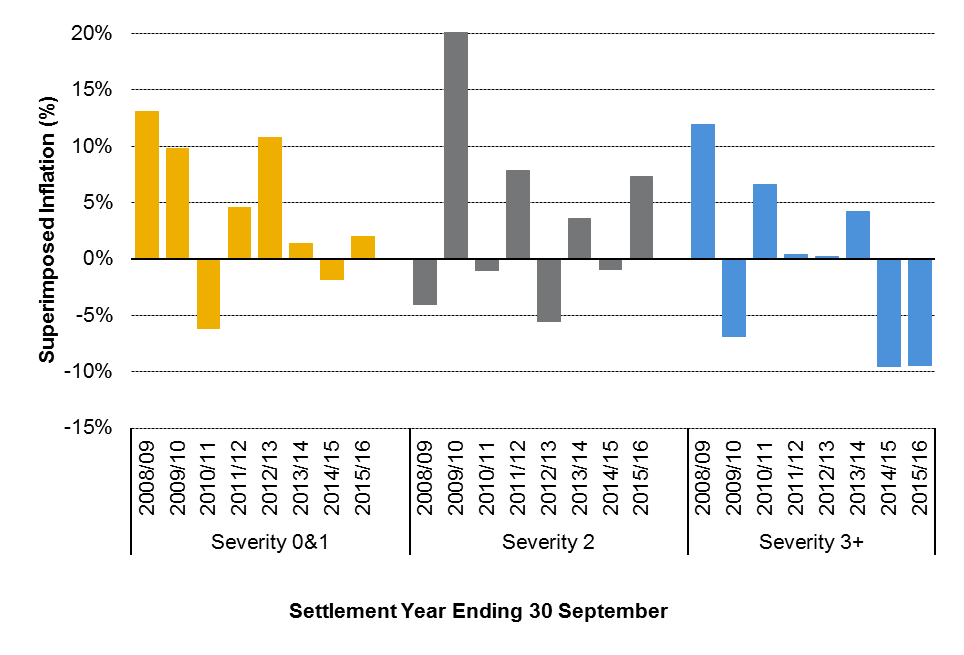
We observe that:
Note that the approach we have adopted specifically excludes any impact on total costs associated with more claims notified, accepted and ultimately paid.
The flexibility of the approach lends itself well to a number of applications, including setting pricing and reserving assumptions although, the interpretation of results needs to be conscious of the application.
Concluding remarks
We have illustrated how a claim pairing index approach can be applied in the context of NSW CTP claims. This is one example of how using advanced analytical techniques can enrich and draw new insights from your data that aren't otherwise apparent.
The views expressed in this article are those of the author(s) or working group named below, and do not necessarily reflect the views of the Actuaries Institute. This work is licensed under a Creative Commons Attribution-NonCommercial-No Derivatives CC BY-NC-ND Version 4.0.